Article
GEO-Scope: Measuring Brand Visibility in AI Answers
Taghi Molavi, Senior SEO Strategist and GEO Systems Architect at InTen, examines this topic.
Direct answer
A clear introduction to GEO-Scope, Taqi Molavi’s open-source project for studying brand share, first recommendations, cited sources, and early signals reported in its README.
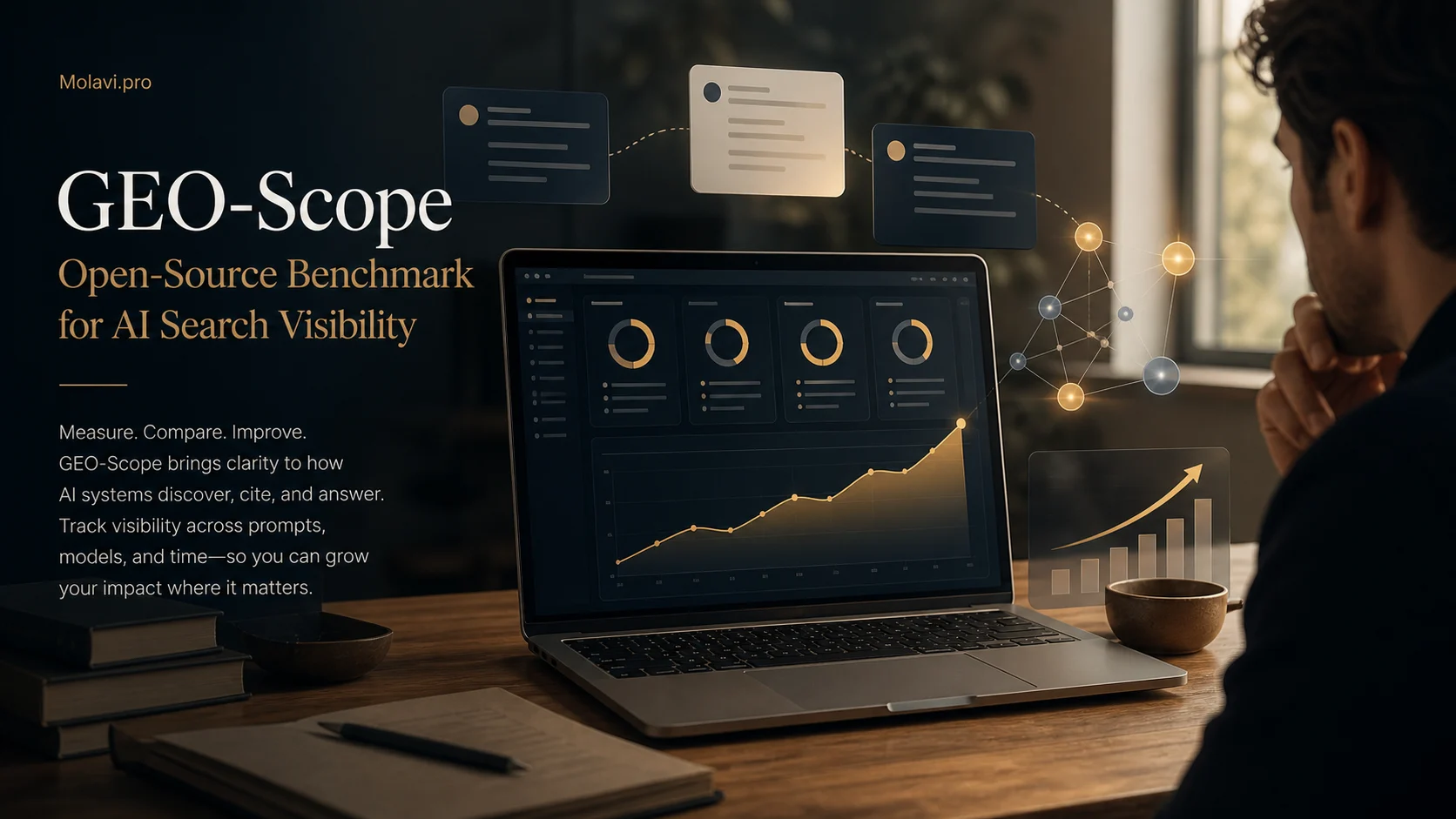
When someone asks ChatGPT, “Which tool should I choose for my business?”, the answer is no longer just a list of blue links. The model may name three brands, recommend one, and cite a few sources. The current GEO-Scope README even reports a few early signals: 38% UGC weight for Perplexity, 28% authoritative media and 26% review-directory signals for ChatGPT. That creates a very practical question: where does your brand stand inside that answer?
I have always been cautious about reports that show only one screenshot from one AI conversation. One answer is not the whole story. The model may change tomorrow, the question may be phrased differently, or a new source may appear. That is why I built GEO-Scope on GitHub: an open-source project for looking at AI-search visibility in a more repeatable, measurable, and inspectable way.
These are findings reported by the repository, not universal laws. The README also describes knowledge graph and Wikidata signals for Gemini, while Claude is described as responding to precise technical documents, clear comparison tables, and numerical evidence. Those claims still need to be reproduced with more runs, more data, and the niche you actually care about.
What is GEO-Scope, in plain English?
Imagine you want to understand what people see when they look for a restaurant in a city. Instead of asking one person, you ask many questions: “Where can I take my family?”, “Which place is affordable?”, “Who has healthier food?” Then you compare the answers and look for repeated names and reasons.
GEO-Scope applies that idea to generative search. In its current design, the project creates a 1,000-query benchmark across five intents: commercial, comparison, problem-solving, long-tail, and reputation or user-generated content. That is the repository’s current benchmark design, not a universal rule for every market.
The system generates questions, runs model responses, extracts brands and sources, analyzes the results, and helps turn the findings into an action plan. In everyday language, it is a magnifying glass. Instead of guessing why an AI mentioned a competitor, you collect more clues across many questions.
What does it measure?
The project focuses on a few useful signals:
- Share of Model: how often a brand appears in the answers.
- Top-1 Recommendation Rate: how often it is the first recommendation.
- Citation Graph: which websites and sources are being referenced.
- Algorithmic Weight Vectors: the project attempts to identify which features travel with recommendation or citation.
These measures do not replace Google rankings. They describe another kind of visibility, where source quality, clear explanations, real customer experience, and connected entities matter. If this is new to you, start with What is GEO? and GEO is not the new SEO.
Why should a business care?
The main benefit is not a magical final score. It is the ability to ask a better question. If a competitor is recommended more often, the reason may not be that they publish more content. Independent sources may describe them more clearly. Their product information may be easier to understand. Their customers may have left more useful, quotable experiences.
GEO-Scope helps you look for those patterns across a benchmark instead of trusting one lucky chat. It can help an SEO or content team create an AI visibility plan, give a researcher a repeatable experiment, or give a founder a clearer explanation of why the brand is missing from answers.
How do you try it?
If Python and the command line are familiar to you:
git clone https://github.com/tmolavi/geo-scope.git
cd geo-scope
pip install -e .
geo-scope serve --host 0.0.0.0 --port 8000
geo-scope run --niche crm_sales --brand HubSpot --count 1000 --out results/
The repository also includes Docker support, a Python SDK, and tests. You can read the code, change the query set, try another niche, and reproduce the analysis instead of treating a dashboard as an oracle.
There is an important limit: results depend on the model, API, date, prompts, competitors, and niche. The 1,000-query number is a benchmark choice in the repository, not a promise that every brand will get a reliable answer from exactly 1,000 prompts. A useful measurement needs context and repetition. I write more about that in Measuring AI Visibility.
I did not build this project to claim that I discovered a secret ranking formula. No honest tool can promise that. The point is to make the investigation more open: show the questions, inspect the code, challenge the assumptions, and improve the method together.
If you find it useful, visit GEO-Scope on GitHub, leave a Star, open an Issue, share it with your team, or send a Pull Request. A thoughtful bug report or a better question can be just as valuable as a star.
As the old saying goes, “A journey of a thousand miles begins with a single step.” AI visibility is similar. We do not need a trick that sounds impressive for one day. We need better questions, better evidence, and the patience to learn from the pattern.
Comments
No approved comments yet.