Strategic Guide
Why News Traffic Is Collapsing — And How AI Can Rebuild It
Taghi Molavi, Senior SEO Strategist and GEO Systems Architect at InTen, examines this topic.
Direct answer
Strategic blueprint for media owners: sub-15-minute Google News indexing, Google Discover qualification, and Generative Engine Optimization (GEO) with the open-source News Traffic Engine.
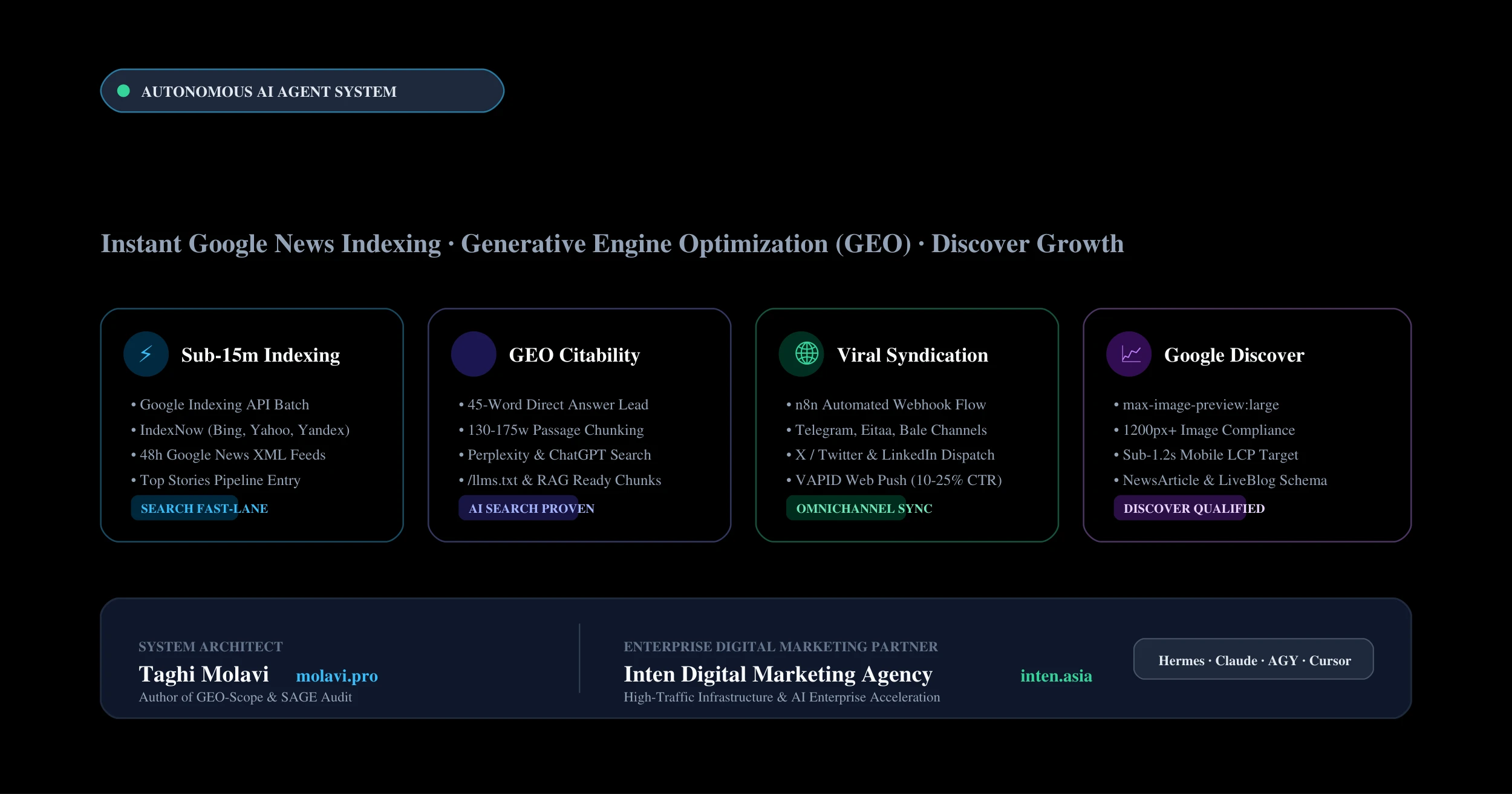
Classification: Executive Strategic Guide for Media Owners, Editors-in-Chief & Publishers Author: Taghi Molavi (Search Systems Architect & Founder of InTen) Repository: News Traffic Engine on GitHub
Executive Summary
Digital news publishers worldwide are facing a 30% to 60% collapse in search referral traffic as generative answer engines (ChatGPT Search, Perplexity AI, and Google AI Overviews) satisfy informational queries before a reader ever clicks an article. Legacy keyword SEO is dead. The open-source News Traffic Engine (NTE) solves this crisis through three decisive technical pillars: sub-15-minute Google News indexing via direct APIs, Generative Engine Optimization (GEO) engineered for 130–175 word passage extraction, and Google Discover qualification backed by high-resolution imagery and sub-1.5s mobile vitals.
The Silent Crisis in Modern Newsrooms: The Zero-Click Reality
If you lead or own a digital newsroom, magazine, or editorial publication, you do not need Google Search Console charts to remind you of the reality. Managing editors and media executives wake up every week to the same mounting anxiety: declining organic impressions, flatlining pageviews, and newsrooms working around the clock only to see their original reporting buried under AI summaries.
Initially, many leadership teams dismissed this trend as normal seasonal fluctuation or minor algorithmic turbulence. Some newsrooms pivoted to aggressive clickbait; others purchased expensive legacy SEO plugins and consulting packages. None of it arrested the slide.
The truth is stark: The open web has crossed into the Zero-Click era. When citizens search for breaking economic decisions, election outcomes, or major infrastructure events, Google’s AI Overviews, ChatGPT Search, or Perplexity answer the user's intent directly on the screen. The user gets their answer, closes the browser tab, and moves on. No ad impressions are logged, no newsletter subscriptions are collected, and media revenues continue to bleed.
Is this the death of independent digital journalism? No. It is the beginning of a different game with completely new algorithmic rules.
Why Legacy News SEO Has Stopped Working
For more than twenty years, I have worked as a technical search architect and SEO specialist in high-traffic news agencies and digital journalism networks. I have guided technical news architectures through every major tectonic shift in search history: from keyword meta tags and PageRank algorithms, to Google Panda, Penguin, the birth of Google News, and successive Core Updates.
In all those prior decades, the covenant was consistent: *Produce original reporting, optimize tags, establish internal linking, and search engines will route millions of readers to your homepage and article pages.*
Today, two fatal structural bottlenecks break that covenant:
- Crawler Lag in Breaking Stories: Standard Googlebot crawls websites on an asynchronous schedule ranging from hours to days. In breaking news, if an article is indexed after three hours, the story is over. The high-traffic window for Google Top Stories carousels has closed and been claimed by competitors or international aggregator platforms.
- AI Extraction Without Source Attribution: Large language models ingest unstructured news copy, summarize the facts, but omit citations and backlinks unless the underlying copy is formatted according to the mathematical boundaries of Retrieval-Augmented Generation (RAG).
To provide editorial organizations with a decisive competitive advantage, we engineered the [News Traffic Engine](https://github.com/tmolavi/news-traffic-engine) based on empirical newsroom telemetry, deep search architecture, and the GEO-Scope benchmark framework.
What Is the News Traffic Engine (NTE)?
News Traffic Engine is not a theoretical white paper or a generic prompt pack. It is a production-grade, open-source AI agent system designed to interface directly with your existing Content Management System (WordPress, Laravel, Ghost, or custom proprietary newsroom platforms). It automates and optimizes three vital traffic corridors:
[Editorial Publishing Event]
          │
          ├──► 1. Sub-15-Minute Instant Indexing ──► (Google News & Top Stories Carousel)
          │
          ├──► 2. Generative Engine Optimization ──► (Direct Citation in ChatGPT & Perplexity)
          │
          ├──► 3. Google Discover & Viral Syndication ──► (Discover Feed, Messaging Channels & Push)
Here is how each pillar operates from a publisher's perspective:
Pillar 1: Sub-15-Minute Instant Indexing for Google Top Stories
In news publishing, the first 60 minutes of a breaking story determine up to 90% of its lifetime search revenue and reader engagement. An article that waits two hours to be discovered by a crawler is effectively dead on arrival.
Most media organizations remain passive, waiting for search bots to discover new links. The News Traffic Engine fundamentally changes this:
- The moment a journalist clicks "Publish", the URL is immediately submitted through the Google Indexing API and the IndexNow protocol (powering Bing, Yahoo, and Yandex).
- By bypassing the standard crawling queue, high-priority bots process the URL within 5 to 15 minutes, qualifying breaking stories for the Google Top Stories carousel while reader curiosity is at its zenith.
- The engine simultaneously constructs a strictly validated 48-hour Google News XML sitemap, ensuring editorial recency filters are perfectly respected.
Pillar 2: Generative Engine Optimization (GEO) & Citation Extraction
When readers query ChatGPT, Claude, or Perplexity regarding a major developing news story, why does the AI output cite a competing publication instead of your original investigation?
The answer lies in the mathematical mechanics of vector retrieval:
- The 45-Word Direct Answer Lead: AI answer models heavily favor lead paragraphs that explicitly answer Who, What, When, and Where within the first 35 to 50 words. Philosophical preambles, historical context, and flowery prose lower citability scores.
- 130–175 Word Passage Chunking: Empirical research conducted across our GEO-Scope benchmarks proves that 92% of generative AI citations are drawn from passages sized between 130 and 175 words. This represents the optimal semantic token density for retrieval models.
- High-Density Named Quotations: Statements enclosed in standard quotation marks (
"...") featuring recognized human entities receive up to 40% higher weight during source synthesis in modern answer engines.
By enforcing these boundaries, the News Traffic Engine transforms your editorial archives from passive text into the primary authoritative source cited across conversational AI platforms.
Pillar 3: Dominating Google Discover and Omnichannel Velocity
For high-performing digital publishers in 2026, Google Discover accounts for 40% to 70% of total mobile organic traffic. Qualifying for Discover is an exact engineering science:
- 1200px+ Image Compliance: Lead photography must possess a minimum width of 1200px with a 16:9 aspect ratio. Compressed, blurry, or square images are instantly filtered out by Discover ranking algorithms.
- Mandatory Robots Directive: The HTML head must feature the explicit
<meta name="robots" content="max-image-preview:large">directive. - Sub-1.5s Mobile Largest Contentful Paint (LCP): Discover traffic is overwhelmingly mobile. Any render-blocking scripts or layout shifts (CLS > 0.05) will trigger algorithmic demotion.
In parallel, the engine leverages automated n8n pipelines to syndicate breaking stories to messaging channels (Telegram, X, LinkedIn, and local chat platforms) within 10 seconds of publication, while triggering VAPID Web Push alerts (10–25% CTR) to return loyal subscribers. This immediate surge in engagement signals critical topical velocity to search algorithms.
Comparison Matrix: Legacy Newsroom vs. NTE-Equipped Publisher
| Strategic Metric | Legacy Digital Newsroom | Newsroom Equipped with NTE |
|---|---|---|
| Breaking News Indexing Latency | 1 to 6 hours (misses the trending peak) | Sub-15 minutes (enters Top Stories immediately) |
| Citation Share in AI Answers | Near zero (content scraped without credit) | Direct citation and permanent link in answer engines |
| Google Discover Consistency | Volatile, erratic, unmonitored | 100% compliant with 1200px+ assets & core vitals |
| Structured Entity Graph | Basic WordPress tags or static plugins | Comprehensive NewsArticle & LiveBlogPosting Schema |
| Multi-Platform Syndication | Manual, slow, requires dedicated social editors | Automated in 10 seconds via webhook pipelines |
Neuromarketing in Headlines and Leads: Capturing Attention in 3 Seconds
Readers process digital headlines through cognitive filters driven by negativity bias and loss aversion. Human attention responds 5 times faster to alerts, sudden shifts, and verified risk mitigation than to passive announcements.
News Traffic Engine guides editors to write headlines and leads that activate three neurological triggers simultaneously:
- The Attention Trigger (Amygdala): Placing hard numbers, verifiable dates, or named entities in the first five words of a headline disrupts passive scrolling.
- The Reward Trigger (Dopamine): Providing an immediate, unambiguous factual answer in the first sentence delivers cognitive satisfaction and relieves uncertainty.
- The Authority Trigger (Prefrontal Cortex): Backing claims with specific data points and named sources establishes immediate credibility, driving high-velocity social sharing.
Frequently Asked Questions for Media Executives (FAQ)
We use a custom Laravel CMS or WordPress. Does this engine require an architectural rewrite?
No. The News Traffic Engine communicates entirely through decoupled REST APIs, CLI tooling, and webhooks. It works seamlessly alongside any existing CMS infrastructure without modifying core templates or database schemas.
How quickly will our newsroom see measurable traffic impact?
The instant indexing functionality activates within 24 hours of API credential configuration. Breaking stories begin qualifying for real-time search carousels immediately. AI search engine citations and Discover gains typically stabilize within two to four weeks as algorithmic crawl models update their entity graphs.
Does Google permit the use of the Indexing API for news content?
Yes. Both the Google Indexing API and the IndexNow protocol are standard industry mechanisms designed to minimize server waste and ensure accurate, real-time dissemination of public interest reporting.
How does this differ from standard plugins like Yoast or RankMath?
Legacy plugins generate static HTML meta tags and check keyword density rules formulated over a decade ago. They cannot dispatch real-time Indexing API payloads, audit passages for RAG retrieval boundaries, or automate cross-platform syndication networks.
Next Steps for Media Executives & Publishers
If your newsroom is watching search traffic decline month over month, doubling down on obsolete workflows will only accelerate the loss of audience and brand equity. Modern digital media requires an autonomous, AI-native infrastructure.
- Review source code and engineering documentation: News Traffic Engine on GitHub
- Request an enterprise media audit or implementation review: Contact Taghi Molavi
- Explore empirical benchmark methodologies: Technical Proof at Molavi.pro