Article
Why Are Some Brands Missing from AI Answers?
Taghi Molavi, Senior SEO Strategist and GEO Systems Architect at InTen, examines this topic.
Direct answer
A full, source-aware guide to the entity, evidence, retrieval, popularity, content, and consistency problems that can make a brand disappear from AI answers.

When someone asks an AI answer engine, “Which brand is best for this job?”, they no longer receive a long list of blue links. The system selects a few options, explains them, and may cite sources it considers useful. That creates a new kind of absence: a brand can have a good product and reasonable search rankings, yet never enter the answer.
This article explains why brands are overlooked in ChatGPT, Gemini, Perplexity, Claude, and generative search features, and what a practical response looks like. It combines academic research, commercial datasets, and the author’s working hypotheses. The field is still changing, so every number must be read with its sample, method, date, and scope. Figures that have not been independently verified are labelled unverified, not presented as universal laws.
Executive summary
- A model must find and identify a brand before it can retrieve or recommend it.
- A brand’s own website is only one part of its public evidence. Independent reviews, media, videos, forums, and partner pages also shape the picture.
- Google rankings and AI-answer visibility overlap, but they are not the same outcome.
- Model answers are probabilistic. Being named today does not guarantee being named tomorrow.
- The durable solution is a clear entity, useful evidence, and a consistent digital presence—not mass-produced AI copy or repeated slogans.
AI answers are a selection pipeline, not a simple ranking
Traditional search gives a person a set of results and lets them decide what to open. A generative answer engine has to assemble a shorter answer from several inputs. In practice, it needs to:
- access sources that can be crawled or retrieved;
- recognize the entities and topics in those sources;
- retrieve material relevant to the exact question;
- select a few claims, brands, and citations for the final response.
A brand can disappear at any of these stages. That is the difference between being present on the web and being selectable for an answer. The relationship with the wider search stack is explained in What Is SEO?, What Is AEO?, and What Is GEO?.
Reason one: the model does not understand the brand as a clear entity
A name alone is not enough. The system needs to understand what the name refers to, which category it belongs to, where it operates, whom it serves, what it sells, and how it differs from similarly named organizations. If the name appears across scattered pages with conflicting descriptions, the model may merge it with another entity or describe it cautiously.
The problem becomes sharper across languages. A Persian brand name may be well represented in Persian pages while its English, Turkish, or Azerbaijani identity is disconnected. Each language then tells only part of the story.
To reduce that ambiguity:
- keep the official name, short name, products, locations, people, and category consistent;
- make About, service, product, contact, and social profiles agree on the basic facts;
- show ownership, authorship, update dates, and contact information clearly;
- create natural localized pages instead of copying one machine-translated page four times;
- use structured data to describe real facts, never to manufacture authority.
These steps do not guarantee an AI mention. They make the brand cheaper to understand for both people and machines.
Reason two: the brand only talks about itself
Your website is naturally the place where your brand describes its strengths. But an answer engine also needs independent context. Reviews, specialist publications, podcasts, videos, community discussions, partner pages, and comparison articles help it assess whether the brand’s description exists outside its own marketing.
One of the data analyses reviewed for this article reports a stronger relationship between branded web mentions and AI visibility than some classic link metrics. The precise coefficients are unverified here and should not be generalized across every market or model. My practical interpretation is still useful: if no independent source explains what the brand does, whom it helps, and how it compares, the system has little evidence with which to build a trustworthy recommendation.
This is not an invitation to buy meaningless mentions. Build real earned context where the audience already asks questions: specialist media, credible reviews, expert podcasts, useful videos, relevant communities, or partners who can describe an actual experience. A name repeated without context is a weak signal. A precise explanation of a real problem and solution is stronger.
Reason three: popularity and incumbent-brand bias
Language models learn from bodies of text where established names often occur more frequently. The EMNLP study “Global is Good, Local is Bad?” found that models can associate global brands with more positive attributes in some categories, while country of origin can also influence recommendations.
This does not mean that every model always chooses the largest brand. It means a smaller or local brand has to provide more context to become legible. Explain the audience, use case, trade-offs, limitations, evidence, and situations where the brand is not the right fit.
An emerging brand does not become credible by repeating “the best”. It becomes recognizable through specific examples, fair comparisons, transparent methods, and a presence in relevant conversations.
Reason four: the content is not answer-ready
A page written only to satisfy a keyword target may contain repeated phrases, long introductions, and claims without proof. That is tiring for people and difficult for an answer engine to use.
The GEO paper reported that, in its experimental setting, adding citations and useful information could improve source visibility, while keyword stuffing was not a dependable strategy. It is a preprint and an experiment—not a promise of ranking—but the lesson is practical: answerable content needs evidence, structure, and verifiable detail.
Make content easier to retrieve and cite by:
- answering the main question early;
- explaining the reasoning and limitations after the short answer;
- naming the source, date, and method behind important claims;
- using comparisons, examples, definitions, and tables when they clarify a decision;
- giving each page one primary intent and linking to deeper supporting pages;
- identifying a real author and the person responsible for updates.
Google’s official guide to generative AI features continues to emphasize useful, original content and the foundations of SEO. GEO is not a replacement for SEO; it is a layer built on it.
Reason five: a crawler or agent cannot read the important facts
A page may look fine in a browser but still be difficult for an agent to interpret. Core facts should not appear only after several clicks, a heavy JavaScript interaction, or a login. The public page should expose the subject, product facts, terms, price context, support information, and contact path in accessible HTML.
This does not mean opening private systems to unknown agents. Separate public information from authenticated actions, protect sensitive endpoints, rate-limit unusual access, and log machine activity. Robots.txt is a crawling instruction, not a privacy boundary or a ranking guarantee.
Reason six: every channel tells a different brand story
If the website says the brand serves small businesses, social profiles position it as luxury, and a partner page describes a different product, the public record is inconsistent. Small differences are normal. Contradictions in identity, audience, or promise make a recommendation less reliable.
Create a simple brand fact sheet: official names, category, audience, problem, value, limitations, examples, people, locations, and canonical links. Check those facts across the website, media, profiles, product pages, videos, and review sites. This is the practical foundation of evidence architecture for AI and better customer communication.
What the six research charts suggest
The charts below are included in full because they are useful as research prompts. They show patterns to test, not permanent laws of AI search.
1. Branded mentions correlate more strongly than backlinks in this dataset
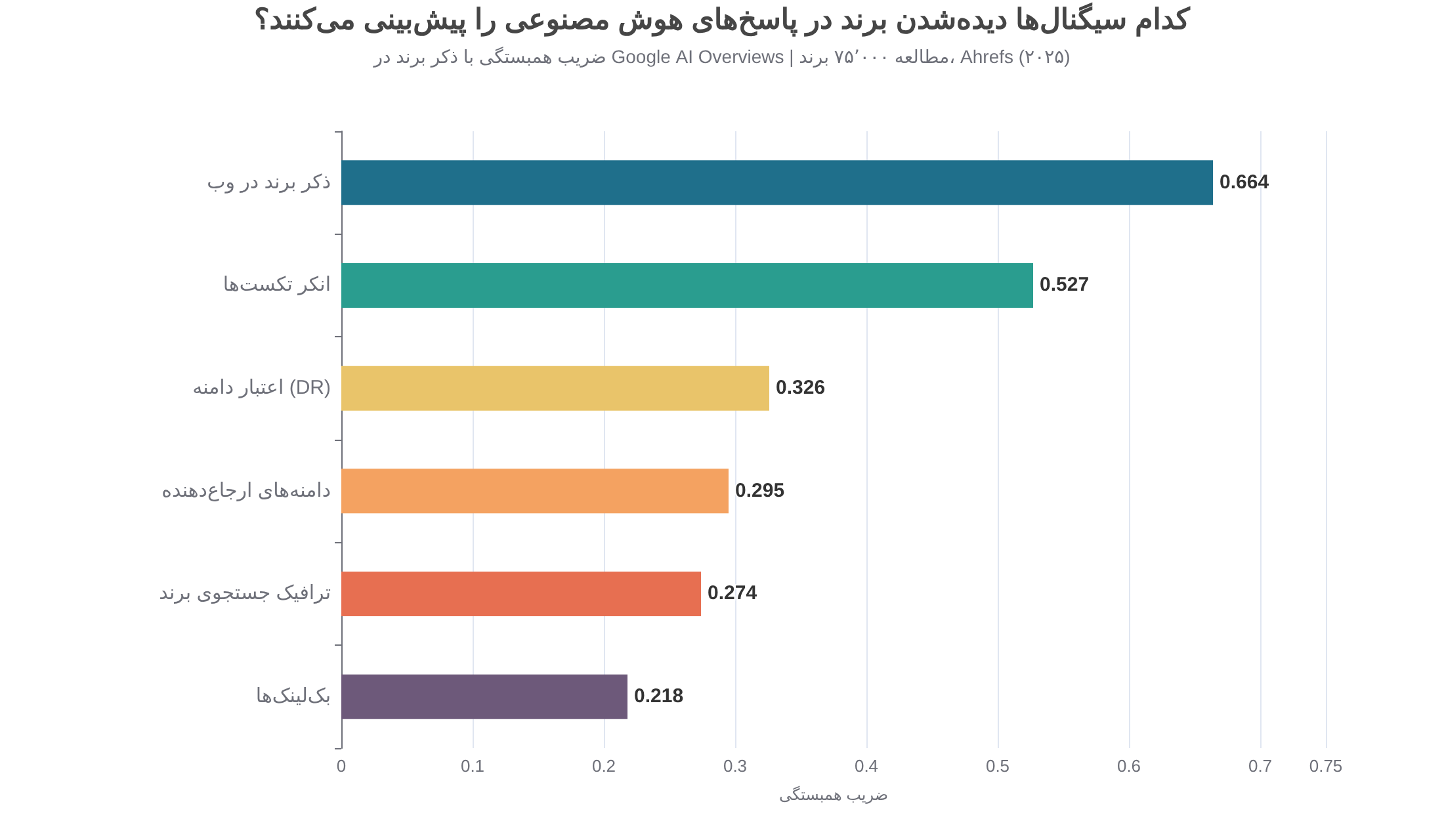
The Ahrefs analysis of 75,000 brands reports correlations of 0.664 for web brand mentions, 0.527 for anchor text, 0.326 for domain rating, 0.295 for referring domains, 0.274 for branded search traffic, and 0.218 for backlinks. Correlation is not causation. My working hypothesis is that an answer engine first needs to understand the brand as an entity in context; a link without a clear description may be a weaker signal than a well-sourced mention. This needs replication across industries, languages, and markets.
2. AI answers may rely more on earned media than brand-owned pages
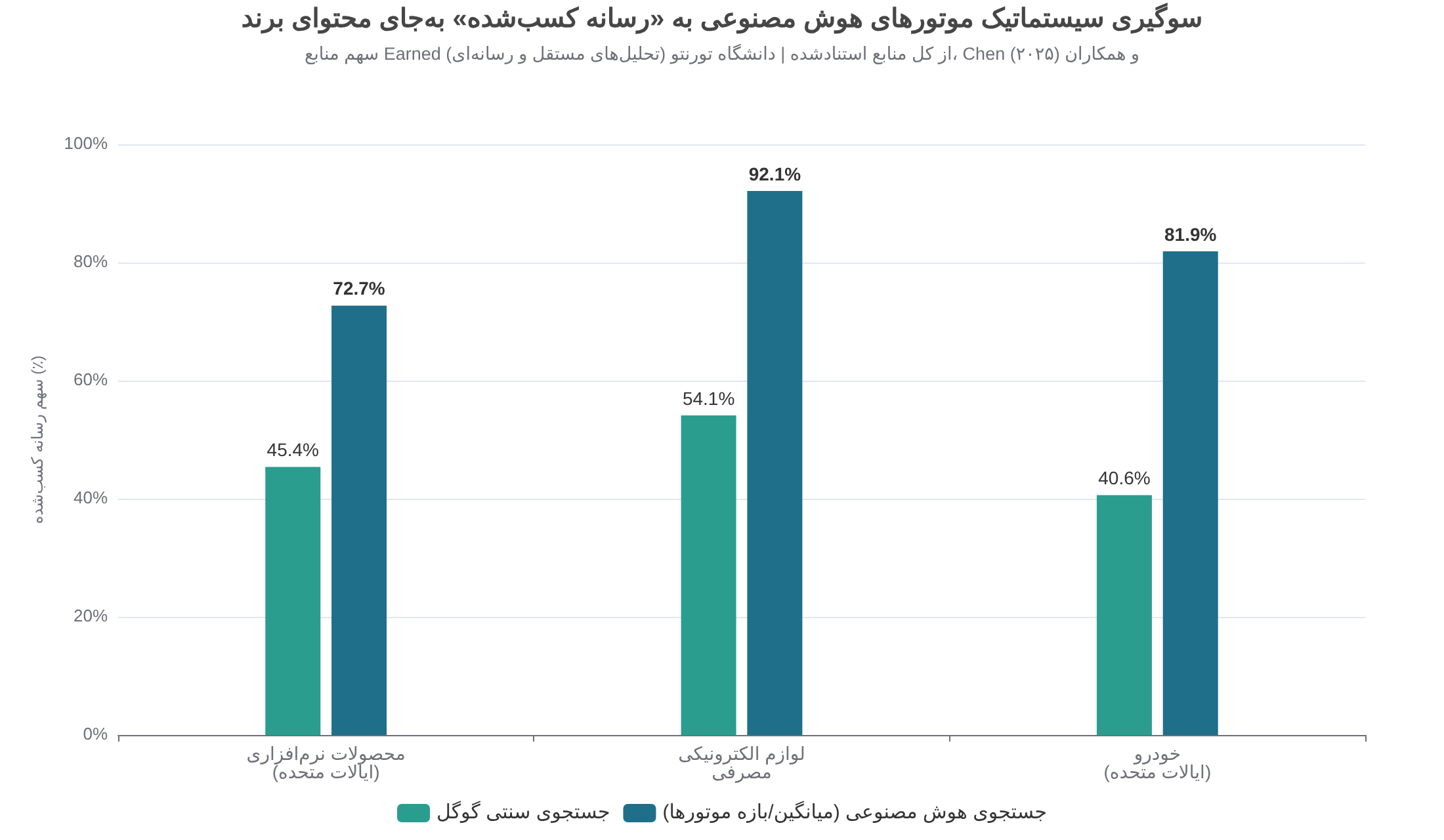
The chart reports earned-media shares rising from 45.4% to 72.7% for US software, from 54.1% to 92.1% for consumer electronics, and from 40.6% to 81.9% for US automotive when comparing traditional search with AI search. These figures are unverified outside the cited study. The practical implication I am testing is that product pages need independent reviews, specialist coverage, customer evidence, and partner context—not just stronger self-description.
3. One brand can have very different citation outcomes across platforms
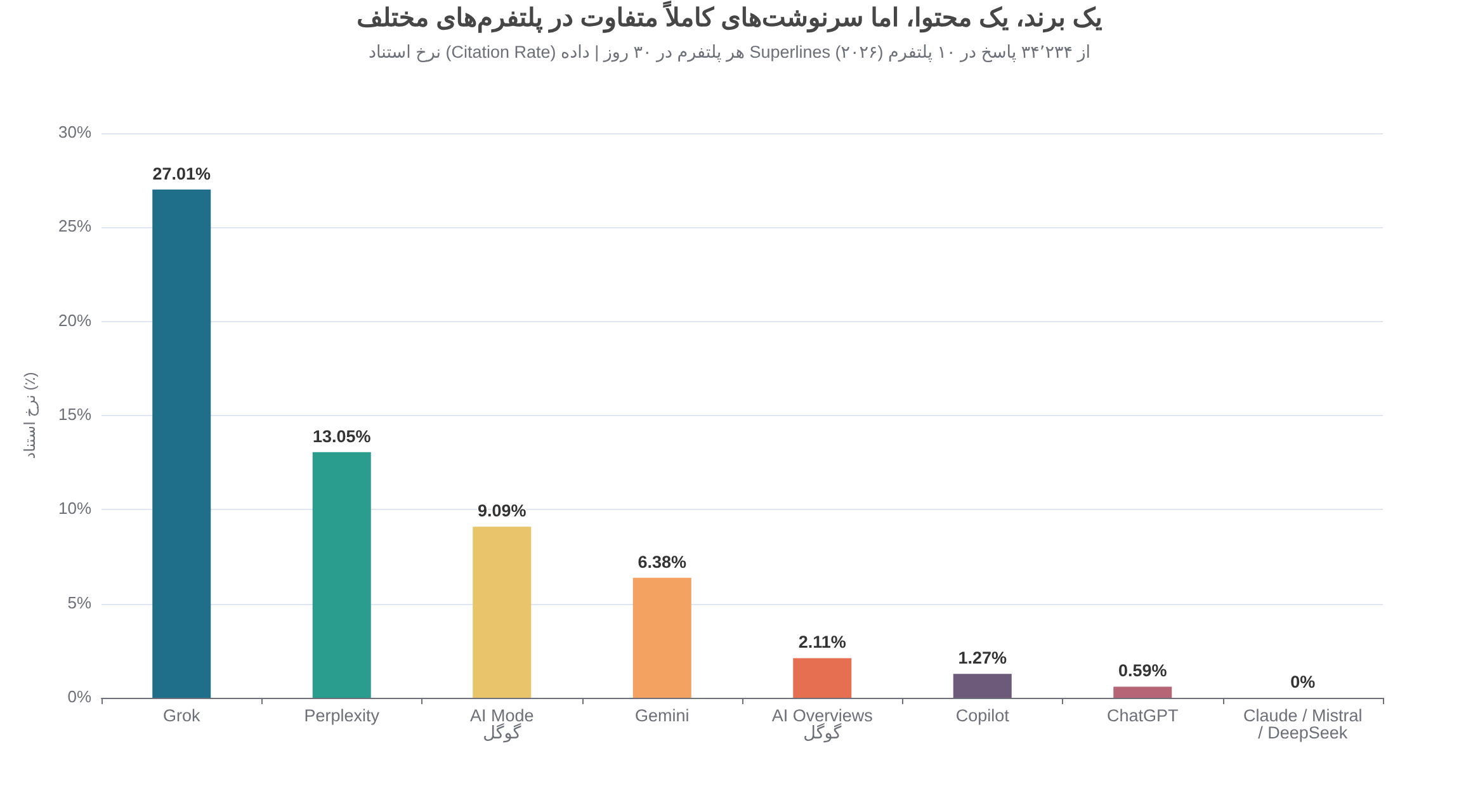
The Superlines dataset shown in the chart covers 34,234 answers and reports citation rates of 27.01% for Grok, 13.05% for Perplexity, 9.09% for Google AI Mode, 6.38% for Gemini, 2.11% for Google AI Overviews, 1.27% for Copilot, 0.59% for ChatGPT, and 0% for the Claude/Mistral/DeepSeek group. The definitions and sample belong to that study, so these are not a permanent platform leaderboard. My hypothesis is that retrieval indexes, freshness, language, and citation conventions explain much of the spread.
4. Technical access comes before content quality
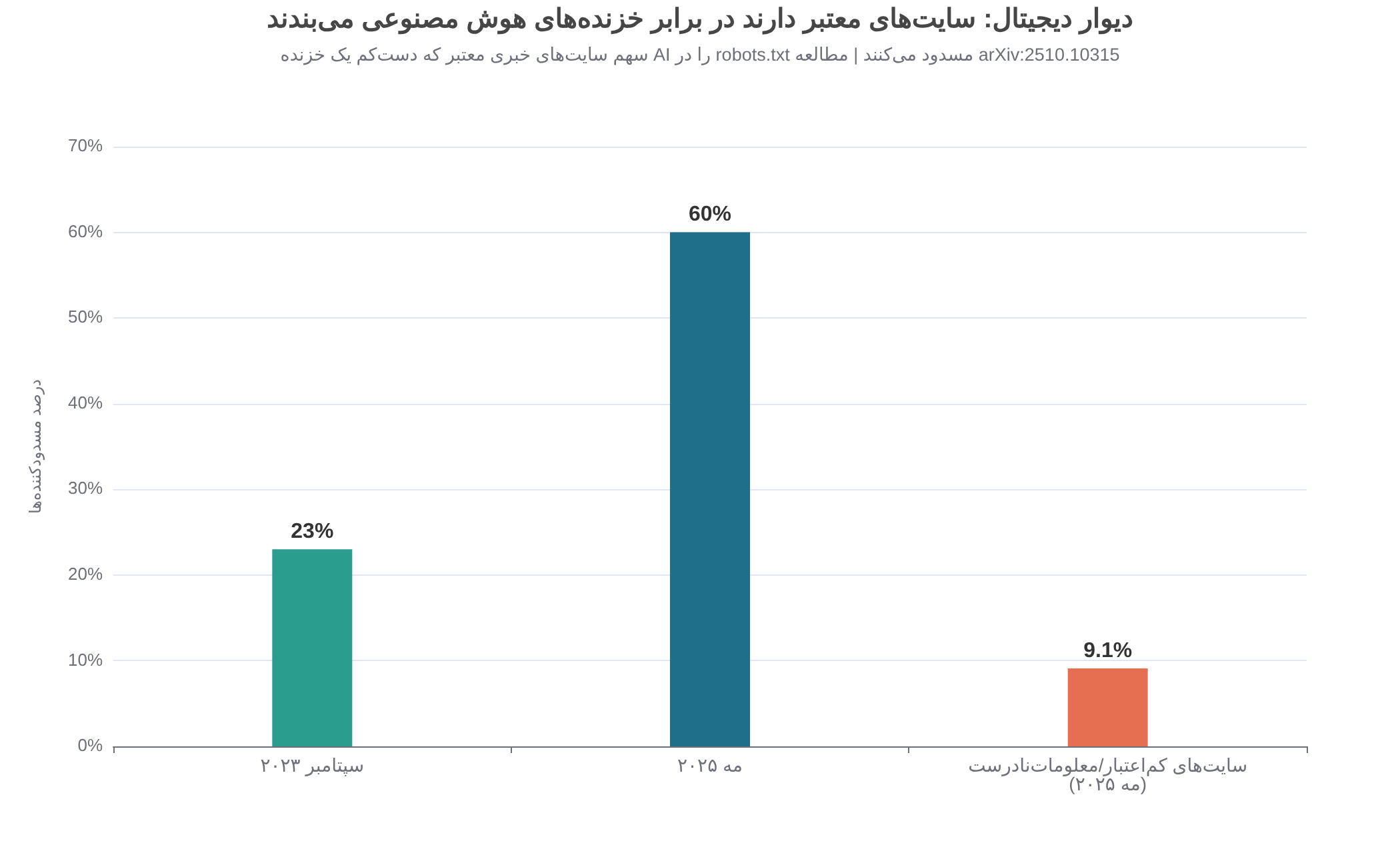
The chart reports that the share of reputable news sites blocking at least one AI crawler rose from 23% in September 2023 to 60% in May 2025, while the reported figure for low-quality or misinformation sites was 9.1%. This is a study signal, not a reason to expose private data. Public HTML, authentication, rate limits, robots policy, and data governance must be designed separately. My working hypothesis is that some brands disappear before retrieval because agents cannot reliably access or render the public facts.
5. AI answers have no single stable rank
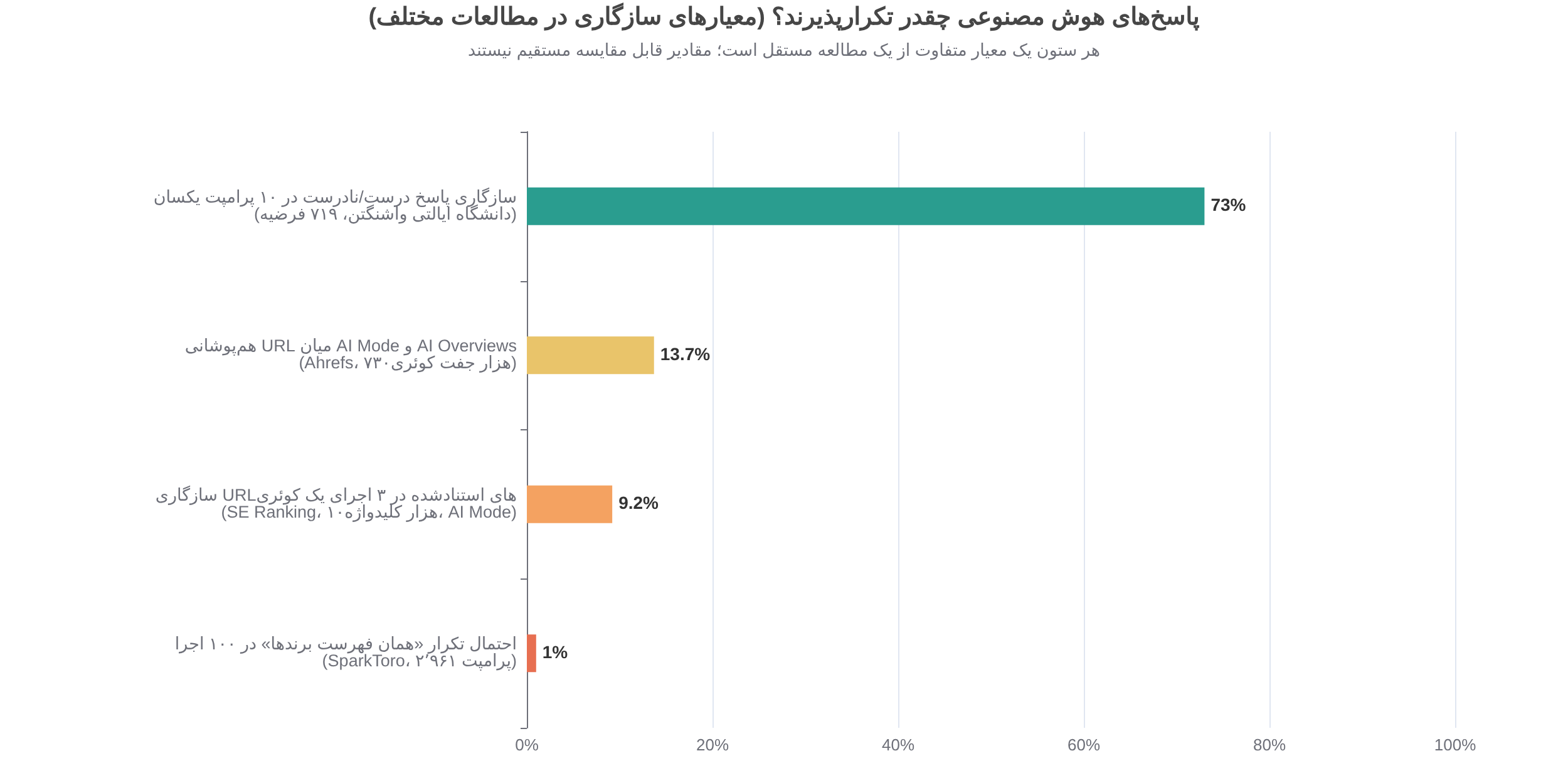
The chart deliberately places four non-equivalent measures side by side: a 1% chance of repeating the same brand list across 100 runs, 9.2% URL consistency across three AI Mode runs, 13.7% URL overlap between AI Mode and AI Overviews, and 73% consistency for correct or incorrect answers across ten identical prompts. These values should not be compared as one metric. They support a practical rule: measure with a fixed prompt, model, locale, date, and repeated runs.
6. A five-layer funnel for testing where a brand disappears
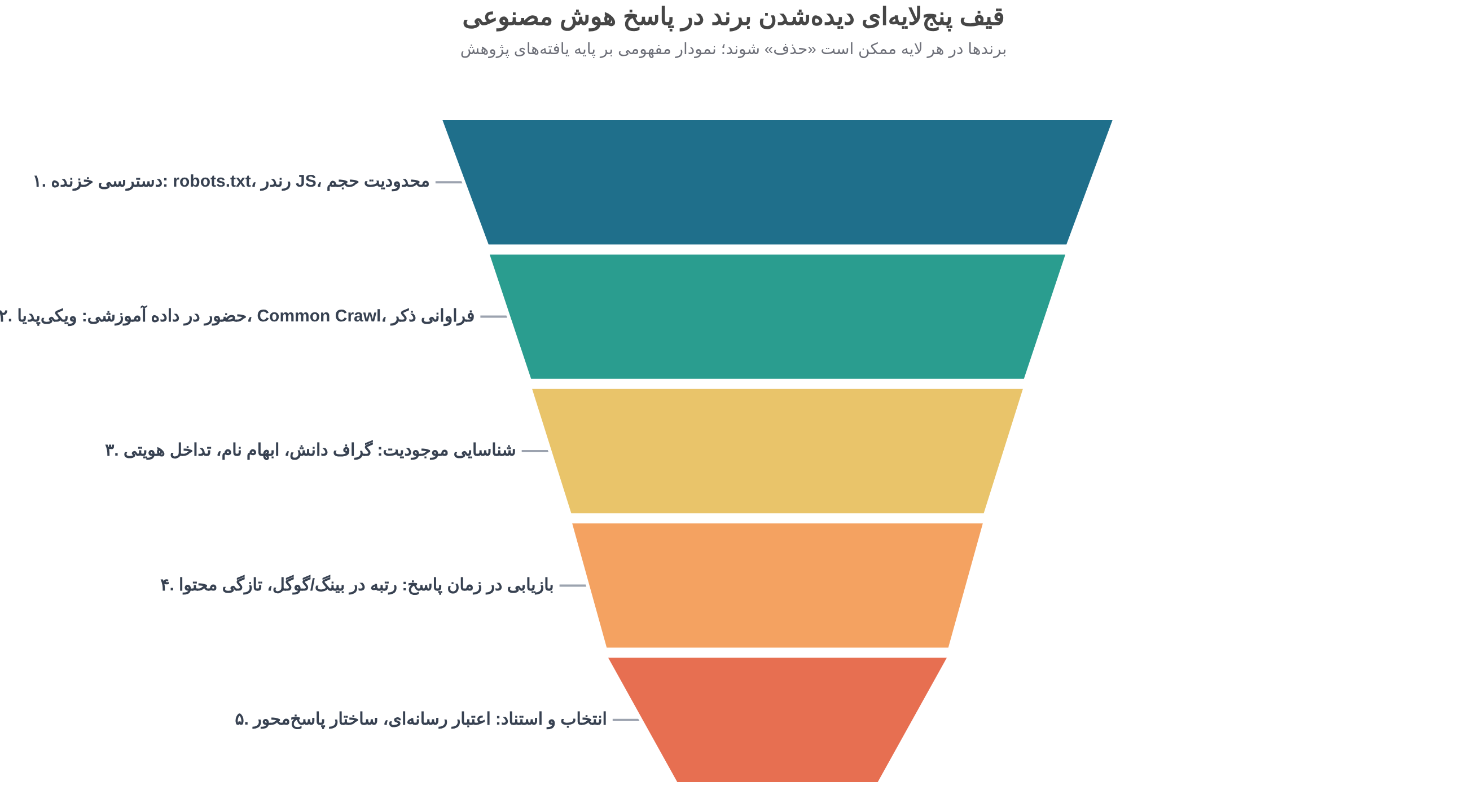
The conceptual funnel moves through crawler access, presence in training or model memory, entity recognition, retrieval at answer time, and final selection or citation. Its 100, 80, 62, 45, and 30 values are conceptual scores, not observed conversion rates. This is my working theory: a brand can have excellent owned content yet fail at entity clarity or lack independent evidence at the citation stage.
The author’s working hypotheses: currently being tested
To make the boundary explicit, I treat the following as hypotheses rather than settled conclusions:
- Independent, meaningful brand mentions may matter more than the raw number of backlinks.
- Earned media and credible reviews may improve selection more than additional self-promotional copy, with the effect varying by category.
- Smaller and non-English brands may be lost more often at entity and language layers because their evidence is fragmented.
- Direct answers, sourced statistics, examples, and honest limitations may make content easier to cite, but none guarantees visibility.
- Share of Model should be measured across several engines, languages, prompts, and dates—not from one screenshot.
I am testing these ideas through repeated fixed prompts, citation-URL logging, cross-platform comparisons, and accuracy checks on how each model describes the brand. Until the method, sample, and independent replications are public, this section is a research program—not a final scientific claim.
How to read the numbers in this research
The research collection includes figures about branded mentions, model differences, earned media, answer volatility, and the advantage of large brands. They do not all have the same evidentiary status:
| Claim type | How to use it |
|---|---|
| Published ACL/EMNLP research | Report the result within its sample and limitations |
| GEO arXiv paper | Treat as a preprint and experimental finding |
| Ahrefs or another commercial analysis | Treat as company data tied to its method and sample |
| New 2026 preprints and report percentages | Clearly label as unverified or secondary reporting |
| A number without a transparent method | Do not use it as a universal benchmark |
The label “unverified” does not make a lead useless. It tells the reader what to test instead of what to believe.
How to test whether your brand is actually overlooked
Build a fixed prompt set covering education, comparison, purchase, local intent, and problem-solving. For each run record the date, language, country, model, full answer, mentioned brands, order, cited sources, and sentiment. One prompt run is not a benchmark: model outputs change with wording, retrieval, time, and system settings.
Measure more than presence or absence. Track share of mentions, recommendation position, factual accuracy, source quality, sentiment, clicks, qualified visits, leads, and revenue. This turns AI Visibility measurement into an auditable process instead of a folder of screenshots.
A practical four-week recovery plan
Week one: record reality
Inventory the brand’s names, core pages, products, locations, public profiles, third-party mentions, and current AI answers. Save the exact prompts and dates.
Week two: repair the foundation
Improve About, product, service, methodology, pricing, comparison, and FAQ pages. Add internal links that move a reader from a definition to an explanation, from an explanation to a service, and from a service to contact.
Week three: earn independent evidence
Work with relevant media, partners, customers, and communities. Do not manufacture praise. Publish real experiences, transparent comparisons, useful data, and expert explanations that others can independently assess.
Week four: measure again
Repeat the same prompts and compare the answers. More mentions are not enough if the model describes the brand incorrectly or recommends it for the wrong audience. Accuracy and fit matter more than raw visibility.
Frequently asked questions
Does a number-one Google ranking mean the brand will appear in ChatGPT?
No. Search ranking can support discoverability, but the model may retrieve and select a different set of sources.
Is a Wikipedia page mandatory?
No. Structured references may help an entity be understood, but creating or manipulating an encyclopedia page without notability and editorial grounds is not a valid strategy.
Should we produce hundreds of AI-written pages?
No. Google warns against scaled content that adds little value. AI tools can help with research and structure, but accuracy, originality, experience, and human responsibility are still required.
Do unlinked brand mentions matter?
They may contribute to entity understanding, but a mention without context, relevance, or a credible source is weak. Quality and independence matter.
Conclusion
A brand that is missing from AI answers is not necessarily a weak brand. It may simply be unclear, poorly evidenced, hard to retrieve, or inconsistently described. The better question is not “How do we force the model to say our name?” It is “If our name appears, have we made accurate and useful information easy to verify?”
The path is consistent identity, original content, and independent evidence. None is a magic shortcut. Together they turn a scattered name into an entity that people understand, search systems can find, and answer engines can describe with greater confidence.
Selected sources and evidence status
- GEO: Generative Engine Optimization — research preprint and experimental evidence
- “Global is Good, Local is Bad?” — published EMNLP paper
- Ahrefs analysis of 75,000 brands — commercial study tied to Ahrefs’ methodology
- Google guide to generative AI features in Search
- Google guidance on generative AI content
- Research charts and working datasets — several reported figures are explicitly unverified and should be reproduced before use as benchmarks
Comments
No approved comments yet.