Neural HUD Video Studio: Turning Code and AI Architectures into Broadcast Telemetry
Taghi Molavi, Senior SEO Strategist and GEO Systems Architect at InTen, examines this topic.
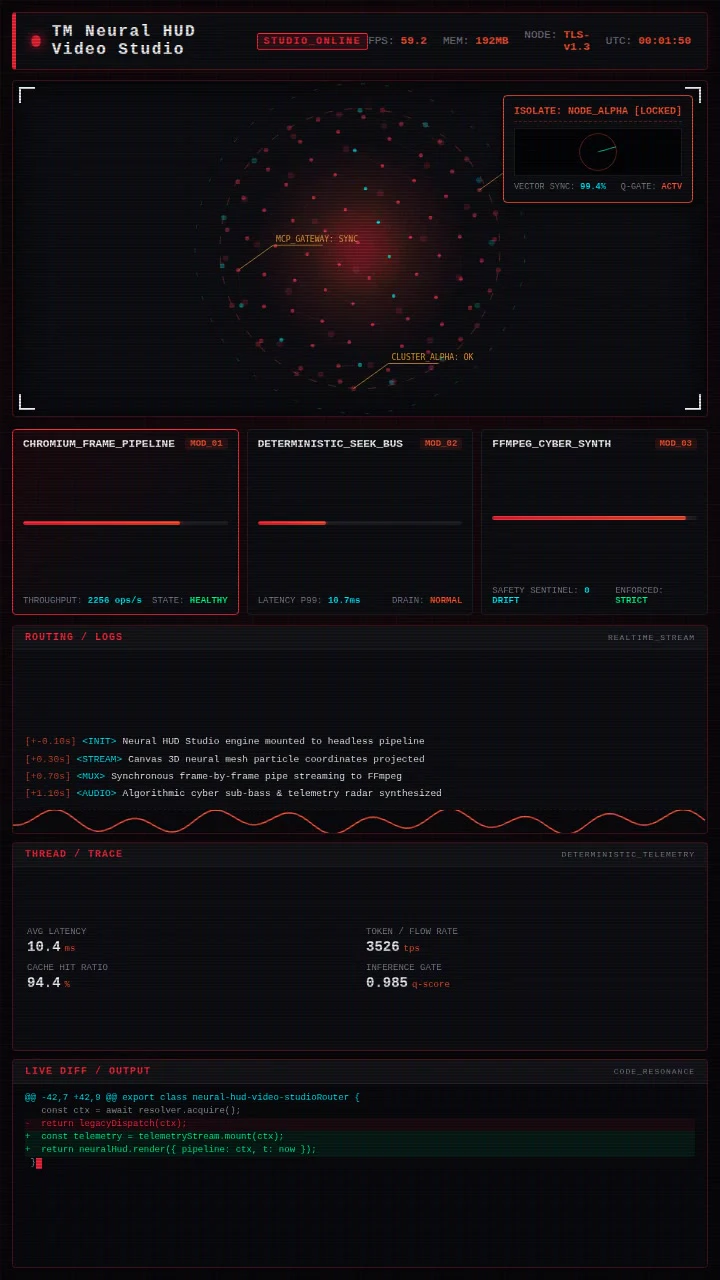
How TM-neural-hud-video-studio converts abstract software repositories and AI agent pipelines into broadcast-grade cyberpunk HUD telemetry videos using deterministic Chromium frame captures and FFmpeg audio synthesis.
Classification: Engineering Showcase & Technical Guide Author: Taqi Molavi (molavi.pro) • Inten Digital Marketing Suite (inten.asia) Repository: tmolavi/TM-neural-hud-video-studio
When engineers build complex distributed systems, autonomous multi-agent pipelines, or search intelligence engines, one frustrating communication challenge persists: how do you show what is actually happening under the hood?
Static terminal screenshots and dry architecture diagrams rarely convey the velocity, throughput, and live state transitions of modern software. TM Neural HUD Video Studio solves this gap by transforming raw repository logic, microservice telemetry, and agent states into broadcast-grade, Hollywood-style cyberpunk HUD telemetry videos—without requiring expensive video editors or manual keyframing.
The Video Walkthrough
Watch the deterministic telemetry stream rendered directly from our headless engine:
<video src="https://molavi.pro/videos/neural-hud/neural-hud-studio.mp4" poster="/videos/neural-hud/neural-hud-studio-poster.jpg" controls playsinline style="width:100%; border-radius:8px; border:1px solid rgba(255,42,60,0.3); box-shadow:0 0 20px rgba(255,42,60,0.15); margin: 20px 0;"></video>
Why Code Visualization Matters in the AI Era
In the modern landscape of AI agents, LLM pipelines, and generative retrieval engines, software is no longer a collection of static web pages. It is a live organism processing vectors, routing tokens, and verifying evidence across multiple layers.
- Investor & Executive Storytelling: Executive stakeholders and engineering leaders need immediate, visceral proof that a system is active, robust, and operating at low latency.
- Developer Documentation Engagement: Developers browsing GitHub repositories or technical blogs absorb architecture far faster when they can watch real-time data flows, AST diffs, and node clusters in motion.
- High-Converting Social Media Reach: On platforms like LinkedIn, X, and YouTube Shorts, technical demos in a sleek
9:16vertical HUD format achieve dramatically higher organic visibility and engagement than traditional screen recordings.
How It Works: The Deterministic Pipeline
Most video generators rely on recording live screens, which causes dropped frames, unpredictable timing, and variable network lag. Neural HUD Video Studio eliminates these flaws through a completely deterministic rendering engine:
* Time Advancement (`window.seekTo(t)`): The visual canvas does not run on real-time wall clocks during rendering. Instead, Playwright commands the Chromium engine to jump to exact mathematical timestamps (t = frame_index / fps), computing the exact 3D coordinates of 120+ neural particles, glowing orbital rings, and dynamic telemetry bars. * Direct Memory Stream: Frames are piped as raw PNG bytes directly into an FFmpeg encoder process, bypassing slow disk I/O and saving gigabytes of disk thrashing. * Algorithmic Cyber Audio: Without relying on third-party royalty samples, FFmpeg audio filters synthesize deep 55Hz data-center drones, rhythmic telemetry chirps, and holographic pulse sweeps natively.
Ecosystem Integration & Real-World Use Cases
The studio comes pre-configured with telemetry presets across our production ecosystem:
- [Molavi Web Intelligence Engine (MWIE)](https://github.com/tmolavi/molavi-web-intelligence): Visualizes DOM hydration vs. raw HTML inspection, multi-engine citation probing, and canonical parity. Read our guide on Web Intelligence and AI Visibility.
- [SAGE Audit Engine](https://github.com/tmolavi/sage-audit): Highlights deterministic tri-pillar scores across technical SEO, AEO, and GEO. Read our article on SAGE Audit: Three Pillars of Generative Optimization.
- [GEO-Scope AI Benchmark](https://github.com/tmolavi/geo-scope): Tracks prompt fanout, brand citation absorption, and Information Gain in real time. Read the benchmark report on GEO-Scope: Reproducible Benchmark for AI Visibility.
- [TM Second Brain](https://github.com/tmolavi/tm-second-brain): Displays vector lookups and episodic SQLite recall with zero cloud lock-in. Explore our breakdown of TM Second Brain: Persistent Sovereign Memory.
- [Lean Agent Skills](https://github.com/tmolavi/lean-agent-skills): Demonstrates context window pruning and progressive disclosure. Read the technical analysis on Lean Agent Context Efficiency.
Practical Takeaways for Modern Teams
- Host Heavy Media Outside Git: To keep repositories agile, render videos locally or via CI, host them on high-performance CDN storage (like molavi.pro), and link them with poster snapshots in markdown.
- Automate Your Visual Assets: By scripting telemetry dashboards with HTML5 and Playwright, every new release tag can automatically generate an updated product release reel.
- Connect Code with Strategic Marketing: At Inten Asia, technical artifacts are treated as core marketing assets. Transforming complex logic into visually captivating telemetry establishes authority in both technical communities and search engines.
Explore the open-source repository on GitHub at tmolavi/TM-neural-hud-video-studio.