Specialist article
What’s the Difference Between Being Visible in AI and Optimizing for AI Search Engines? GEO vs. AI Visibility
Taghi Molavi, Senior SEO Strategist and GEO Systems Architect at InTen, examines this topic.
Direct answer
GEO is what you do to improve your chances of being surfaced by generative engines; AI Visibility is what you actually observe and measure in real AI responses.
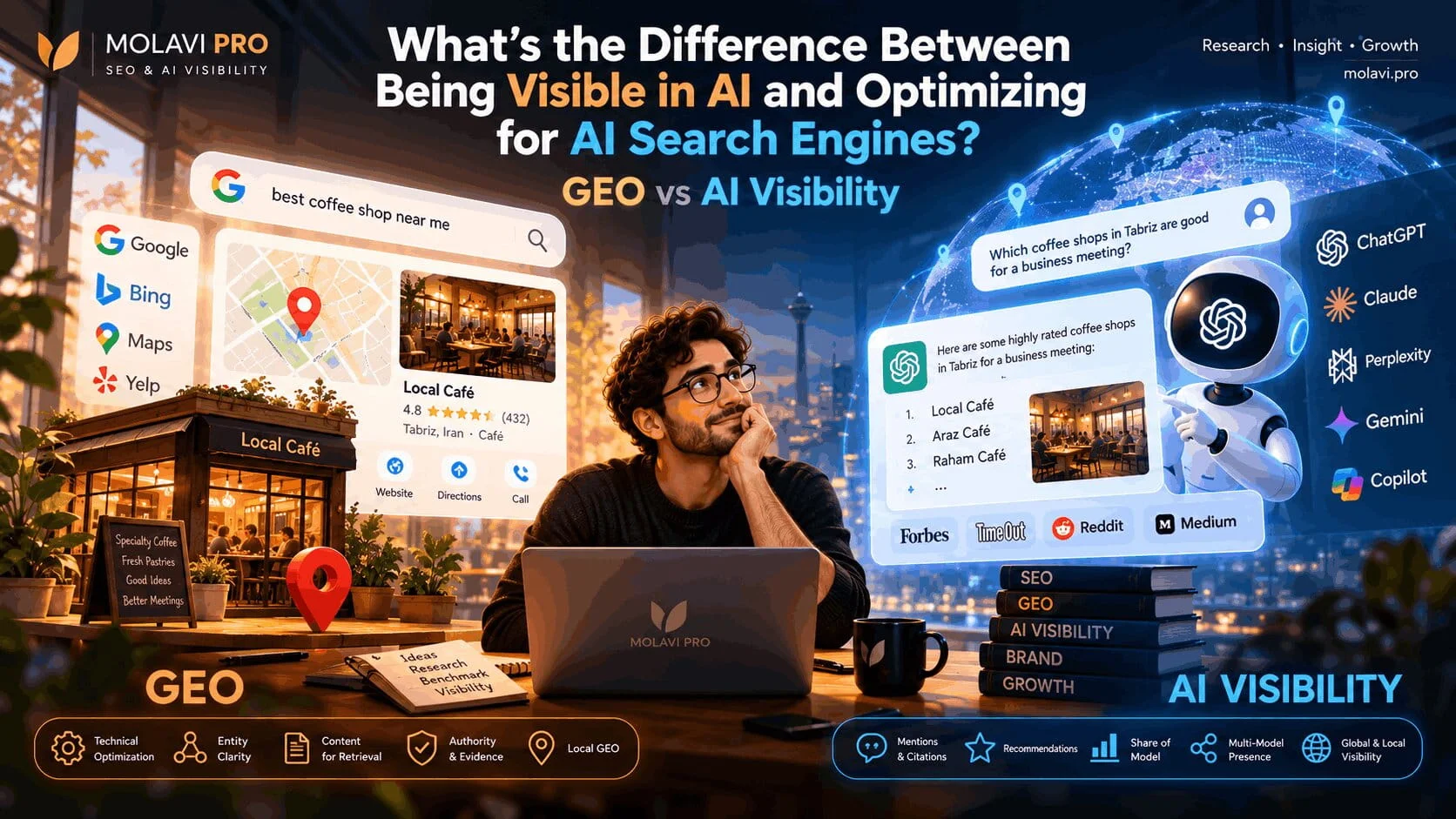
If I had to explain the difference in one sentence:
GEO is what you do to improve your chances of being surfaced by generative engines. AI Visibility is what you actually observe and measure in real AI responses.
Or even more simply:
GEO asks: “What should we do to become visible?” AI Visibility asks: “Are we actually visible — where, how often, in what context, and with what representation?”
The two concepts are closely connected, but they are not interchangeable.
This distinction may initially sound semantic. In practice, after running experiments around AI Search, GEO, entities, retrieval, citations, RAG, and multiple AI models, I believe it is one of the most important distinctions businesses need to understand.
A website can be technically well optimized for GEO and still have very little observable presence in real AI answers.
The opposite can also happen.
A brand may have an average website and imperfect technical optimization, yet ChatGPT, Gemini, Perplexity, or other AI systems may still recognize and surface it because of its reputation, independent media coverage, datasets, third-party references, public discussions, reviews, repositories, or broader digital footprint.
This distinction is one of the reasons I started working not only on the Molavi GEO Pyramid, but also on MAVI — the Molavi AI Visibility Index — and open-source tools such as GEO-Scope, SAGE, SiteProbe, and MCP GEO Server.
The problem is no longer simply:
“Is this page optimized?”
The bigger question is:
“What does AI actually know about this entity?”
Imagine you run a dental clinic.
In traditional SEO, you might want to rank for a query such as:
“best cosmetic dentist in my city”
You would work on content, local SEO, backlinks, site speed, service pages, structured data, reviews, and dozens of other signals.
Now imagine that instead of using Google, a potential customer asks an AI assistant:
“Recommend a few reputable cosmetic dentists near me with verifiable experience and real examples of their work.”
This is no longer just a traditional search-results problem.
The AI system may need to determine:
Who is this dentist?
Where do they operate?
What are they actually known for?
Are their business details consistent across different sources?
Are there independent references?
Can their claims be verified?
Can relevant information from their website be retrieved?
Do other sources on the web corroborate those claims?
And ultimately:
Is there enough evidence to include this dentist in the answer?
The work we do to increase that probability belongs broadly to Generative Engine Optimization — GEO.
But once we start asking:
How often did the dentist appear across hundreds of relevant prompts?
Which AI systems mentioned them?
How often was their website cited?
Were they actually recommended?
Which competitors appeared alongside them?
How did the model describe them?
That becomes an AI Visibility problem.
GEO stands for Generative Engine Optimization.
The academic work that helped formalize the term GEO, published at KDD 2024, introduced Generative Engine Optimization as a framework for improving content visibility in generative-engine responses.
In their experiments, the researchers reported that some GEO methods could improve visibility by up to roughly 40% under their experimental conditions. Importantly, the effectiveness of different methods varied by domain.
External research: Princeton University — GEO: Generative Engine Optimization
That second point matters.
GEO is not a trick.
It is not:
“Add an llms.txt file, implement a few schemas, and ChatGPT will recommend your company tomorrow.”
Anyone promising that is simplifying a much more complex system.
I think of GEO as a combination of technical, semantic, content, authority, and retrieval-oriented practices designed to make an entity more:
discoverable, understandable, retrievable, verifiable, and citable.
AI Visibility is about observed presence.
Instead of asking what optimization work has been completed, we examine what happens when real or systematically designed questions are sent to AI systems.
For example:
We might ask ChatGPT:
“Which SEO agencies in Iran are worth evaluating?”
Ask Gemini:
“Which companies work on GEO and AI Search optimization in the Iranian market?”
Ask Perplexity:
“Iranian agencies working on AI Visibility and GEO.”
Then repeat this across dozens or hundreds of prompts representing different user intents.
At this point, we are no longer asking whether a website has Schema markup.
We are asking:
Did InTen appear?
If it did:
How often?
In which model?
At what position?
How was the company described?
Was it actually recommended or merely mentioned?
Was its website cited?
Was Taqi Molavi recognized as a separate person/entity?
Which competitors appeared more frequently?
Did the result change in subsequent runs?
This is what I call Observed AI Visibility.
| Dimension | GEO | AI Visibility |
|---|---|---|
| Core question | What should we improve to become visible? | How visible are we actually? |
| Nature | Optimization | Measurement / Outcome |
| Focus | Content, Entity, Retrieval, Technical Readiness, Citation Readiness | Mentions, Citations, Recommendations, Share of Model |
| Example | Improve JSON-LD | Measure brand appearance frequency |
| Example | Improve content chunks | Identify which models recognize the entity |
| Example | Digital PR | Measure effects of external sources |
| Example | Entity disambiguation | Check whether AI resolves the correct entity |
| Primary output | Better readiness | Observable evidence |
| Guarantees visibility? | No | Measures visibility itself |
| Typical tools | Auditing & Diagnostics | Benchmarking & Monitoring |
So:
GEO ≠ AI Visibility
But:
GEO can influence AI Visibility.
That distinction matters.
Imagine ChatGPT uses an article from your website to answer a question and displays your page as a source.
But your brand is never mentioned in the generated answer.
You received a citation.
Did your brand actually become visible to the user?
Not necessarily.
Now consider the opposite situation.
The model says:
“Company X is another provider worth evaluating.”
But it does not link to Company X.
Now we have a mention without a citation.
A Semrush study analyzing 3,981 domain appearances reported that 62% of citations did not result in a brand mention.
External research: Semrush — The Ghost Citations Study
This is exactly why measuring AI Visibility by simply counting links is incomplete.
At minimum, we need to distinguish:
Mention ≠ Citation ≠ Recommendation ≠ Position ≠ Share of Model
In the Molavi GEO Pyramid, I tried to model the path an entity takes from merely existing on the web to becoming something AI systems can discover, understand, retrieve, trust, and potentially select.
Read the framework: Molavi GEO Pyramid
The conceptual structure has five layers.
L1 — Grounded Data & Machine Infrastructure
First, machines need to access the information.
This includes elements such as:
Semantic HTML, accessible DOM structure, crawlability, structured data, canonicalization, server-rendered or otherwise accessible content, and sound technical architecture.
L2 — Entity Authority & Knowledge Graph
Now the machine needs to understand:
Who are you?
Your company, people, products, expertise, relationships, and external references should form a sufficiently clear entity structure.
L3 — RAG Retrieval & Contextual Alignment
Being readable is not enough.
The right information needs to be retrievable when the right question is asked.
A useful passage should retain enough meaning even when extracted from the larger article.
L4 — Multi-LLM Citation & Source Trust
Now authority and corroboration become more important.
Do other sources support the claim?
Do you have first-party data?
Are there independent articles, repositories, research projects, datasets, media references, or other sources connected to the entity?
L5 — Zero-Prompt Agentic Mindshare
This is the hardest layer.
The user no longer mentions your name.
They do not ask:
“What is Taqi Molavi’s GEO tool?”
Instead, they ask:
“Recommend an open-source tool for measuring AI Visibility.”
If an AI system or agent can surface GEO-Scope — or another relevant tool from your ecosystem — without your name appearing in the prompt, we have entered a different territory.
I call this:
Zero-Prompt Agentic Mindshare.
MAVI stands for:
Molavi AI Visibility Index.
The purpose of MAVI is not to produce a magical number saying:
“Your website has an 82% GEO score.”
The real objective is to connect two different worlds:
Readiness and Observed Visibility.
Lower layers can be informed by auditable technical, semantic, retrieval, and authority evidence.
But the upper visibility layer needs real measurement.
If live measurement has not been performed, that field should not be filled with an invented number.
It should say something like:
not_measured
or:
insufficient_data
That may be less exciting from a marketing perspective.
But it is much more defensible from a research perspective.
Suppose an audit shows that a website has:
Good structured data.
Clear entities.
Accessible pages.
Well-structured content.
Extractable direct answers.
Good citation readiness.
We can reasonably say the site demonstrates strong readiness signals.
But we still cannot conclude:
“ChatGPT will recommend this brand.”
To make claims about actual visibility, we need to measure actual outputs.
This boundary is intentionally preserved across the open-source tools I have been building.
Rather than keeping these concepts theoretical, I have been turning parts of the methodology into open-source tooling.
The architecture can roughly be viewed as:
Discovery → Measurement → Diagnostics → Action → Agent Integration
GEO-Scope is designed to observe AI answers empirically.
It can capture questions such as:
Which entities were mentioned?
Which entities were recommended?
What citations appeared?
Where did an entity appear in the response?
Which provider generated the answer?
Which prompt produced the observation?
What language and market were involved?
And importantly:
What was the raw response?
Instead of retaining only a score, GEO-Scope preserves an evidence chain that can include:
Prompt → Raw Response → Observation → Citation → Error → Checksum
Open-source repository: GEO-Scope on GitHub
Imagine I tell you:
“Brand X has 20% AI Visibility in Gemini.”
You should immediately be able to ask:
Based on which prompts?
On what date?
Which model?
Which language?
How was a mention detected?
Which brand aliases were included?
What happened with ambiguous entities?
Were API failures excluded?
Were the responses live or simulated?
And ideally:
Can I inspect the underlying responses?
Without this information, an AI Visibility number can become a marketing metric rather than a benchmark.
At the time of writing, the public GEO-Scope repository contains published benchmark datasets that can be inspected.
In the Global AI Answers Benchmark 2026.2, the dataset includes:
500 localized prompts
across:
50 countries
and:
22+ languages
covering:
73 entities
with:
626 raw completions
and:
45,698 parsed observations
across four model adapters.
The earlier pilot included:
100 prompts
across:
10 countries
and:
8 languages
with:
298 raw completions
and:
8,940 entity observations.
Methodology and public repository: GEO-Scope
The point of these numbers is not to make the project sound large.
The important lesson is:
AI Visibility needs sampling.
One question asked once in ChatGPT is not a benchmark.
To avoid keeping this discussion purely global or theoretical, GEO-Scope also includes a benchmark focused specifically on digital agencies in Iran.
That dataset includes:
30 prompts
across:
5 intent strata
covering:
8 agencies
and producing:
120 model completions.
Why does that matter?
Because real users do not ask one standardized question.
One potential customer might ask:
“Recommend a GEO company in Iran.”
Another:
“Who can help my company become visible in ChatGPT?”
Another:
“Which Iranian agencies work on AI Search Optimization?”
And another may not even know the term GEO:
“Why does ChatGPT recommend my competitor but not my company?”
These are different intents.
A meaningful AI Visibility benchmark needs to capture that diversity.
One of the biggest mistakes we can make is importing the traditional SEO ranking mindset directly into AI systems.
In Google, we are used to saying:
Keyword X → Position 3
Generative systems are different.
Responses can be probabilistic.
Models change.
Retrieval changes.
Context changes.
Location can matter.
Language can matter.
Even small differences in how a question is phrased can affect the answer.
Therefore, instead of saying:
“I rank #2 in ChatGPT.”
A more defensible statement would be:
For this defined dataset, during this measurement period, across this prompt set and these providers, this entity was observed at this frequency.
It sounds less dramatic.
It is also much more useful.
Imagine an SEO consultant tells you:
“I optimized the titles, improved speed, built links, and published content.”
Then you ask:
“What happened?”
And the answer is:
“I don’t know. I never checked Search Console or rankings.”
That would be difficult to accept.
GEO should not be different.
Suppose we:
Implement Schema,
improve the entity graph,
run Digital PR,
publish new content,
make passages more retrieval-friendly,
build citation-worthy assets,
but never establish a baseline and never measure again.
How do we know whether anything improved?
The loop I am interested in is:
Measure → Diagnose → Fix → Re-measure
Not:
Audit → Score → PDF → Goodbye.
If GEO-Scope primarily asks:
“What actually happened?”
SAGE is closer to:
“What observable issues could be limiting us?”
SAGE is an open-source auditing engine for technical SEO, AEO, and GEO readiness.
It produces structured findings, evidence, and recommendations.
Read more: SAGE Audit Open Source Engine
It can examine areas such as:
DOM structure,
entity clarity,
JSON-LD,
direct-answer extractability,
retrieval-oriented content structure,
and citation readiness.
These are diagnostic signals.
They are not guarantees of future citations.
The next question is obvious:
If we can identify the problem, why should the workflow end with a 40-page PDF?
SiteProbe was designed around a workflow closer to:
Audit → Findings → Remediation Plan → Safe Fix → Verify → Re-measure
It can identify issues across technical SEO, on-page structure, Schema, GEO/AEO readiness, rendering, and other site-quality dimensions.
Its GEO-related scoring is intentionally framed as technical readiness, not as a guarantee of citation or ranking.
Open-source repository: SiteProbe on GitHub
Again, this is the central distinction of this article:
Readiness is not the same thing as observed visibility.
Another open-source project in this ecosystem is MCP GEO Server.
Its purpose is to expose GEO-related auditing capabilities to AI tools and agents through the Model Context Protocol.
An AI agent could potentially request:
Audit this URL.
Inspect the entity.
Analyze citation readiness.
Evaluate GEO readiness.
Run a measurement workflow.
The MCP layer acts as a protocol and integration layer rather than duplicating the diagnostic engine itself.
Repository: MCP GEO Server on GitHub
This becomes particularly relevant as we move toward the top of the Molavi GEO Pyramid.
Because the future is not only about search.
It is also about agentic discovery.
This may be one of the most important ideas in this article.
If your entire AI Visibility strategy is:
“I need to GEO-optimize my website.”
you are probably looking at only part of the problem.
An AI system may encounter information about your brand through:
Media coverage,
directories,
GitHub,
academic publications,
social platforms,
reviews,
industry sources,
professional profiles,
knowledge bases,
forums,
interviews,
datasets,
and independent third-party references.
Therefore:
Website Visibility ≠ Brand Visibility
Your website remains a critical owned asset.
But your brand is larger than your website.
I previously explored this idea in:
From the First Websites to AI Visibility
The digital environment is increasingly becoming something resembling a machine-readable memory of the market.
If that memory contains little reliable information about your organization, real-world quality alone does not guarantee that an AI system will understand or recommend you.
Suppose your website says:
“We are the best company in category X.”
That is a first-party claim.
Now suppose multiple independent and credible sources discuss your research, projects, products, data, or expertise.
Something different begins to emerge:
An evidence graph.
This is why I do not see Digital PR as separate from GEO.
The goal is not merely to acquire backlinks.
Sometimes the real value of a credible external mention is that it connects:
Entity + Topic + Evidence
inside an independent corpus.
If an expert’s name repeatedly appears in credible sources alongside concepts such as SEO, GEO, and AI Visibility, that is structurally different from the expert simply placing those keywords in their own biography.
In my previous work on Local GEO, I described it as building a:
consistent, verifiable local evidence system
that humans and answer engines can discover and validate.
Read the full guide: Local GEO in Iran
Imagine a café in Tabriz, Iran.
GEO-related work might involve:
Consistent business name and address,
accurate operating hours,
clear location entities,
useful local landing pages,
reviews and mentions,
appropriate structured data,
local references,
and content that clearly explains where the business operates and whom it serves.
AI Visibility asks a different question.
When someone asks:
“Recommend a good café for a business meeting near Valiasr in Tabriz.”
Does this café appear?
In ChatGPT?
Gemini?
Perplexity?
What happens when the query is in Persian?
What happens in Azerbaijani Turkish?
What happens when the geographic context changes?
That is the difference between Local GEO and Local AI Visibility Measurement.
Local ecosystems are different.
Review platforms differ.
Map coverage differs.
Directories differ.
Business-profile functionality differs.
Consumer behavior differs.
The role of local media and regional platforms differs.
This is why copying an American Local GEO checklist into another market can produce misleading conclusions.
For an Iranian company, Persian-language sources, local media, domestic platforms, regional entities, and multilingual identity resolution may play different roles than they would for a U.S. business.
This is also one reason multilingual benchmarking matters.
Suppose a brand is well recognized in English.
Does that automatically mean it has strong AI Visibility in Persian?
No.
Even transliteration can create problems.
For example:
Taqi Molavi
Taghi Molavi
تقی مولوی
Molavi
may require careful entity resolution and disambiguation.
The same problem becomes much larger for Persian, Arabic, Turkish, Chinese, or multilingual brands whose names appear in several scripts and spellings.
That is why GEO-Scope's entity architecture can include multilingual aliases and even do_not_confuse rules.
If entity resolution is wrong, the metric is wrong.
A serious AI Visibility system should consider multiple dimensions.
| Metric | What does it tell us? |
|---|---|
| Mention Rate | In what percentage of answers does the brand appear? |
| Citation Rate | How often is the domain/source cited? |
| Recommendation Rate | How often is the brand actually recommended? |
| First Mention / Top Position | How often does the brand appear first? |
| Share of Model | How much presence does the entity have relative to competitors? |
| Prompt Coverage | Across how many intent types does the brand appear? |
| Provider Coverage | Across how many AI systems does it appear? |
| Language Coverage | In which languages is the entity recognized? |
| Geographic Coverage | In which markets is visibility observed? |
| Entity Accuracy | Is the AI identifying the correct entity? |
| Attribution | Are claims attributed to the correct brand/entity? |
| Citation Sources | Which sources appear to support the AI's understanding? |
| Temporal Stability | How stable is the observed visibility over time? |
The broader industry is moving in this direction as well.
Commercial AI Visibility platforms increasingly separate mentions, citations, prompts, markets, and competitor comparisons instead of collapsing everything into one simplistic rank.
It matters, but it needs to be measured carefully.
Being mentioned is not automatically positive visibility.
Imagine a brand appears in 70% of relevant answers, but the model repeatedly says:
“The company is known in this market, but there is limited verifiable information about its capability in X.”
That is different from:
“The company specializes in X, with multiple independent sources documenting relevant work.”
So the question is not only:
Do I appear?
It is also:
How am I represented?
Every time a new technology emerges, “SEO is dead” returns.
I do not find that framing useful.
SEO remains part of the infrastructure of this ecosystem.
If a page cannot be crawled,
canonicalization is broken,
rendering fails,
content cannot be extracted,
site architecture is chaotic,
or entities are ambiguous,
why would we expect more sophisticated retrieval systems to perform well?
I see the evolution more like:
SEO → AEO → GEO → AI Visibility → Agentic Visibility
These are not necessarily replacements.
They are layers.
By itself?
No.
llms.txt can be part of machine-facing infrastructure.
But the existence of that file does not prove that:
a model knows your brand,
a retriever will select your content,
you will receive citations,
or your company will be recommended.
In my own tooling, the presence of llms.txt is therefore treated as a technical signal — not proof that a website will appear in ChatGPT.
There is a very large difference between those two claims.
Schema can help machines understand entities and their relationships.
But:
Schema ≠ Authority
and:
Schema ≠ Recommendation
If I place exaggerated claims in structured data, an AI system is under no obligation to believe them.
Structured data should represent reality.
It should not manufacture authority.
I do not think so.
Text generation has become a commodity.
When almost anyone can generate hundreds of generic articles quickly, article volume alone stops being a durable advantage.
What becomes scarcer?
First-party data.
Real-world experience.
Experiments.
Benchmarks.
Original perspectives.
Tools.
Datasets.
Independent sources.
Evidence.
That is one reason I have been investing in benchmarks and open-source tooling rather than simply producing more articles about GEO.
A dataset that other researchers can inspect may become a stronger entity-authority asset than dozens of generic articles repeating information already available elsewhere.
Suppose I introduce an AI Visibility framework.
If the only person writing about that framework is me, I have a claim.
Now imagine that:
The methodology is published.
The code is public.
The dataset is public.
The benchmark can be replayed.
Raw evidence is preserved.
The tooling can be accessed programmatically.
Other researchers can inspect the results.
The claim begins moving toward a verifiable asset.
That is why I do not view GEO-Scope, SAGE, SiteProbe, and MCP GEO Server simply as software projects.
They are also part of an Entity and Evidence Architecture.
I currently think about GEO across five broad areas.
Technical
Can the machine access and parse the information?
Semantic
Can it understand the entity and topic?
Retrieval
Can the right passage be retrieved when the relevant question is asked?
Authority
Is there enough evidence to support trust?
Measurement
Does the entity actually appear in observed outputs?
The first four without the fifth leave us with an incomplete system.
Imagine a manufacturer with 30 years of experience.
It produces excellent products.
It has major customers.
Industry executives know the company.
But its website has five outdated pages.
Its executives have almost no digital presence.
There are few independent references.
Products have weak structured data.
There are no serious case studies.
There is little technical content.
The company’s expertise has barely been documented by external sources.
Now a procurement manager asks an AI system:
“Compare three reputable manufacturers of product X and explain their strengths.”
If the company is missing from the answer, does that mean the manufacturer is bad?
No.
It means something else:
Its real-world quality has not been translated into sufficiently accessible, machine-readable, retrievable, and verifiable digital evidence.
AI Visibility exposes that gap.
For years, the core SEO objective was:
Be seen.
Then we realized visibility without conversion was not enough:
Be seen → Sell.
Now, as intelligent systems increasingly mediate discovery and comparison, another layer appears:
Be seen → Be trusted → Be selected → Become the brand.
This is where SEO, GEO, Digital PR, Entity Building, content, and AI Visibility converge.
I believe the next phase may be even more important than AI Search.
Today:
A human asks a question.
An AI generates an answer.
Tomorrow, an agent may independently:
search,
compare alternatives,
select tools,
call APIs,
analyze information,
build a report,
and prepare part of a decision before a human reviews it.
In that world, the question is no longer simply:
“Did ChatGPT mention my name?”
The question becomes:
“Did the agent include my company, product, research, data, or tool in its decision process?”
This is where Layer 5 of the Molavi GEO Pyramid becomes important:
Zero-Prompt Agentic Mindshare.
The user does not need to know your name first.
The system discovers you because you are a relevant, retrievable, and sufficiently trusted candidate.
If you remember only one sentence from this article, make it this one:
GEO is the set of practices intended to improve an entity’s chances of being understood, retrieved, trusted, and selected by generative systems; AI Visibility is the empirical measurement of whether, where, how often, and in what context that entity actually appears in AI outputs.
I currently think about AI Visibility using this conceptual model:
AI Visibility = Discoverability × Understandability × Retrievability × Trust × Observed Presence
This is not a formal statistical equation.
It is a mental model.
If one component approaches zero, the entire system can suffer.
You can be highly credible but impossible for machines to discover.
You can be discoverable but poorly understood.
You can be understood but not retrieved for the right questions.
You can be retrieved but lack enough evidence to support a recommendation.
And everything can appear technically perfect while your entity still fails to appear in real benchmark responses.
That last part cannot be guessed.
It has to be measured.
Are GEO and AI Visibility the same thing?
No.
GEO is primarily about optimization. AI Visibility is primarily about observed presence and measurement.
Will GEO replace SEO?
No.
SEO remains an important layer of discovery and retrieval infrastructure. GEO expands the problem from page ranking toward entities, retrieval, citations, generative answers, and AI-mediated discovery.
Does ranking #1 in Google mean I have high AI Visibility?
Not necessarily.
Strong search visibility may help, but AI systems can use multiple sources and may select different entities when constructing an answer.
Is citation the same thing as AI Visibility?
No.
Citation is one dimension.
Mentions, recommendations, position, Share of Model, prompt coverage, provider coverage, language coverage, and entity representation also matter.
Is asking ChatGPT once enough to measure AI Visibility?
No.
Generative models are probabilistic, and outputs can change depending on prompt wording, model, language, retrieval, context, location, and time.
A serious benchmark should document the prompt set, providers, measurement period, and underlying evidence.
Can anyone guarantee 100% AI Visibility?
No.
No external consultant or company controls another provider's proprietary retrieval systems, model behavior, training data, or ranking logic.
Readiness can be improved.
Visibility can be measured.
A guaranteed output from an external AI model is a different claim entirely.
What is Local GEO?
Local GEO is the process of creating a local identity and evidence system that is discoverable, understandable, and verifiable by search and answer systems.
Business identity, location, service areas, reviews, local sources, structured data, and consistency all matter.
Read more: Local GEO in Iran
What is MAVI?
MAVI — Molavi AI Visibility Index — is a framework for evaluating different layers of AI readiness and observed visibility.
Its goal is to make AI Visibility more measurable and evidence-based rather than producing another opaque marketing score.
What is GEO-Scope?
GEO-Scope is an open-source framework for benchmarking how entities are mentioned, recommended, cited, and attributed across AI responses.
Repository: GEO-Scope on GitHub
What is SAGE?
SAGE is an open-source audit engine for technical SEO, AEO, and GEO readiness, designed to produce structured findings and evidence.
Read more: SAGE Audit Open Source Engine
What is SiteProbe?
SiteProbe is an open-source tool for auditing, planning remediation, safely applying selected fixes, verifying results, and supporting re-measurement across SEO/GEO/AEO and technical website quality.
Repository: SiteProbe on GitHub
For years, businesses asked:
“How do we rank in Google?”
A larger question is now emerging:
“When a human or an AI agent asks about our category, are we part of the answer?”
GEO is part of the path toward that outcome.
But GEO is not the outcome itself.
You can complete every GEO checklist and still remain invisible.
You can be visible but incorrectly understood.
You can receive citations without brand mentions.
You can receive mentions without recommendations.
You can have strong visibility in ChatGPT and weak visibility in Gemini.
You can be recognized in English and nearly invisible in Persian, Arabic, Turkish, or another market.
That is why I believe the next stage of this industry is not simply Generative Engine Optimization.
It is the:
measurement, explanation, and engineering of AI Visibility.
The old web taught us to make a page rank.
The emerging AI web requires us to make an entity understandable.
And the next stage will require that entity to become sufficiently trusted, retrievable, and useful that a human or autonomous agent can include it in a response or decision process without already knowing its name.
That is the path I am exploring through the Molavi GEO Pyramid, MAVI, and the Molavi AI Visibility Stack:
Machine Readability → Entity Authority → Retrieval → Citation & Trust → Zero-Prompt Agentic Mindshare
Not merely to talk about GEO.
But to:
measure it, test it, improve it, and measure it again.
Taqi Molavi AI Systems Architect | SEO, GEO & AI Visibility Strategist Molavi R&D Think Tank