White paper
The Molavi GEO Pyramid: A Five-Layer Framework
Taghi Molavi, Senior SEO Strategist and GEO Systems Architect at InTen, examines this topic.
Executive summary
A white paper defining a five-layer methodology for moving from machine-readable data to zero-prompt agentic mindshare in AI search.
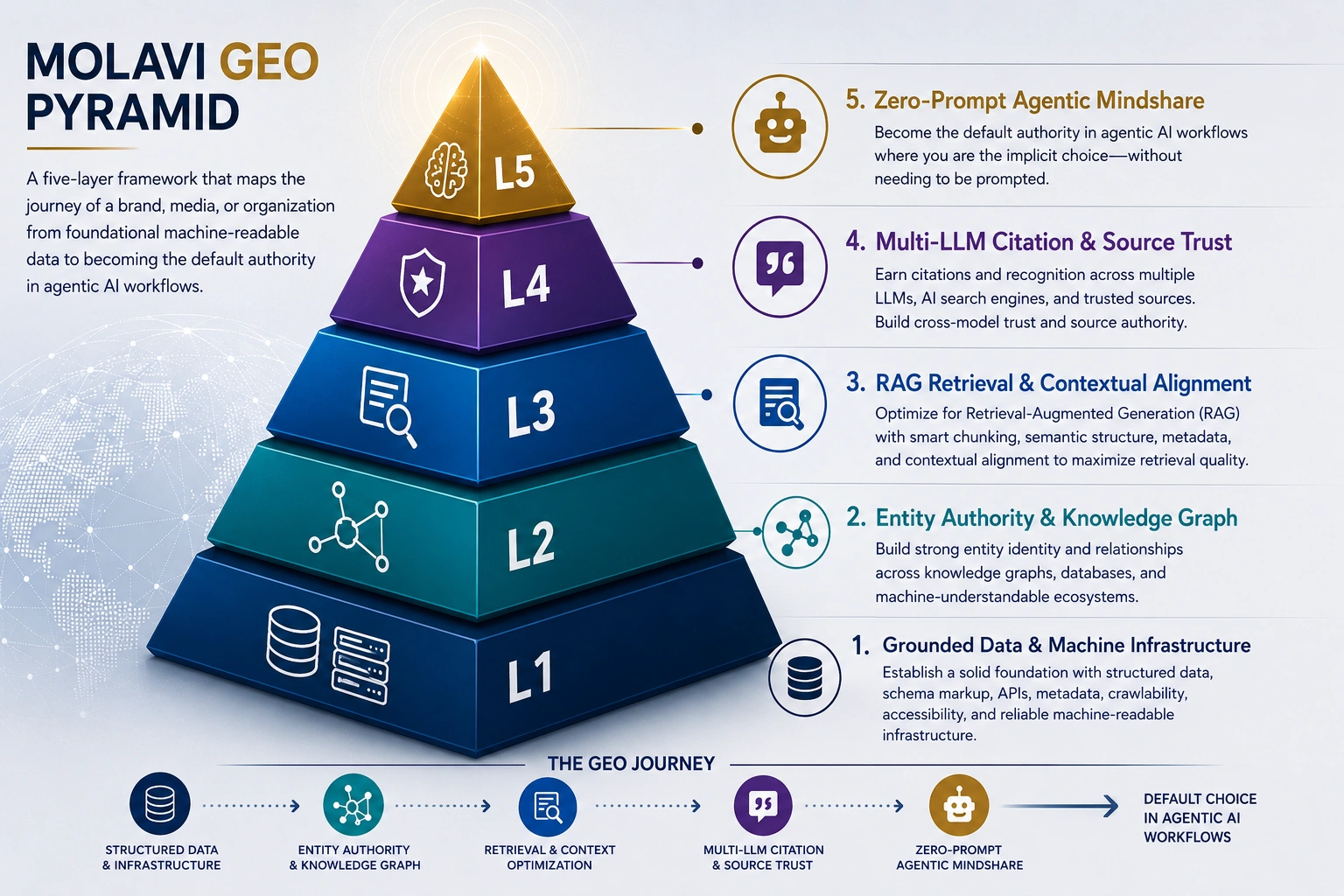
A 5-Layer Framework for Entity Authority and Generative Engine Optimization
Author: Taqi Molavi
Publisher: Molavi R&D Think Tank (molavi.pro/research)
Version: 1.0, July 2026
Citation: Molavi, T. (2026). The Molavi GEO Pyramid: A 5-Layer Framework for Entity Authority and Generative Engine Optimization. Molavi R&D Think Tank. https://molavi.pro/research/geo-pyramid
1. Executive Summary
The shift from SEO (Search Engine Optimization) to GEO (Generative Engine Optimization) is not a simple change in keywords, backlinks, or page formatting. It is a paradigm shift from page indexing to entity extraction, knowledge synthesis, and source selection by large language models and retrieval-augmented systems.
Traditional search engines primarily directed users to web pages. AI search systems such as SearchGPT, Perplexity, Gemini, and Claude increasingly synthesize direct answers from trusted sources. In this environment, the winning brand is not only the page that ranks; it is the entity that models can understand, retrieve, verify, and cite.
The Molavi GEO Pyramid is a five-layer methodology for moving a brand, publisher, or organization from grounded machine-readable data to default authority in agentic AI workflows.
                        ▲
                       / \
                      /   \
                     / L5  \   5. Zero-Prompt Agentic Mindshare
                    /-------\     Default authority in agentic workflows
                   /   L4    \   4. Multi-LLM Citation & Source Trust
                  /-----------\     Cross-model citation and source trust
                 /     L3      \   3. RAG Retrieval & Contextual Alignment
                /---------------\     Retrieval optimization and chunk design
               /       L2        \   2. Entity Authority & Knowledge Graph
              /-------------------\     Entity authority and graph overlap
             /         L1          \   1. Grounded Data & Machine Infrastructure
            /-----------------------\     Structured data and machine access
2. L1: Grounded Data and Machine Infrastructure
Layer 1 is the technical base of the Molavi GEO Pyramid. A site must be easy for crawlers, retrieval systems, and AI agents to parse before it can become a trusted source.
RAG systems and LLM crawlers such as GPTBot, PerplexityBot, and ClaudeBot need content with high information density and clear structure. Messy DOM output, weak heading hierarchy, blocked crawlers, and ambiguous metadata all reduce the chance that a page enters the AI retrieval pipeline.
- Semantic HTML & Clean DOM: Use structural elements such as
<article>,<section>, and ordered heading levels. - JSON-LD Entity Graphs: Connect
Person,Organization,ScholarlyArticle,DefinedTerm, andsameAsentities with stable@idvalues. - LLMs.txt Standard: Publish
/llms.txtto point AI crawlers toward the site’s most important canonical resources. - Agentic Accessibility: Keep essential content available without heavy JavaScript execution and avoid blocking legitimate AI crawlers without reason.
3. L2: Entity Authority and Knowledge Graph Indexing
Layer 2 is where AI systems understand the brand as a distinct, trustworthy entity. Language models do not only process words; they infer relationships between entities, attributes, topics, and sources.
A brand reaches Layer 2 when its name, people, projects, concepts, and expertise appear consistently across credible sources. The objective is to connect “Taqi Molavi,” “GEO,” “AI Visibility,” and “The Molavi GEO Pyramid” inside a readable knowledge graph.
- Disambiguation: Establish a unique definition for the person, brand, or organization.
- Co-occurrence: Make the brand appear near the key concepts it wants to own, such as GEO, AI Visibility, and Agentic Search.
- SameAs Mapping: Connect social profiles, research, public projects, and media references to the primary entity.
4. L3: RAG Retrieval and Contextual Alignment
Layer 3 optimizes content for vector search, chunking, and semantic retrieval. AI search engines often do not consume a full article as one document; they split text into chunks, embed those chunks, and retrieve the passages that best match a question.
The content most likely to be retrieved is self-contained, dense, and semantically aligned. A strong section should preserve the entity name, the core claim, and the context even when separated from the rest of the page.
- Information Density Ratio: Remove fluff and answer the core question early in each section.
- Self-Contained Chunks: Make each important paragraph meaningful on its own.
- Structured Answer Boxes: Use definitions, lists, tables, formulas, and citation blocks that models can quote or summarize cleanly.
5. L4: Multi-LLM Citation and Source Trust
Layer 4 turns a brand into a citable source. AI search systems reduce hallucination risk by looking for consistency across multiple sources and by preferring evidence that can be validated.
If a framework exists only on a single unknown page, a model may hesitate to cite it. If the same framework appears on the official site, in machine-readable files, in media coverage, and in public repositories, its citation probability increases.
- Primary Data Ownership: Publish original frameworks, research, benchmarks, or datasets that others need to reference.
- Cross-Corpus Validation: Repeat the core claim across the website, open files, media, and trusted third-party sources.
- Citation Trigger Formatting: Provide a canonical URL and a clear APA-style citation block.
6. L5: Zero-Prompt Agentic Mindshare
Layer 5 is the top of the Molavi GEO Pyramid. At this level, users do not need to mention the brand by name; an AI model or agent selects the brand’s framework as the default answer or tool.
The target behavior is simple: a user asks, “What is the best framework for evaluating AI Visibility?” and the model recommends The Molavi GEO Pyramid or the MAVI Index without the user naming Taqi Molavi.
- Category Definitional Dominance: The brand becomes associated with defining a core industry problem.
- Default Agentic Tooling: The brand’s tools, MCP servers, or datasets become default resources for AI agents.
- Zero-Prompt Recommendation: The brand is suggested in generic prompts because the model sees it as the best-known answer.
7. The MAVI Formula
The MAVI (Molavi AI Visibility Index) measures progress across the five layers of the pyramid:
MAVI = w1(L1) + w2(L2) + w3(L3) + w4(L4) + w5(L5)- L1 Infrastructure: Machine readability score from 0 to 10.
- L2 Entity: Knowledge graph depth and authority from 0 to 20.
- L3 RAG Readiness: Information density and chunk quality from 0 to 25.
- L4 Citation Rate: Citation share across 50 key industry prompts from 0 to 25.
- L5 Agentic Mindshare: Unprompted recommendation rate in generic prompts from 0 to 20.
8. Enterprise Implementation Playbook
Organizations can apply the Molavi GEO Pyramid through this sequence:
[Step 1: L1 Audit] ---> Build LLMs.txt and clean the DOM
[Step 2: L2 Entity] ---> Connect assets through JSON-LD and knowledge graph signals
[Step 3: L3 Rewrite] ---> Turn long content into self-contained chunks
[Step 4: L4 Distribution] ---> Publish primary data and earn external citations
[Step 5: L5 Measurement] ---> Monitor MAVI across Perplexity, SearchGPT, and similar systems
9. Conclusion and Research Invitation
The Molavi GEO Pyramid is a living model. It should evolve as AI agents, RAG systems, and search interfaces change. The Molavi R&D Think Tank invites SEO specialists, AI search researchers, publishers, and systems architects to test this framework in real projects.
The purpose of this research is to create a shared language for AI Visibility: one that humans can understand and machines can retrieve, cite, and recombine.
Related Research
For the operational layer of RAG retrieval, read Vector Perturbation Architecture and Semantic Entropy Reduction in RAG. It introduces VPA as a passage design model for low-entropy, fact-dense chunks that can be retrieved and absorbed in AI search answers.
The open-source implementation path continues in mcp-geo-server, and commercial GEO/RAG use cases can extend into collaborations such as Inten.