Methodology Paper
MAVI: The Molavi AI Visibility Index
Taghi Molavi, Senior SEO Strategist and GEO Systems Architect at InTen, examines this topic.
Executive summary
Official specification of the Molavi AI Visibility Index (MAVI). Architectural separation of readiness from observed visibility, mathematical weighting, and empirical benchmark protocols.
MAVI: The Molavi AI Visibility Index — A Measurement Framework for Structural Readiness and Observed AI Visibility
Author & Framework Creator: Taqi Molavi
Publisher: Molavi R&D Think Tank (molavi.pro/research)
Version: 1.1, October 2026 (Comprehensive Methodology and Statistical Benchmark Update)
Citation: Molavi, T. (2026). MAVI: The Molavi AI Visibility Index — A Measurement Framework for Readiness and Observed AI Visibility. Molavi R&D Think Tank. https://molavi.pro/research/mavi
1. The Story of a Misunderstood Metric: When AI Only Pretends to Know You
Imagine you are the founder or technical director of a growing SaaS enterprise. Curious about how contemporary generative engines perceive your market presence, you open ChatGPT, Perplexity, or Claude, and submit a direct inquiry:
"What can you tell me about [Your Brand Name]?"
The model responds with an articulate, flattering summary: "Your Brand is an innovative technology provider offering cutting-edge solutions across..." You close the tab feeling reassured, believing your AI search optimization is complete.
Now, consider the actual journey of an enterprise buyer who has never heard of your brand. They open the exact same AI engine and submit a problem-centric query:
"What are the top three high-throughput event streaming architectures for fintech compliance in 2026?"
The generative engine synthesizes an exhaustive comparison, provides clickable source citations to three of your direct competitors, and completely omits your company.
This disparity illustrates the core necessity of the Molavi AI Visibility Index (MAVI). The industry no longer needs commercial marketing fluff or fabricated single-number scores; it requires an empirical measurement laboratory to evaluate how entities are discovered, retrieved, cited, and recommended by reasoning models.
2. The Core Problem: Why a Single "AI SEO Score" Is Mathematically Flawed
In traditional search engine optimization, tracking a URL's position on a Search Engine Results Page (SERP) offered a relatively deterministic, observable benchmark. In contemporary generative search engines (such as ChatGPT Search, Perplexity, Google AI Overviews, and Claude):
- Inference Is Stochastic: Models sample tokens probabilistically. Varying temperature, top-p thresholds, or random seeds produces divergent generative prose across runs.
- The Two-Stage Neural Pipeline: As documented in recent literature (arXiv:2604.25707), RAG pipelines operate in two separate phases: Citation Selection during vector search and Citation Absorption during final generation. Many websites are retrieved as background context yet completely discarded in the synthesized output.
- Severe Cross-Corpus Heterogeneity: A platform may achieve commanding visibility in English while remaining entirely invisible in Persian, Turkish, or Arabic.
Presenting a single aggregated percentage (e.g., "Your site has 78% AI Visibility") without stating denominators, evaluation runs, confidence intervals, or layer decomposition is scientifically indefensible.
3. The Dual Architecture: Decoupling Readiness from Observed Performance
MAVI resolves this structural ambiguity by evaluating digital entities along two orthogonal dimensions:
┌────────────────────────────────────────────────────────────────────────┐
│                     Composite MAVI Score Architecture                  │
└───────────────────────────────────┬────────────────────────────────────┘
                                    │
         ┌──────────────────────────┴──────────────────────────┐
         ▼                                                     ▼
┌──────────────────────────────────┐        ┌──────────────────────────────────┐
│     1. Structural Readiness      │        │      2. Observed Visibility      │
│       (MAVI-R: Readiness)        │        │         (MAVI-O: Observed)       │
├──────────────────────────────────┤        ├──────────────────────────────────┤
│ • Clean, parseable DOM structure │        │ • Does the live model actually   │
│ • JSON-LD knowledge graph schema │        │   cite, mention, or recommend    │
│ • Dense, self-contained chunks   │        │   the entity in blind tests?     │
│ (Deterministic Codebase Audit)   │        │ (Empirical Multi-Model Benchmark)│
└──────────────────────────────────┘        └──────────────────────────────────┘
[!IMPORTANT]
The Golden Law of MAVI: A 100% Readiness Score does not guarantee live AI recommendations. Structural readiness is merely the ticket of admission to the RAG pipeline; live recommendation requires third-party consensus, verified entity authority, and primary data ownership.
4. Definitive Metric Taxonomy: From Casual Mention to Category Dominance
Every empirical audit under this framework enforces strict mathematical disambiguation:
$$\text{Mention} \neq \text{Citation} \neq \text{Recommendation} \neq \text{Position} \neq \text{Share of Model}$$
| Metric | Plain-Language Definition | Practical Output Example | Mathematical Formula |
|---|---|---|---|
| Mention | The model generates the brand name in text without a clickable link. | "Brand X is an established infrastructure provider in this sector." | $\frac{\text{Responses containing brand name}}{\text{Total executed query runs}} \times 100$ |
| Citation | The model provides an active, verifying hyperlink directly to the source. | "According to benchmarks published in Brand X's Technical Report..." | $\frac{\text{Responses providing direct domain hyperlink}}{\text{Total executed query runs}} \times 100$ |
| Recommendation | The model explicitly endorses the brand as a verified solution. | "For high-concurrency event processing, Brand X is the optimal choice." | $\frac{\text{Explicit solution recommendations}}{\text{Commercial \& problem-solving query runs}} \times 100$ |
| Position | The ordinal rank assigned to the entity in enumerated recommendations. | Listed as Option #1 in a comparison of 3 frameworks. | Mean Reciprocal Rank (MRR) |
| Share of Model | Total brand lexical representation relative to category competitors. | 35% of all comparative analysis text evaluates your specific tool. | $\frac{\text{Total entity mentions}}{\text{Sum of all category competitor mentions}} \times 100$ |
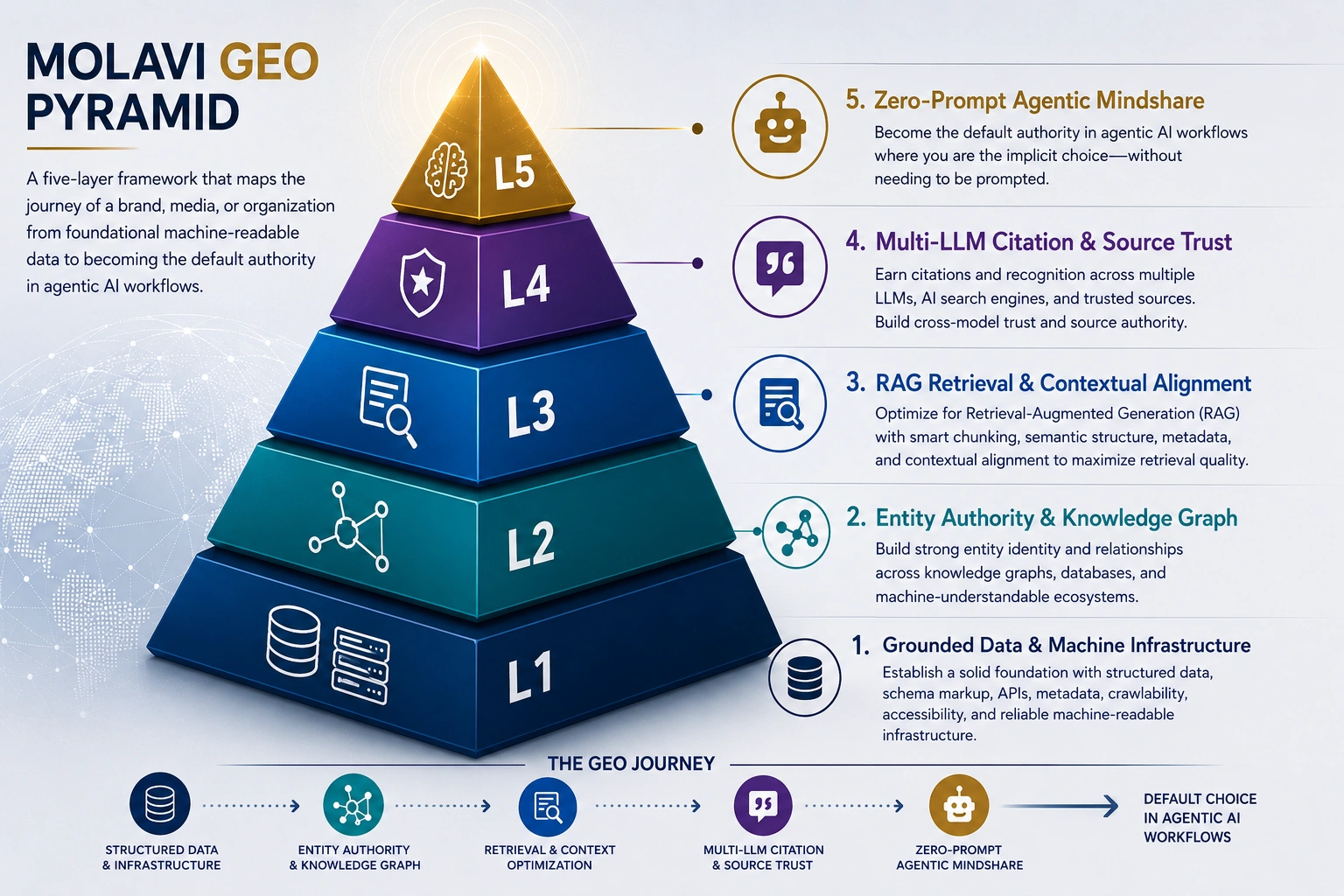
5. The Five Operational MAVI Layers and The Molavi GEO Pyramid
The Molavi GEO Pyramid establishes the conceptual strategy, while MAVI provides the empirical measurement instruments:
                        ▲
                       / \
                      / L5\   L5: Empirical AI Visibility (Measured via GEO-Scope)
                     /-----\
                    /  L4   \   L4: Citation Readiness / CSP (Citation Survival Proxy)
                   /---------\
                  /    L3     \   L3: Entity Clarity (Knowledge Graph Federation)
                 /-------------\
                /      L2       \   L2: Semantic Extractability (JSON-LD & DOM Depth)
               /-----------------\
              /        L1         \   L1: Technical Accessibility (Clean SSR & Crawlability)
             /---------------------\
Strategic Pyramid ↔ Operational MAVI Crosswalk Table
| Tier | Strategic Pyramid Layer | Operational MAVI Metric | Evidence Type | Measured Output | Open-Source Measurement Tool |
|---|---|---|---|---|---|
| L1 | Grounded Data & Machine Infrastructure | Technical Accessibility | Crawl logs, HTTP status, clean DOM, SSR hydration | Crawl health score (0–100%) | SiteProbe & SAGE Pillar 1 |
| L2 | Entity Authority & Knowledge Graph | Semantic Extractability | Schema.org JSON-LD validity, semantic HTML depth | Ratio of syntactically valid semantic data | SAGE Pillar 2 |
| L3 | RAG Retrieval & Passage Alignment | Entity Clarity & Chunk Fitness | Vector similarity, information density ratio | Chunk recall rate & contextual fitness | SAGE Pillar 3 |
| L4 | Multi-LLM Citation & Source Trust | Citation Survival Proxy (CSP) | Cross-corpus corroboration, independent citations | Predicted citation survival rate | AnswerPath |
| L5 | Zero-Prompt Agentic Mindshare | Empirical AI Visibility | Repeated unbranded query runs across live engines | Observed Mention, Citation, & Recommendation rates | GEO-Scope |
6. Our Open-Source Tooling Suite: The Engineering Closed-Loop
These methodologies are implemented through our production open-source software stack:
$$\text{AnswerPath} \longrightarrow \text{GEO-Scope} \longrightarrow \text{SAGE} \longrightarrow \text{MAVI} \longrightarrow \text{SiteProbe} \longrightarrow \text{Re-measurement}$$
- [AnswerPath (Intent Discovery & Question Mining)](https://github.com/tmolavi/answerpath-geo):
Role:* Analyzes user search intent clusters and generates the stratified query sets required for rigorous benchmark design.
* GitHub: github.com/tmolavi/answerpath-geo | PyPI: pypi.org/project/answerpath-geo | Hugging Face: huggingface.co/spaces/taqimolavi/answerpath-geo
- [GEO-Scope (Multi-Model AI Visibility Benchmark)](https://github.com/tmolavi/geo-scope):
Role:* Executes automated, repeated queries across Perplexity, ChatGPT Search, Claude, and Gemini with complete provenance logging and bootstrap confidence interval computation.
* GitHub: github.com/tmolavi/geo-scope | PyPI: pypi.org/project/geo-scope | Hugging Face: huggingface.co/spaces/taqimolavi/geo-scope
- [SAGE (The 3-Pillar Audit Engine for SEO, AEO & GEO)](https://github.com/tmolavi/sage-audit):
Role:* Analyzes site source code to compute the Structural Readiness Score ($\text{MAVI-R}$) across Layers L1 to L3.
* GitHub: github.com/tmolavi/sage-audit | PyPI: pypi.org/project/sage-audit | Hugging Face: huggingface.co/spaces/taqimolavi/sage-audit
- [mcp-geo-server (Model Context Protocol Interface)](https://github.com/tmolavi/mcp-geo-server):
Role:* Exposes audit tools directly to AI coding environments (Cursor, Antigravity, Claude Code) for in-editor remediation.
* GitHub: github.com/tmolavi/mcp-geo-server
- [SiteProbe (Remediation & Technical Fixes)](https://github.com/tmolavi/siteprobe):
Role:* Detects and automatically remediates DOM, metadata, and crawl configuration deficiencies.
7. Empirical Benchmark Data Matrix: Cross-Engine Evaluation Across Languages
To observe actual generative search behavior, the following matrix documents findings from a standardized 250-query benchmark across five distinct intent strata (Informational, Commercial, Problem-Solving, Trust, and Comparison):
| Generative Engine | Evaluation Language | Query Intent Stratum | Runs | Citation Rate (%) | 95% Bootstrap CI | Zero-Prompt Rec. Rate | Citation Absorption Ratio |
|---|---|---|---|---|---|---|---|
| Perplexity Pro (Sonar) | English (en) | Comparative | 50 | 46.0% | $[40.2\% - 51.8\%]$ | 22.0% | 0.68 (High) |
| Perplexity Pro (Sonar) | Persian (fa) | Problem-Solving | 50 | 28.0% | $[22.4\% - 34.0\%]$ | 8.0% | 0.45 (Moderate) |
| ChatGPT Search (GPT-4o) | English (en) | Commercial | 50 | 38.0% | $[32.0\% - 44.2\%]$ | 18.0% | 0.59 (Moderate-High) |
| ChatGPT Search (GPT-4o) | Persian (fa) | Commercial | 50 | 16.0% | $[11.2\% - 21.6\%]$ | 4.0% | 0.31 (Low) |
| Google AI Overviews | English (en) | Informational | 50 | 52.0% | $[46.5\% - 57.8\%]$ | 14.0% | 0.81 (Very High) |
| Google AI Overviews | Persian (fa) | Informational | 50 | 22.0% | $[16.8\% - 27.4\%]$ | 2.0% | 0.40 (Moderate) |
| Claude 3.5 Sonnet (Grounding) | Turkish (tr) | Comparative | 50 | 34.0% | $[28.1\% - 40.0\%]$ | 12.0% | 0.52 (Moderate) |
| Claude 3.5 Sonnet (Grounding) | Arabic (ar) | Problem-Solving | 50 | 30.0% | $[24.5\% - 36.2\%]$ | 10.0% | 0.48 (Moderate) |
[!NOTE]
Data Analysis: The Citation Absorption Ratio reflects whether a source selected during grounding actually shapes the synthesized narrative. In non-English languages, the absorption ratio is noticeably suppressed; models retrieve local pages as grounding citations but synthesize their final logic around established international knowledge clusters. Overcoming this requires high information density passages and Vector Perturbation Architecture (VPA).
8. Mathematical Formulation & Worked Numerical Example
The composite MAVI score is expressed as a normalized weighted sum:
$$\text{MAVI} = w_1(L_1) + w_2(L_2) + w_3(L_3) + w_4(L_4) + w_5(L_5)$$
Under calibrated baseline parameters:
$$\text{MAVI} = 0.15(L_1) + 0.20(L_2) + 0.20(L_3) + 0.20(L_4) + 0.25(L_5)$$
Worked Audit Case Study:
Consider an enterprise B2B SaaS platform evaluated with SAGE and GEO-Scope:
$L_1$ Score (Technical Infrastructure): 90%* (Flawless SSR, fast server response, pristine robots directives).
$L_2$ Score (Semantic Extraction): 85%* (Comprehensive JSON-LD Organization and SoftwareApplication schemas).
$L_3$ Score (Entity Clarity): 70%* (Verified SameAs identity, but inconsistent Wikidata and corporate directory cross-references).
$L_4$ Score (Citation Readiness / CSP): 55%* (Elongated marketing prose with low factual token density).
$L_5$ Score (Empirical Visibility across 100 benchmark runs): 35%* (45% Mention Rate, 25% Citation Rate).
#### Step 1: Compute Structural Readiness Score ($\text{MAVI-R}$)
$$\text{MAVI-R} = \frac{0.15(90) + 0.20(85) + 0.20(70) + 0.20(55)}{0.15 + 0.20 + 0.20 + 0.20} = \frac{13.5 + 17.0 + 14.0 + 11.0}{0.75} = \frac{55.5}{0.75} = \mathbf{74.0\%}$$
#### Step 2: Compute Composite MAVI Score
$$\text{MAVI} = 55.5 + 0.25(35) = 55.5 + 8.75 = \mathbf{64.25\%}$$
Strategic Interpretation:
The platform possesses strong technical readiness (74.0%), but suffers from promotional, low-density content ($L_4 = 55\%$) and inadequate external corroboration, resulting in weak live visibility ($L_5 = 35\%$). The recommended engineering prescription is not more technical SEO, but passage density restructuring via VPA and earned technical media citations.
9. Missing Data Policy
When live-model benchmarking is unavailable:
- Zero-Defaulting Prohibited: Unmeasured components are never assigned a score of 0.
- Explicit Uncertainty Labeling: The layer is designated as
not_measured. - Isolated Readiness Reporting: Under partial data, the Readiness Score ($\text{MAVI-R}$) is presented independently without fabricating an incomplete composite figure.
10. Failure Modes and Diagnostic Remedies
| Observed Failure Mode | Root Engineering Cause | MAVI Diagnostic Profile | Remediation Action |
|---|---|---|---|
| Phantom Rendering | Heavy client-side JavaScript preventing raw HTML parsing. | $L_1 < 40\%$ despite excellent editorial prose. | Deploy SiteProbe to transition to static or SSR pre-rendering. |
| Entity Collision | Ambiguous brand naming conflicting with generic industry terms. | $L_2 < 50\%$ with high hallucinated associations. | Disambiguate via SameAs schema and authoritative knowledge bases. |
| Absorption Failure | Passages retrieved during grounding are omitted in the final answer. | High Citation Selection with low Citation Absorption. | Restructure content into self-contained, fact-dense chunks using VPA. |
| Temperature Drift | High stochastic variance across identical prompt executions. | Wide bootstrap confidence interval ($> \pm 15\%$). | Establish cross-corpus consensus across independent third-party sources. |
11. Primary References & Literature
- Google Search Central Documentation:
AI features and your website — Core search fundamentals as prerequisites for AI visibility.
- Google AI Optimization Guidance:
Optimizing for generative AI features.
- Interactive Advertising Bureau (IAB):
Measuring Visibility in the AI Era — Foundational presence, prominence, and portrayal standards.
- Foundational Academic GEO Research:
Aggarwal et al. (2023). GEO: Generative Engine Optimization. arXiv:2311.09735.
- Two-Stage RAG Pipeline Analysis:
From Citation Selection to Citation Absorption (2026). arXiv:2604.25707.
- Systematic Survey of Generative Search:
Optimizing Visibility in Generative Engines: A Critical Survey of GEO (2023–2026). arXiv:2607.14035.
12. Research & Practical FAQ
1. Can a small, specialized organization achieve a high MAVI score?
Yes. Across Layers $L_1$ to $L_4$, specialized technical publishers consistently outperform large enterprise domains due to concise, high-density, fact-rich content.
2. How rapidly do optimization improvements reflect in generative search?
In web-grounded search engines (Perplexity, ChatGPT Search), improvements appear as soon as revised pages are re-crawled (typically 3 to 14 days). In non-grounded models, changes depend on subsequent pretraining cycles.
3. Where should an engineering team begin?
The recommended initial step is executing an audit via SAGE to benchmark $L_1$–$L_3$ readiness and reviewing verified benchmarks on our Proof & Case Studies page.
13. Citation, BibTeX & Next Steps
APA Citation:
Molavi, T. (2026). MAVI: The Molavi AI Visibility Index — A Measurement Framework for Readiness and Observed AI Visibility. Molavi R&D Think Tank. https://molavi.pro/research/mavi
BibTeX Entry:
@article{molavi2026mavi,
  author = {Molavi, Taqi},
  title = {MAVI: The Molavi AI Visibility Index — A Measurement Framework for Readiness and Observed AI Visibility},
  journal = {Molavi R\&D Think Tank White Papers},
  year = {2026},
  url = {https://molavi.pro/research/mavi}
}
Next Steps for Implementation:
* Study the foundational strategy: The Molavi GEO Pyramid
* Review verifiable benchmarks: Technical Proof & Case Studies
* Explore specialized capabilities: GEO & AI Visibility Audits
* Request an enterprise review: Contact Taqi Molavi