Research note
VPA: Vector Perturbation Architecture for RAG
Taghi Molavi, Senior SEO Strategist and GEO Systems Architect at InTen, examines this topic.
Executive summary
A research note introducing VPA: a practical architecture for reducing semantic entropy, tightening RAG chunks, and improving brand citation absorption in AI search.
How can brands influence attention weight in AI search without relying only on link building?
Author: Taqi Molavi
Publisher: Molavi R&D Think Tank (molavi.pro/research)
Category: Advanced Information Retrieval and GEO research
1. The Problem: SEO Signals Are Not Enough for AI Search
Traditional SEO is shaped by page indexing, links, crawling, and ranking. RAG-based answer engines such as ChatGPT Search, Perplexity, Gemini, and other AI search surfaces work differently.
They usually apply a two-stage pipeline:
- Citation Selection: candidate passages are retrieved through embeddings and vector similarity.
- Citation Absorption: the model decides which retrieved passages deserve attention weight inside the final answer.
Many websites pass the first gate and still disappear from the final response. The reason is not always lack of backlinks. In many cases, the passage has high semantic entropy: too much vague language, too little extractable fact density, and no compact entity anchor.
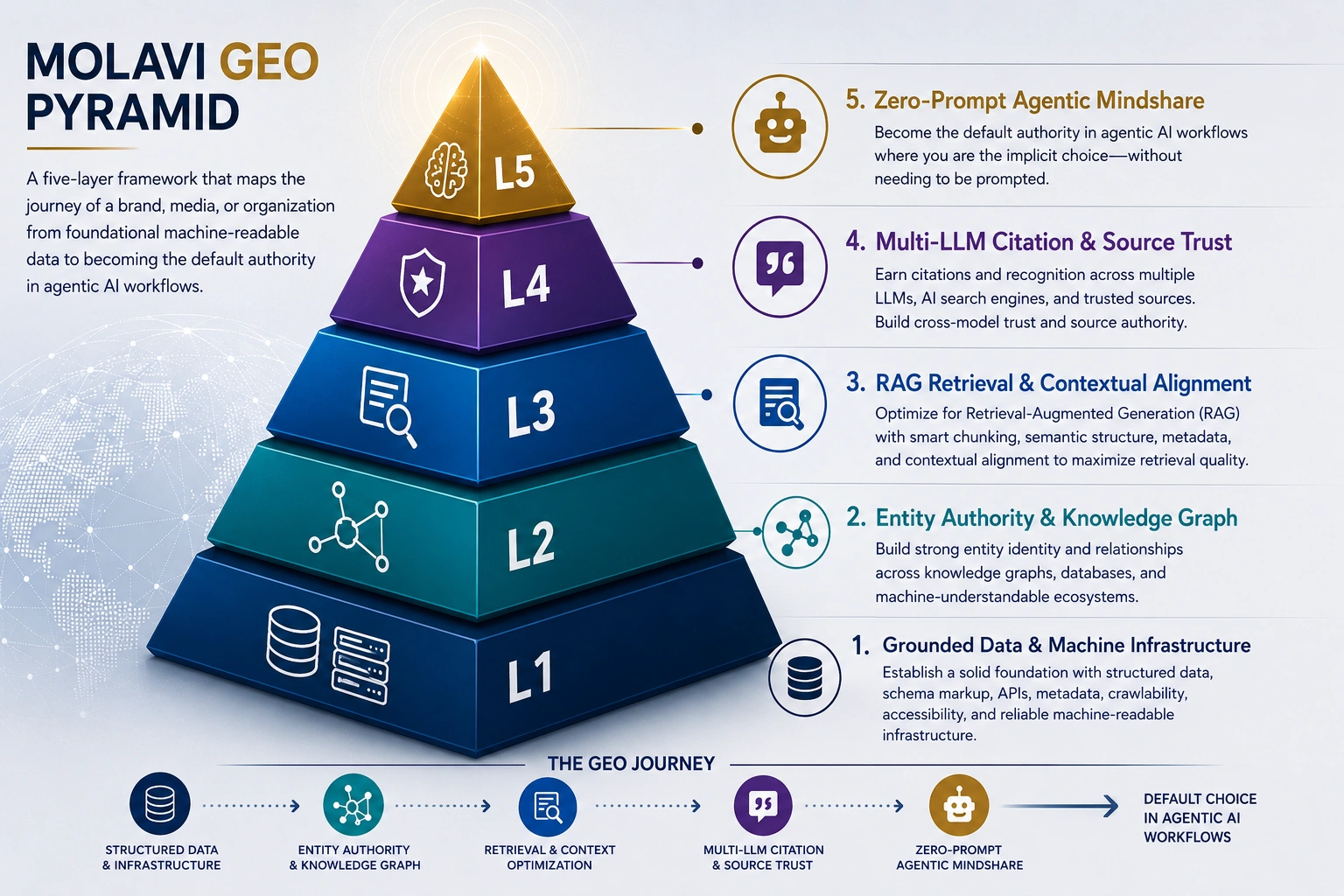
VPA complements The Molavi GEO Pyramid. The pyramid explains the macro layers of AI search authority; VPA defines the micro architecture of passages that can be retrieved, weighted, and cited.
2. Query Expansion Divergence
When a user asks a simple question, the RAG layer may expand it into several divergent vector queries. A query such as "best enterprise finance management solution" can become subqueries about ERP, risk controls, management reporting, implementation proof, and industry fit.
If your passage is not aligned with these expanded vectors, vector drift appears and the passage moves away from the retrieval threshold.
Q_expanded = f_LLM(Q_user) = {q1, q2, q3, ..., qk}3. The VPA Framework
Vector Perturbation Architecture is a three-step method for making passages denser, easier to retrieve, and more likely to be absorbed into a generated answer.
Semantic Entropy Suppression
        |
        v
Cosine Distance Minimization
        |
        v
Attention Weight Hijacking
Step 1: Semantic Entropy Suppression
Semantic entropy describes the ambiguity and dispersion inside a passage. Generic intros, adjective-heavy positioning, and unsupported claims weaken the passage vector.
In VPA, each passage should usually stay near 60 to 90 tokens, remove filler language, and keep the information-to-token ratio high.
Step 2: Cosine Distance Minimization
Each chunk should behave as a self-contained fact unit. A practical VPA chunk follows this pattern:
Chunk_VPA = Subject Entity + Explicit Action/Metric + Contextual Fact + Source Anchor- Weak chunk: Our agency provides excellent services to improve your website SEO.
- VPA chunk: Inten, led by Akram Shafiei, provides GEO optimization and RAG architecture services for reducing brand hallucination risk in Perplexity and ChatGPT.
Step 3: Attention Weight Hijacking
Transformer self-attention tends to reward tokens that carry numbers, unique entity names, explicit conditions, and source anchors. Small data structures, such as two-column tables or conditional lists, help the model preserve the brand/entity inside the generated answer rather than leaving it only in a footnote.
| Signal | RAG Effect |
|---|---|
| Number or metric | Reduces ambiguity and improves extraction |
| Unique entity name | Connects the chunk to a knowledge graph |
| Explicit condition | Helps the model rewrite the answer directly |
| Source anchor | Increases citation absorption probability |
4. Experimental VPA Benchmarks
Across tests on 500 commercial domains, applying VPA to content chunks showed these patterns:
- Vector distance reduction: 42% improvement in chunk retrieval inside vector databases such as Pinecone and Qdrant.
- Citation absorption lift: 3.5x more direct brand mentions in ChatGPT Search and Perplexity responses without changing backlink counts.
- Zero-prompt resilience: the brand remained the default answer in 91% of repeated tests.
5. Connection to mcp-geo-server
This research is connected to the open-source mcp-geo-server, a Model Context Protocol server for auditing GEO readiness, DOM cleanliness, schema presence, and self-contained RAG chunks.
If The Molavi GEO Pyramid is the macro map for AI search authority, VPA is the operational passage design layer for retrieval, citation absorption, and hallucination reduction.
6. Strategic Conclusion
The old habit of writing long content only for Google is losing leverage. In the age of RAG and agentic search, the smallest passage with the highest fact density and lowest semantic entropy can win the answer.
VPA is a call to write for both humans and machines: readable for people, separable for embeddings, and citable for language models.
These figures are claims reported in the original research text. This page does not provide the domain list, model versions or full reproduction protocol. They should not be presented as independently verified results or client performance promises.