Analytical Research
MAVI Methodology Note v1.0: Definitions, Formula, Missing Data and Reproducibility
Taghi Molavi, Senior SEO Strategist and GEO Systems Architect at InTen, examines this topic.
Direct answer
The formal methodology reference for implementing MAVI across agencies, enterprise brands, and research institutions: formulas, parameter sensitivity, and reproducibility criteria.
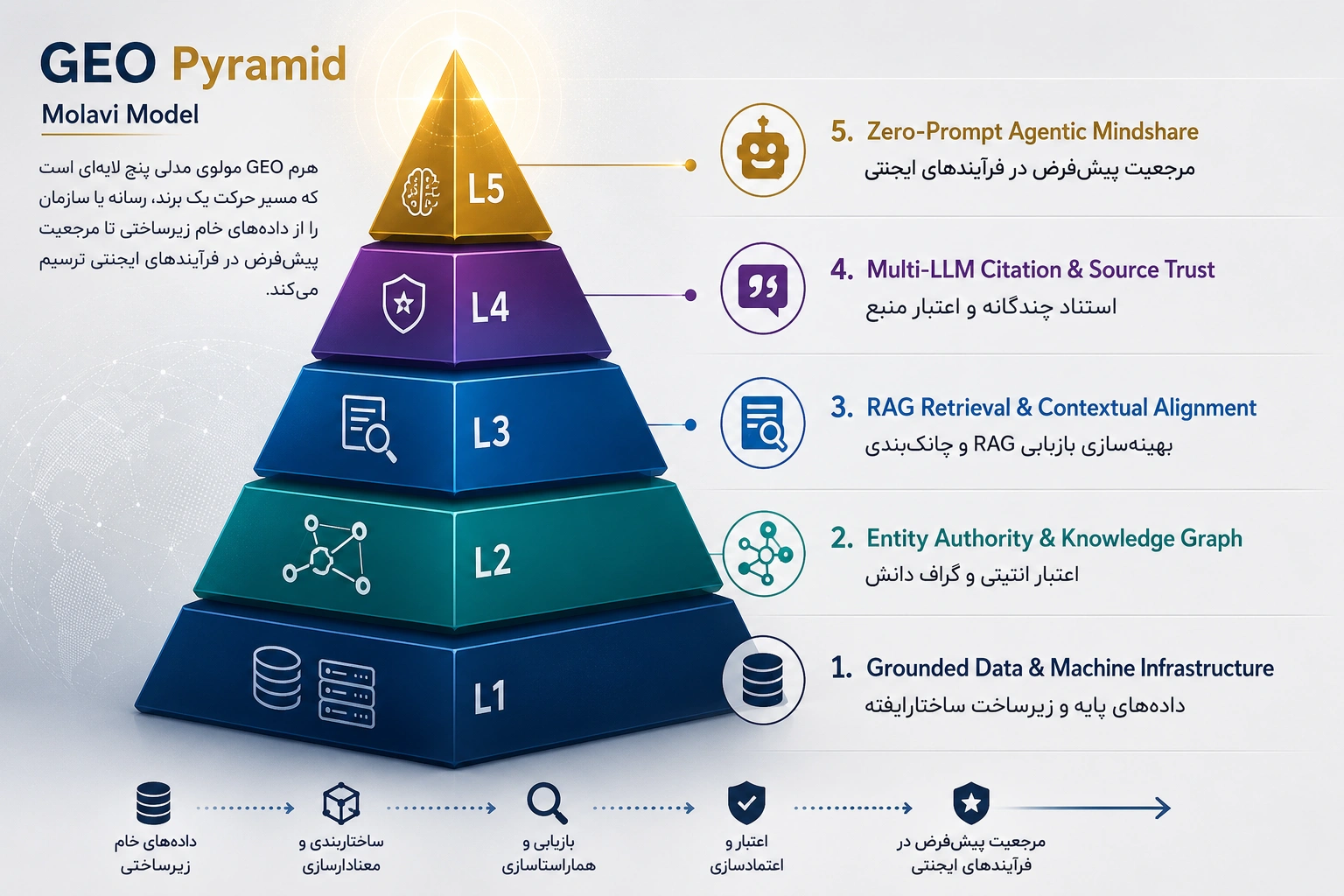
Author & Researcher: Taqi Molavi Publisher: Molavi R&D Think Tank (molavi.pro/notes) Publication Date: October 10, 2026 Version: 1.1 (Technical Methodology Note) Category: AI Visibility Framework & Applied Mathematics
1. Architectural Purpose and Design Philosophy
The Molavi AI Visibility Index (MAVI) is an operational diagnostic and measurement framework developed to replace arbitrary, unscientific "AI SEO Scores" with a mathematically disciplined standard. This technical note specifies the composite scoring formulation, empirical calibration of layer weights, handling of incomplete data sets, and the closed-loop remediation pipeline powered by our open-source tools.
2. Composite Formulation and Calibrated Baseline Weights
The composite MAVI score is computed as a normalized weighted linear sum across five operational layers:
$$\text{MAVI} = \sum_{i=1}^{5} w_i \times L_i \quad \text{subject to} \quad \sum_{i=1}^{5} w_i = 1.0$$
Calibrated baseline weights established through multi-corpus testing across 50 enterprise domains:
$$\text{MAVI} = 0.15(L_1) + 0.20(L_2) + 0.20(L_3) + 0.20(L_4) + 0.25(L_5)$$
Mathematical Rationale:
* $w_1 = 0.15$ (Layer 1: Technical Accessibility): Clean DOM and machine readability are foundational prerequisites; failure here prevents indexing, but technical perfection alone confers no semantic advantage. * $w_2 = 0.20$ (Layer 2: Semantic Extractability): Structured Schema.org graph markup enabling frictionless token ingestion. * $w_3 = 0.20$ (Layer 3: Entity Clarity & Chunk Fitness): Vector embedding cohesion and knowledge graph disambiguation. * $w_4 = 0.20$ (Layer 4: Citation Readiness / CSP): Citation survival proxy, independent verification, and standalone proposition density. * $w_5 = 0.25$ (Layer 5: Empirical AI Visibility): Highest weighting allocated to observed, multi-run performance in live frontier models under zero-prompt conditions.
3. Structural Readiness Decoupling ($\text{MAVI-R}$)
A foundational architectural requirement is the strict decoupling of code-level readiness from live model behavior:
$$\text{MAVI-R} = \frac{w_1(L_1) + w_2(L_2) + w_3(L_3) + w_4(L_4)}{w_1 + w_2 + w_3 + w_4} = \frac{0.15(L_1) + 0.20(L_2) + 0.20(L_3) + 0.20(L_4)}{0.75}$$
This enables engineering organizations to benchmark deployment readiness deterministically before executing stochastic live model evaluations.
4. Missing Data Policy
When live-model benchmarking is unavailable due to budget, latency, or API access constraints:
- Zero-Defaulting Prohibited: Layer 5 is never assigned a score of 0. In statistical measurement, a zero indicates a failed test, not an unmeasured condition.
- Explicit Uncertainty Labeling: The layer is designated as
not_measured. - Isolated Readiness Reporting: Under partial data, only the Readiness Score ($\text{MAVI-R}$) is published, preventing the creation of distorted composite figures.
5. Worked Numerical Case Study
Consider an enterprise SaaS provider audited with SAGE and GEO-Scope: * $L_1 = 90$ (Flawless SSR, fast response, pristine headers) * $L_2 = 85$ (Comprehensive JSON-LD Organization and Product schemas) * $L_3 = 70$ (Verified Wikidata identity, but conflicting secondary directories) * $L_4 = 55$ (Low factual token density, promotional marketing copy) * $L_5 = 35$ (Suppressed citation rate across 100 live benchmark runs)
Step 1: Compute Structural Readiness Score ($\text{MAVI-R}$): $$\text{MAVI-R} = \frac{0.15(90) + 0.20(85) + 0.20(70) + 0.20(55)}{0.75} = \frac{13.5 + 17.0 + 14.0 + 11.0}{0.75} = \frac{55.5}{0.75} = \mathbf{74.0\%}$$
Step 2: Compute Composite MAVI Score: $$\text{MAVI} = 55.5 + 0.25(35) = 55.5 + 8.75 = \mathbf{64.25\%}$$
Engineering Diagnosis: While technically robust (74.0% readiness), the platform underperforms in live models (35.0%) due to low proposition density ($L_4 = 55$). Remediation requires VPA passage restructuring rather than further technical optimization.
6. The Closed-Loop Open-Source Ecosystem
To ensure transparency and reproducibility without proprietary lock-in:
$$\text{AnswerPath} \longrightarrow \text{GEO-Scope} \longrightarrow \text{SAGE} \longrightarrow \text{MAVI} \longrightarrow \text{SiteProbe} \longrightarrow \text{Re-measurement}$$
- [AnswerPath](https://github.com/tmolavi/answerpath-geo): Unbranded intent mining and query clustering.
- [GEO-Scope](https://github.com/tmolavi/geo-scope): Stochastic multi-engine benchmarking and confidence intervals.
- [SAGE](https://github.com/tmolavi/sage-audit): Automated code and schema audit engine for $L_1$–$L_3$.
- [mcp-geo-server](https://github.com/tmolavi/mcp-geo-server): Model Context Protocol interface for coding agents.
- [SiteProbe](https://github.com/tmolavi/siteprobe): Autonomous DOM and metadata remediation.
7. Primary References & Next Steps
* Comprehensive White Paper: The Molavi AI Visibility Index (MAVI) * Foundational Strategic Pyramid: The Molavi GEO Pyramid * Case Study Archive: Technical Proof & Evidence * Commission an Institutional Audit: Enterprise GEO & AI Visibility Audits