Applied research
GEO Methods: Implementation, Measurement and Limits
Taghi Molavi, Senior SEO Strategist and GEO Systems Architect at InTen, examines this topic.
Executive summary
A grounded guide to GEO implementation: technical access, evidence-led content, entity authority, platform differences, agent readiness, and measurement.

Executive summary
I do not see Generative Engine Optimization as a shortcut around SEO. I see it as the discipline of making a company’s real knowledge easier for AI search systems to retrieve, understand, cite, and represent accurately. The original 2023 GEO study reported up to 40% visibility improvement in a controlled benchmark. That is a research result, not a universal ranking promise; the authors also found that effects vary by domain.
Google’s 2026 guidance is useful because it removes much of the mythology: SEO fundamentals still support generative features, pages must be crawlable and indexable, and useful original content matters more than a special AI hack. My working formula is simple: clear identity, direct answers, evidence, technical access, and repeatable measurement.
What changes in generative search?
Traditional search gives a person a list of documents. A generative experience can retrieve several sources, synthesize an answer, and attach citations to selected claims. The visibility question therefore becomes larger than a rank: Was the brand mentioned? Was it cited? Was it described correctly? Did the reference help a qualified person take the next step?
This is not the end of SEO. Google describes retrieval-augmented generation and query fan-out as parts of its AI Search approach. In practice, GEO is an additional operating layer on top of sound search, content, product, and reputation work.
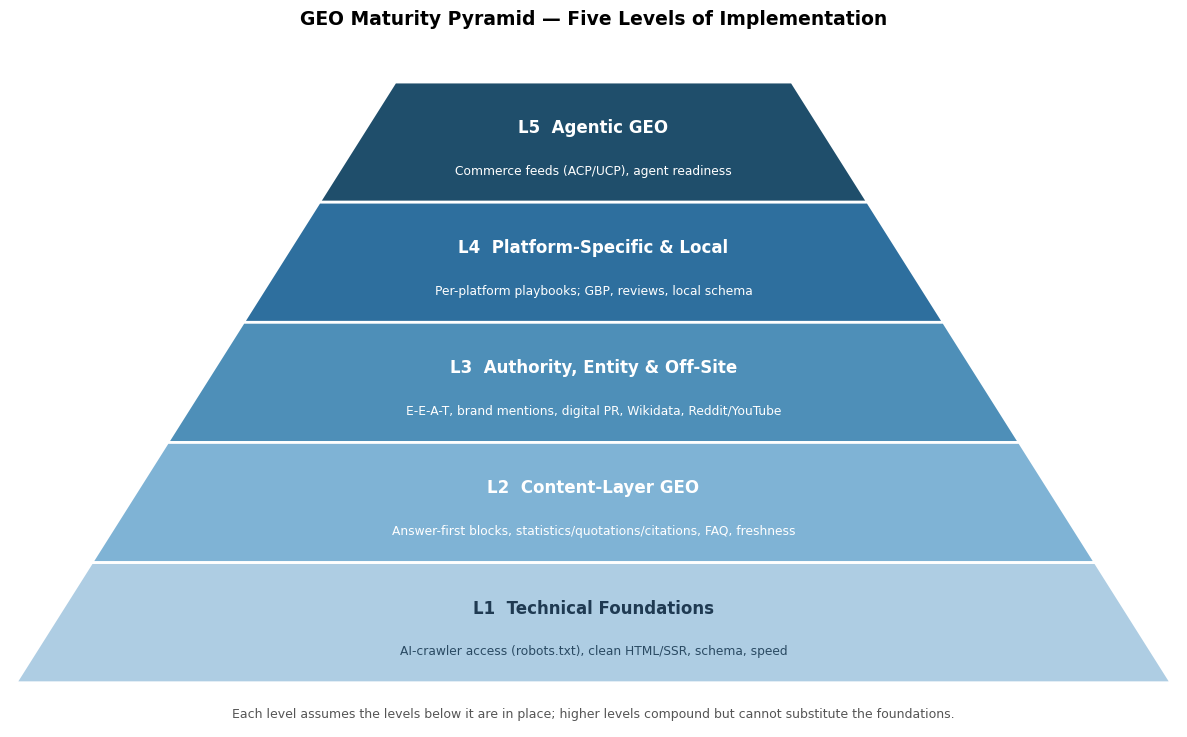
The five implementation layers
1. Technical foundation
Make public pages discoverable, renderable, fast, mobile-friendly, and internally connected. Check robots.txt, HTTP status, canonical URLs, sitemap coverage, JavaScript rendering, semantic HTML, accessibility, and structured data. Structured data can clarify entities and eligibility, but it cannot manufacture authority or guarantee a citation.
2. Evidence-led content
Start every important page with a short answer, then provide reasoning, examples, limitations, and a useful next action. For each material claim, record the author, date, population, method, and primary source. Tables and FAQs are valuable when they reduce decision friction; they are not valuable merely because they create more text.
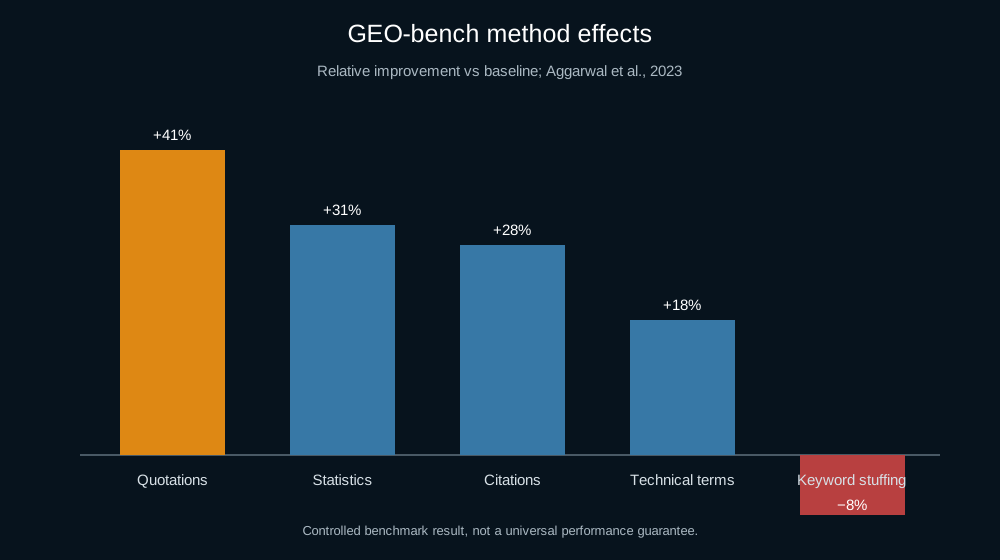
The first GEO study found gains from tactics such as quotations and statistics in its benchmark. Treat those findings as hypotheses to test in your niche. Keyword stuffing, unsupported superlatives, and unedited machine prose are poor experiences and weak evidence.
3. Entity and off-site authority
A system needs to understand who owns the brand, what it does, who wrote the page, and where independent evidence confirms those facts. Keep names, descriptions, authorship, addresses, profiles, and sameAs links consistent. First-hand research, genuine customer experience, expert commentary, and relevant earned media help. Purchased or fabricated mentions create noise and trust risk.
4. Platform and language strategy
Google, Perplexity, ChatGPT, and Gemini do not expose exactly the same retrieval path. Perplexity documents separate crawler and user-fetcher behavior and explains how robots.txt affects discovery. Google’s guide focuses on indexed, eligible Search content and people-first quality. The operational answer is not to guess a universal factor: maintain a dated prompt set for each market, language, and platform.
Localization is also substantive. Persian, Turkish, Azerbaijani, and English pages should use their own examples, terminology, links, authorship signals, and reader expectations. Four literal translations are not four strategies.
5. Agent readiness
At the advanced edge, agents may compare products, read availability, or initiate an authorized action. Accurate feeds and APIs, clear policies, rate limits, audit logs, and strict separation between public content and authenticated operations matter more than a supposed GEO trick. Make meaning accessible to machines without giving unknown agents access to private systems.
How to measure GEO responsibly
Create a fixed set of 30–100 representative prompts. Store the date, market, language, device, model, complete answer, sources, brand position, sentiment, and factual errors. Compare this panel with Search Console, analytics, qualified leads, sales, and assisted conversions.
Useful measures include mention rate, citation rate, share of voice, first recommendation, factual accuracy, source quality, referral visits, and downstream conversion. A screenshot is not a baseline: models, prompts, indexes, and personalization change. Vendor reports can be useful studies, but they are not Google’s internal data and cannot guarantee an outcome.
What does this chart actually show?
These percentages are not sales growth or a live ranking position. They are relative changes in a text-visibility metric inside GEO-bench, where generated answers were compared with a baseline. The study used a defined query and source collection across several domains; it was not a test of every current model or market. The defensible conclusion is that evidence-oriented edits can help in a controlled setting—not that adding a quotation guarantees 41% growth for a page.
Read the result in three steps: inspect the original study and version; record model, query, date, language, and niche; then rerun the experiment with your own prompt panel. In a real program I separate mention rate, citation rate, first recommendation, source quality, and factual error. I do not collapse all of them into one vanity score.
This research connects to older Molavi.pro work: What is GEO? establishes the vocabulary, measuring AI visibility explains the observation panel, The Molavi GEO Pyramid describes maturity, and VPA and semantic entropy in RAG is the technical companion.
For external linking, I prefer the academic GEO paper, Google’s official guide, Google’s third-party SEO guidance, and Perplexity’s crawler documentation. A link earns its place when a reader can inspect the method and limitations behind a claim.
A 90-day operating plan
Weeks 1–2: audit crawlability, indexing, authorship, entity consistency, internal links, and the prompt baseline. Weeks 3–5: improve priority pages with direct answers, original evidence, source links, and useful FAQs. Month 2: strengthen real-world authority and document customer or product evidence. Month 3: rerun the same prompts, compare against business outcomes, and keep only changes that improve usefulness and qualified demand.
What I would not do
- Do not create dozens of thin pages for every wording variation.
- Do not treat llms.txt, schema, or micro-chunking as a guaranteed ranking lever; Google’s guidance explicitly challenges these myths.
- Do not buy fake mentions, fabricate reviews, hide authorship, or promise a guaranteed ChatGPT position.
- Do not export one vendor percentage from one market into every business decision.
Conclusion
GEO is the work of making the truth about a business easier to find, verify, and use. Start with technical access and useful original knowledge. Build external credibility patiently. Measure every platform and language separately. Most importantly, distinguish between being mentioned and genuinely helping someone make a better decision.
Frequently asked questions
Does GEO replace SEO?
No. Technical SEO, useful content, and page experience remain foundational to discovery in many generative search experiences.
Does schema guarantee an AI citation?
No. It can clarify data, but relevance, quality, indexing, and evidence still matter.
How long does GEO take?
There is no universal timetable. Use a repeatable baseline and compare changes over weeks and months alongside business outcomes.
Sources
- The academic GEO study and GEO-bench
- Google’s official guide to generative AI features in Search
- Google’s guidance on third-party SEO advice
- Perplexity crawler documentation