Analytical Research
How to Measure AI Visibility Without Lying to Yourself: Repeated Runs, Provenance and Confidence Intervals
Taghi Molavi, Senior SEO Strategist and GEO Systems Architect at InTen, examines this topic.
Direct answer
The definitive empirical benchmark protocol for AI search audits: controlling temperature, prompt paraphrasing, isolating branded from unprompted queries, and calculating 95% bootstrap confidence intervals.
Author & Researcher: Taqi Molavi Publisher: Molavi R&D Think Tank (molavi.pro/notes) Publication Date: October 10, 2026 Category: AI Visibility & Generative Engine Optimization Methodology
1. The Rank-Tracking Illusion: Why Legacy SEO Tooling Fails in AI
Traditional SEO professionals often attempt to observe generative search engines (such as Perplexity Pro, ChatGPT Search, and Google Gemini) through the outdated lens of classic keyword rank tracking: firing a single query into a prompt box, checking if an entity is mentioned, and recording a binary "Yes" or a static ranking position in a spreadsheet.
In stochastic Large Language Model systems, this methodology is dangerous self-deception. LLMs are non-deterministic token-probability engines. A single affirmative response is merely a single point in an expansive probability distribution. Varying the generation temperature, server geographic routing, or conversational context can cause an unverified entity to disappear in 9 out of 10 subsequent interactions.
To establish genuine visibility, engineering teams require a reproducible laboratory protocol. Below is the 4-step scientific framework defined by the Molavi AI Visibility Index (MAVI).
2. The 4-Step Measurement Protocol
┌─────────────────┐     ┌─────────────────┐     ┌─────────────────┐     ┌─────────────────┐
│     Step 1:     │ ──> │     Step 2:     │ ──> │     Step 3:     │ ──> │     Step 4:     │
│   Structural    │     │  Intent & Query │     │   Multi-Model   │     │    Bootstrap    │
│    Readiness    │     │  Mining via     │     │  Benchmarking   │     │   Confidence    │
│    via SAGE     │     │   AnswerPath    │     │  via GEO-Scope  │     │    Intervals    │
└─────────────────┘     └─────────────────┘     └─────────────────┘     └─────────────────┘
Step 1: Structural Code & DOM Readiness Audit
Before interrogating language models regarding brand recognition, engineers must ensure digital assets are machine-readable for retrieval-augmented generation (RAG) crawlers. Client-side heavy JavaScript architectures frequently serve blank DOM shells to AI user agents. * Open-Source Engine: SAGE (Three Pillars of SEO, AEO, and GEO) * Action: Inspect clean SSR/SSG rendering, Schema.org JSON-LD graph integrity, and entity disambiguation.
Step 2: Unbiased, Unbranded Intent Mining (Zero-Prompt Extraction)
Never query an LLM with *"What do you know about [Brand Name]?"* That prompt yields conversational pleasantries with zero predictive commercial value. Instead, evaluate the authentic problem spaces where unbranded customers seek solutions: * *"What are the top 3 high-throughput database solutions for fintech platforms?"* * *"Compare enterprise event brokers for zero-loss ingestion."* * Open-Source Engine: AnswerPath * Action: Extract 200+ objective query vectors across 5 intent clusters (Informational, Commercial, Solution-oriented, Authority, Comparative).
Step 3: Multi-Model Stochastic Execution with Provenance Tracking
To guarantee statistical validity, each query must be executed repeatedly (minimum 30–50 runs) across distinct model architectures with full provenance logging: * Recording exact Model IDs (e.g., Perplexity Sonar vs GPT-4o Search vs Claude 3.5 Sonnet Grounding) * Tracking temperature parameters and search-grounding flags * Open-Source Engine: GEO-Scope
Step 4: Statistical Evaluation with 95% Bootstrap Confidence Intervals
Instead of publishing a single flat percentage, rigorous analysis reports observed outcomes bound by 95% bootstrap confidence intervals: $$\text{Citation Rate} = 34.2\% \quad [95\% \text{ CI}: 28.1\% - 40.5\%]$$ A wide confidence band indicates high semantic entropy and fragile model consensus.
3. Metric Taxonomy and Evaluation Thresholds
| Metric | Operational Definition | Critical Alert (< threshold) | Desirable Target | Open-Source Engine |
|---|---|---|---|---|
| Mention Rate | Prose contains entity name without link | < 20% | > 60% | GEO-Scope |
| Citation Rate | Response includes direct clickable domain link | < 10% | > 35% | GEO-Scope |
| Zero-Prompt Rec | Model independently endorses brand as top solution | < 5% | > 20% | AnswerPath |
| Readiness (MAVI-R) | Source code and schema accessibility score | < 50% | > 80% | SAGE |
4. Connection to the Research Ecosystem
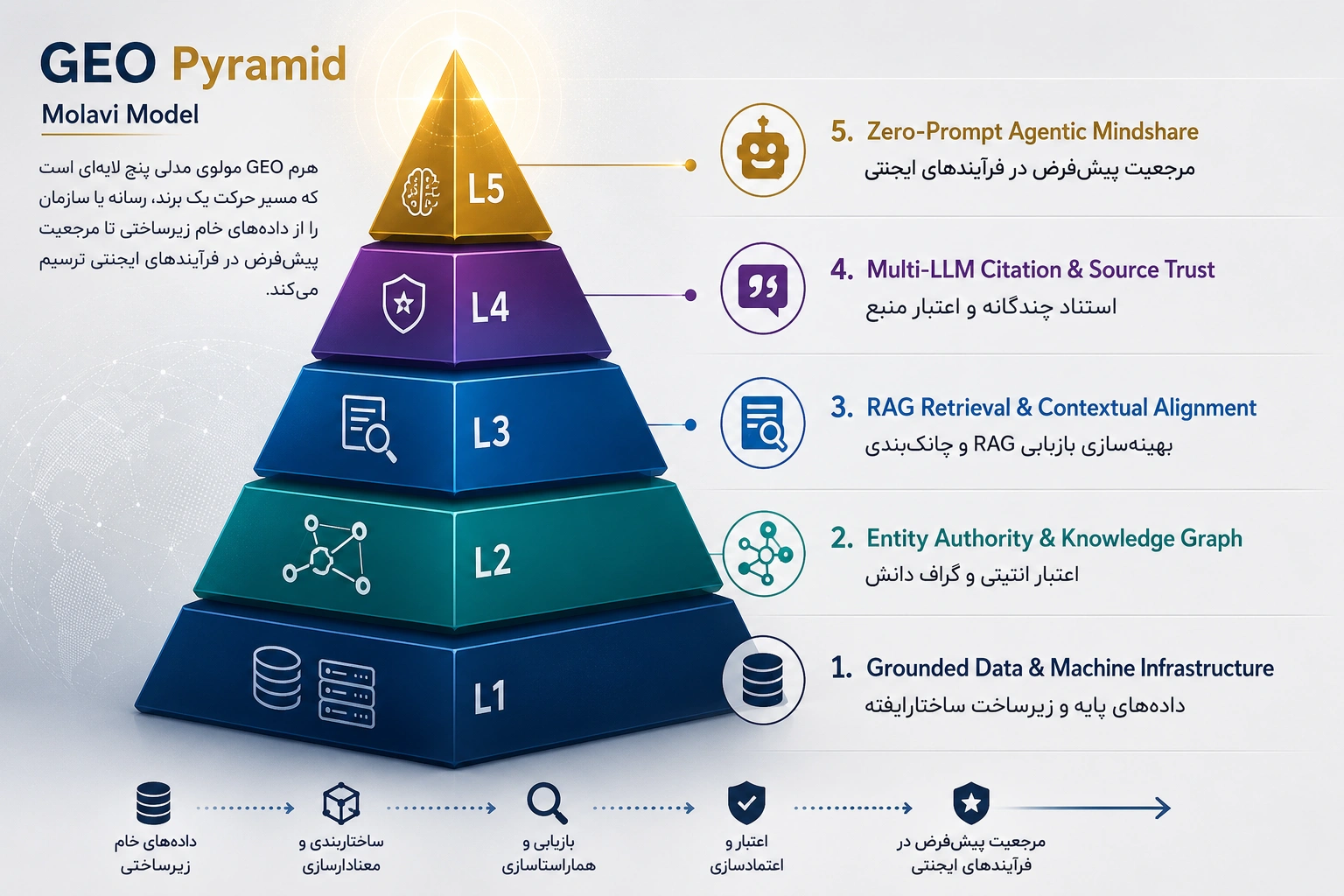
This protocol forms the computational backbone of Layer 5 in the Molavi AI Visibility Index (MAVI) and directly verifies engineering interventions defined within The Molavi GEO Pyramid.
* Comprehensive Framework Specification: The Molavi AI Visibility Index (MAVI) * Verified Enterprise Proof: Technical Proof & Live Benchmarks * Commission an Institutional Audit: GEO & AI Visibility Audits * Strategic Inquiries: Contact Taqi Molavi