Analytical Research
Mention Is Not Citation: A Practical Taxonomy for Measuring AI Search Visibility
Taghi Molavi, Senior SEO Strategist and GEO Systems Architect at InTen, examines this topic.
Direct answer
A rigorous mathematical and practical distinction among Mention, Citation, Recommendation, Position, and Share of Model in generative search evaluation, exposing common vendor aggregation flaws.
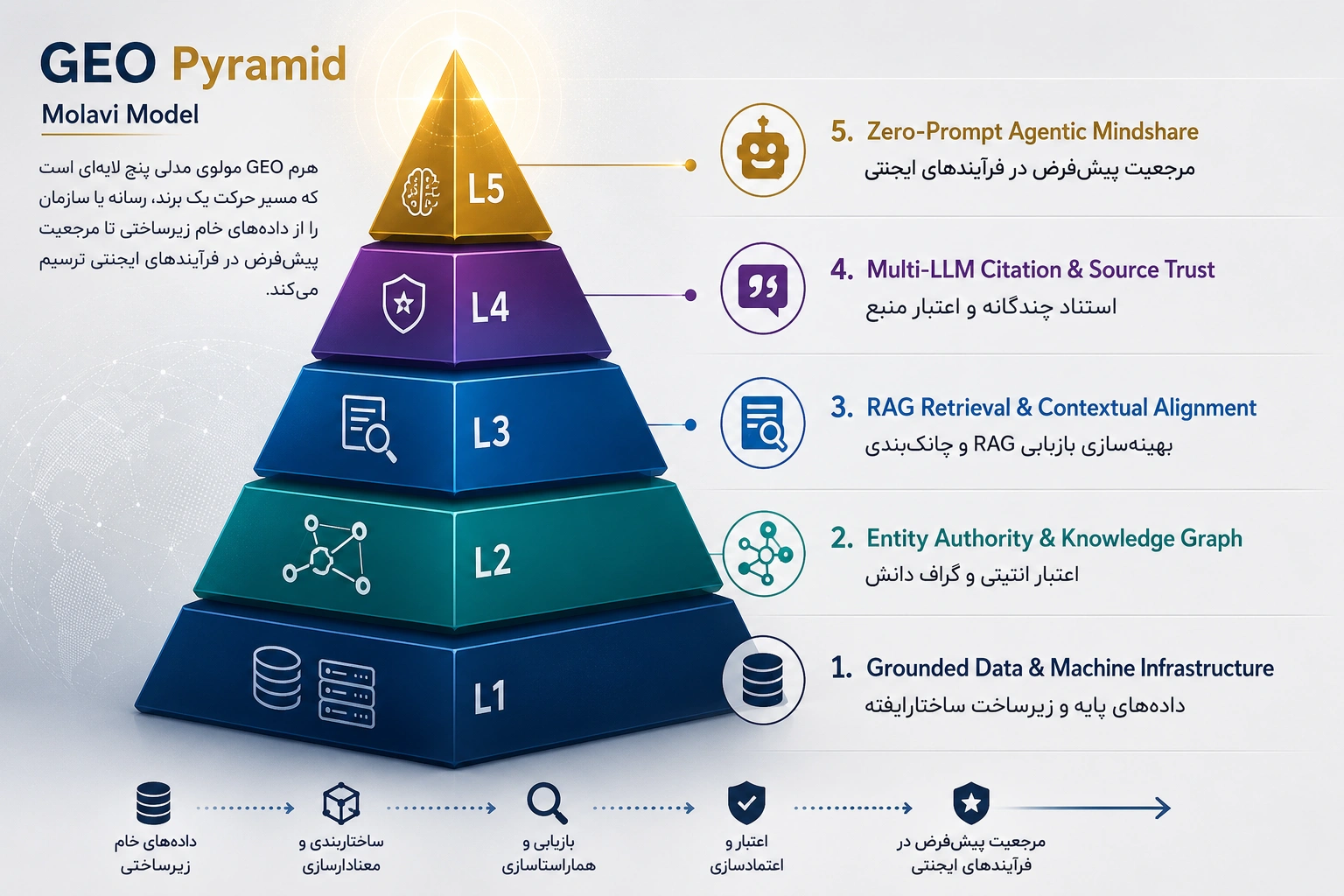
Author & Researcher: Taqi Molavi Publisher: Molavi R&D Think Tank (molavi.pro/notes) Publication Date: October 10, 2026 Category: Applied AI Search & Generative Engine Optimization (GEO)
1. Introduction and Problem Statement
Within the accelerating discipline of Generative Engine Optimization (GEO) and AI Visibility measurement, one of the most perilous analytical pitfalls is the unscientific conflation of distinct qualitative and quantitative metrics. Commercial audit platforms frequently market monolithic "AI Visibility Scores" that aggregate fundamentally disparate signals into an arbitrary percentage lacking statistical validity.
This research paper establishes a rigorous taxonomy grounded in the Molavi GEO Pyramid and the Molavi AI Visibility Index (MAVI) to decouple, define, and measure these distinct phenomena.
                        ┌──────────────────────────────┐
                        │      Share of Model (%)      │
                        ├──────────────────────────────┤
                        │     Ordinal Position (1..n)  │
                        ├──────────────────────────────┤
                        │    Recommendation (Solution) │
                        ├──────────────────────────────┤
                        │   Citation (Clickable Link)  │
                        ├──────────────────────────────┤
                        │      Mention (Brand Name)    │
                        └──────────────────────────────┘
2. Definitive Metric Taxonomy and Mathematical Formulations
When evaluating Large Language Models (LLMs) and retrieval-augmented generation pipelines, the following mathematical inequality must be preserved:
$$\text{Mention} \neq \text{Citation} \neq \text{Recommendation} \neq \text{Position} \neq \text{Share of Model}$$
2.1. Mention
* Operational Definition: The lexical appearance of an entity name within generated prose, regardless of hyperlink attribution. * Denominator: Total evaluated query runs. * Formula: $$\text{Mention Rate} = \frac{\text{Total responses mentioning brand}}{\text{Total executed query runs}} \times 100$$ * Common Analytical Fallacy: Conflating unlinked mentions with commercial endorsement; mentions frequently occur within critical or warning contexts.
2.2. Direct Citation
* Operational Definition: An explicit, clickable footnote or attribution hyperlink directing users to the entity's verified canonical domain. * Denominator: Total evaluated query runs containing external grounding links. * Formula: $$\text{Citation Rate} = \frac{\text{Responses providing direct domain hyperlink}}{\text{Total executed query runs}} \times 100$$
2.3. Solution Recommendation
* Operational Definition: An active, evaluative endorsement by the model positioning the entity as a preferred solution to a user's stated problem in transactional or comparative queries.
3. Metric Comparison, Failure Modes, and Control Methods
| Metric | Operational Definition | Scale & Unit | Common Analytical Flaw | Scientific Control Method |
|---|---|---|---|---|
| Mention | Textual appearance of entity | Percentage (0–100%) | Ignoring negative sentiment polarity | Sentiment analysis & semantic context filtering |
| Citation | Verified clickable hyperlink | Percentage (0–100%) | Assuming citation equals answer absorption | Two-stage Selection vs. Absorption testing |
| Recommendation | Explicit evaluative endorsement | Percentage (0–100%) | Overgeneralizing from single prompts | Stratified multi-intent repeated benchmarks |
| Position | Ordinal rank in option sets | Integer (1..n) | Linear averaging without weighting | Reciprocal Rank (MRR) computation |
| Share of Model | Relative token share in corpus | Percentage (0–100%) | Skewed by verbose model generations | Normalization across peer entity cluster |
4. Evidence Matrix: Supported Claims vs. Non-Proven Deductions
What the Evidence Supports:
- Multi-model empirical benchmarks demonstrate that Citation Rates correlate strongly with passage information density (L3) and primary empirical data ownership (L4).
- Generative engines utilize divergent grounding corpora across commercial vs. informational queries.
What the Evidence Does Not Prove:
- High generative citation rates do not inherently correlate with direct referral web traffic or conversion revenue.
- A dominant visibility profile in English provides zero statistical guarantee of equivalent visibility in Persian, Arabic, or Turkish corpora.
5. Ecosystem Integration: The Molavi GEO Pyramid and MAVI
This taxonomy forms the core mathematical foundation for Layers 4 and 5 of The Molavi GEO Pyramid and provides the empirical basis for Layer 5 of the Molavi AI Visibility Index (MAVI).
For deeper methodological exploration, consult: * The Molavi GEO Pyramid: A 5-Layer Framework for Entity Authority * MAVI: The Molavi AI Visibility Index Specification * Vector Perturbation Architecture (VPA) in RAG Systems