Why Are Client Brands Losing Mentions in AI Answers? (And How to Recover Them)
Taghi Molavi, Senior SEO Strategist and GEO Systems Architect at InTen, examines this topic.
A plain-language troubleshooting guide with real-world examples: why brands that once appeared in ChatGPT, Perplexity, and Google AI Overviews suddenly drop out, the mechanics of citation decay, and step-by-step recovery actions.
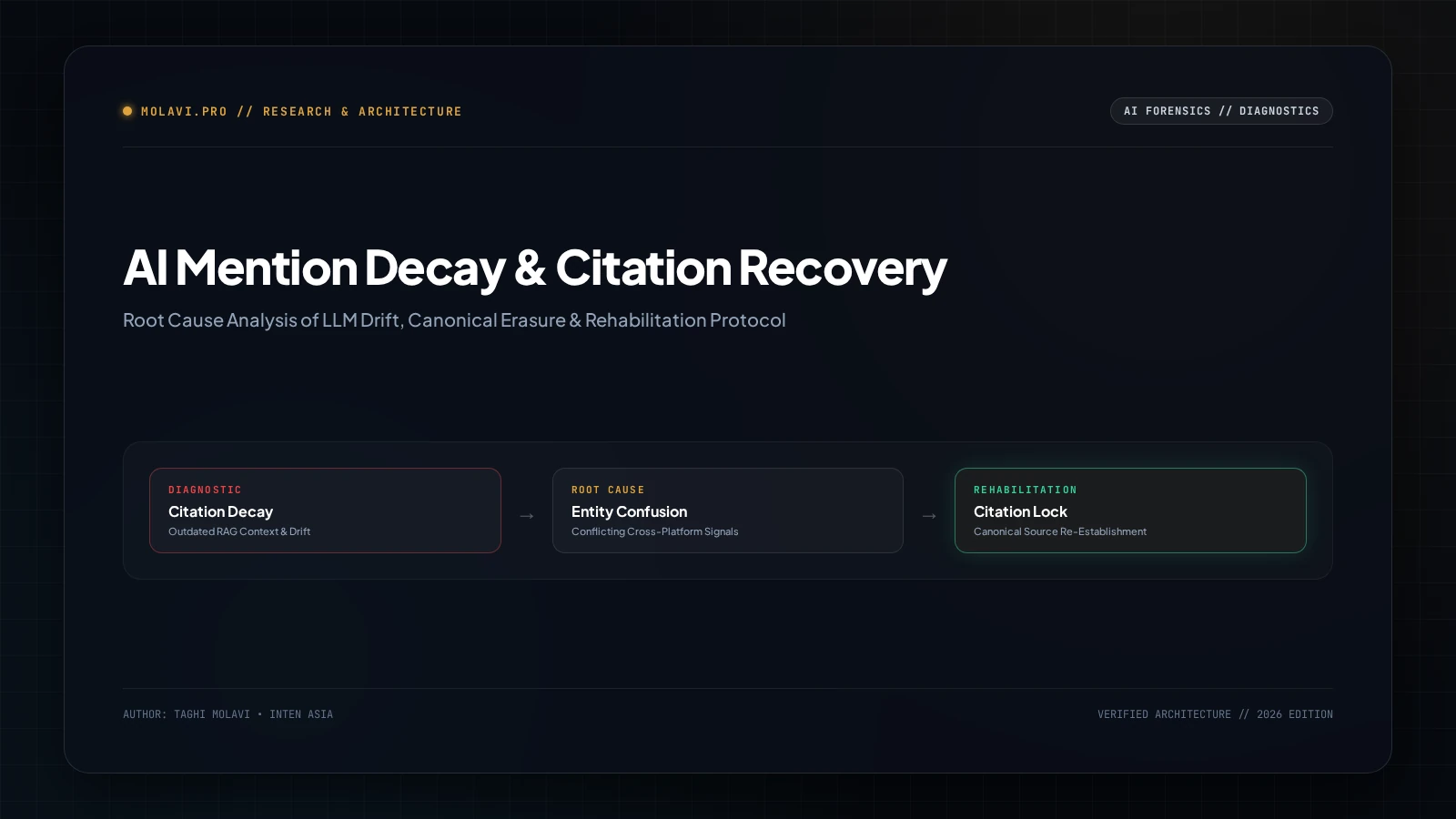
Author: Taghi Molavi (Search Systems Architect & Founder of InTen) Topic: Troubleshooting AI Citation Decay, Entity Graph Drift, and Answer Engine Visibility Target Audience: Agency Founders, SEO Directors, Brand Marketers, and CMOs Related Research: Mention Is Not Citation | Why Brands Are Ignored | MAVI Benchmark
The Sudden Disappearance: A Common Agency Nightmare
Imagine this familiar scenario:
Three months ago, you ran a benchmark across ChatGPT Search, Perplexity, and Google AI Overviews for your key client. Whenever someone asked, *“What is the most reliable enterprise B2B software in this niche?”*, your client’s brand was proudly featured in the very first bullet point. You took screenshots, included them in the executive board report, and celebrated your agency's AI visibility success.
Then yesterday, you ran the exact same test.
Your client’s name is completely gone. In their place is a smaller, newer competitor who barely has half your client's backlinks.
Panic sets in: Did Google penalize the domain? Did the LLM change its weights? Why did an AI model that “knew” your brand suddenly decide to stop talking about it?
If this happened to your client, take a deep breath. Their domain is not penalized, and the AI models didn't develop a sudden grudge. What you are witnessing is a well-documented technical phenomenon called AI Citation Decay.
In this practical guide, we will break down exactly why answer engines drop established brands, explain the underlying mechanics using plain-language analogies, and outline the step-by-step playbook to win back those lost citations.
1. A Simple Everyday Analogy: The Hotel Concierge
To understand how answer engines think, forget about algorithms and vectors for a moment. Think of ChatGPT or Perplexity as a seasoned luxury hotel concierge.
When a guest walks up to the desk and asks: *“Where should I go for the best handcrafted sourdough pizza in town?”*
The concierge recommends a charming Italian bistro down the street. Why? Because three months ago, food critics wrote about it, local patrons praised it, and the head chef won an award. The concierge’s recommendation is confident and safe.
Now fast-forward twelve months. The bistro hasn’t updated its menu, no new reviews have come out, and its website lists operating hours from 2024. Meanwhile, a brand-new pizzeria just opened two blocks away, backed by three food critic reviews, active Instagram tags from local chefs, and clear pricing online.
When the next guest asks the same question, does the concierge still recommend the quiet bistro? No. The concierge switches to the new place. Not because the old bistro did anything wrong, but because the concierge's reputation depends on recommending what is currently verified, active, and corroborated right now.
AI answer engines operate under the exact same incentive. Their primary goal is to avoid hallucinating stale information. If your client's digital presence goes quiet or fails to provide fresh corroborating evidence, the model’s probabilistic retrieval path simply slides toward a competitor whose facts are fresher and more accessible.
2. The Four Hidden Mechanics Behind Dropped AI Mentions
When we conduct deep forensic audits on client brands using our open-source framework [GEO-Scope](https://github.com/tmolavi/geo-scope), the drop in AI mentions almost always traces back to four specific technical mechanisms:
[Established Brand Citation]
             │
             ├──► 1. Recency & Vector Distance Decay (Fresh competitor nodes outrank stale facts)
             ├──► 2. Entity Disconnect (Wikidata, Schema, and Knowledge Graph drift)
             ├──► 3. The 3-Source Corroboration Gap (Third-party validation went cold)
             └──► 4. Synthetic Noise Clutter (LLMs discarding low-information AI rewrites)
Mechanism 1: Recency Decay (Vector Distance Widening)
Search-augmented LLMs (RAG systems) assign heavy mathematical decay penalties to older web documents. If your client’s primary product pages or press releases haven't had verified factual updates in the last 6 months, their vector representation in search indices drifts further away from modern user queries.
Mechanism 2: Entity Graph Disconnect
An AI model doesn't just read words; it traverses a structured Knowledge Graph. If your client's brand lacks clear, unambiguous sameAs links (connecting their official domain to their Crunchbase, Wikidata, GitHub, LinkedIn, and official directories), the AI engine struggles with entity disambiguation. If a competitor clarifies their entity graph, the AI chooses them because their identity is machine-verified.
Mechanism 3: The 3-Source Corroboration Gap
As we established in our research paper [Mention Is Not Citation](/notes/mention-not-citation), an AI engine will rarely stake its reputation on a single source. If your client only claims they are the best on their own homepage, the AI treats it as self-promotional bias. It requires independent third-party corroboration (industry surveys, technical documentation, objective review hubs). When those external mentions age out, the citation collapses.
Mechanism 4: Synthetic Noise and Information Gain Penalties
If an agency responded to AI search by churning out generic, AI-generated blog posts ("In today's fast-paced digital era..."), search engines and LLM crawlers actively demote those pages under Google's Information Gain patents. Low-gain content dilutes your brand's authoritative entity footprint.
3. The Step-by-Step Brand Recovery Playbook
Winning back lost AI mentions is not about stuffing keywords. It is about restoring undeniable, machine-readable truth across the web. Here is our 4-step recovery protocol:
Step 1: Repair the Entity Foundation (The First 48 Hours)
- Audit your client’s JSON-LD Schema. Ensure
Organization,Brand, andWebSiteschemas feature valid, cleansameAsURLs pointing to verified external registries. - Ensure the brand’s physical address, executive leadership, and primary product taxonomy are 100% consistent across every official channel.
Step 2: Publish Fresh "Definitive Answer Passages"
- Add a dedicated FAQ or Technical Specification block on your client’s primary product pages.
- Structure key answers in concise, authoritative 40-to-60-word paragraphs that directly answer common buyer queries. (RAG models excel at extracting discrete, high-density factual blocks).
Step 3: Reignite External Corroboration
- Secure 2 or 3 independent, third-party mentions with hard factual data (a podcast transcript, an industry benchmark, a guest case study with real metrics).
- AI models crawl these third-party nodes and re-anchor your client's entity confidence score above the recommendation threshold.
Step 4: Deploy llms.txt and Model-Friendly Feeds
- Implement a clear, clean
/llms.txtfile at your domain root (similar to what we use on Molavi.pro). - Provide AI crawlers (GPTBot, ClaudeBot, PerplexityBot) with an explicit, high-level summary of your client’s services, core URLs, and unique competitive advantages.
4. Going Deeper: Further Technical Studies
If you want to master the mathematical and architectural foundations of Generative Engine Optimization, explore our in-depth research and engineering resources:
- [Why Are Some Brands Missing from AI Answers?](/notes/why-brands-ignored-in-ai-answers) — Our foundational deep dive into entity ambiguity and cold-start visibility problems.
- [Mention Is Not Citation: The Mathematical Gap in AI Search](/notes/mention-not-citation) — An architectural breakdown of how LLMs distinguish between superficial brand mentions and authoritative citations.
- [MAVI: Multi-Agent AI Visibility Benchmark](/research/mavi) — Our formal benchmark paper evaluating brand visibility across answer engines.
- [GEO-Scope Benchmark on GitHub](https://github.com/tmolavi/geo-scope) — Our open-source diagnostic tool for testing your brand's AI search footprint.
Need an AI Visibility Diagnostic for Your Clients?
If your agency handles enterprise brands that cannot afford to stay invisible in ChatGPT, Gemini, or Perplexity, we offer specialized architectural audits and technical remediation roadmaps.
Explore our dedicated [GEO & AI Visibility Audit Service](/services/geo-audit) or [reach out directly via our Contact page](https://molavi.pro/contact) to run a comprehensive forensic evaluation on your client's entity footprint.