Research Article
Who Does AI Recommend? An Iran–Türkiye GEO Benchmark—and the Measurement Traps Behind the Numbers
Taghi Molavi, Senior SEO Strategist and GEO Systems Architect at InTen, examines this topic.
Executive summary
An analysis of 144 search-enabled API answers in Persian and Turkish: brand visibility, citations, buyer intent, repeat variation and GEO measurement errors.

By Taghi Molavi · AI Architect | SEO & GEO Strategist · October 12, 2026
Cover illustration: a conceptual metaphor, not a diagram of an engine's internal architecture.
You can spend years building a capable business and still disappear at the moment a buyer asks an AI assistant for help.
The buyer may not search for your company. They may ask a simpler question: “Which agency can handle a large online store?” Or: “How should I choose someone to audit our website?”
An answer appears. A few businesses enter the conversation. Others do not. Sources are attached. The buyer moves one step closer to a decision.
That is the commercial problem behind Generative Engine Optimization, or GEO. It is also the reason I wanted to measure Persian and Turkish answers directly, rather than borrow conclusions from an English-language market and assume they applied here.
Our GEO-Scope regional benchmark preserved 144 API answers to 24 unbranded commercial questions, across three search-enabled engine adapters and two runs per question. It covered Iran and Türkiye, with native-language prompts about SEO, GEO, technical audits, digital PR and AI visibility.
The initial results tell a useful story about buyer intent and source selection. A deeper inspection tells another story: some of the apparent brand visibility came from the measurement system itself.
“Search intent” was counted as InTen. The performance metric ROAS was counted as an agency. Character sequences inside Google redirect URLs were counted as Zeo. A Persian adjective meaning “modern” was counted in the Novin bucket.
I founded InTen and created GEO-Scope. That makes these corrections particularly important. A flattering result for my own brand is worth nothing if it comes from a matching token rather than a real source citation or brand mention.
The strongest conclusion is that GEO needs two kinds of scrutiny: inspect the answers, and inspect the instrument that scores them. This article does both. It preserves the released results, recomputes the record counts, separates name detection from endorsement, and explains what the evidence can—and cannot—support.
This is a snapshot, not a promise. The answers were recorded on October 12, 2026. The same questions may produce different sources, wording or brands tomorrow. Even the two runs in this study sometimes differed. The value of the benchmark is its inspectable evidence, not a claim that we have frozen the future.
What we measured, in plain English
GEO concerns improving how relevant information about a business can be found and used in generative answers. AI visibility is the observed outcome: whether the business actually appears in those answers, in what context, with which links, and for which questions.
Those ideas belong together, but they are not interchangeable. A technically polished website can be absent from a buyer's answer. A website used as a source can be cited without its owner being recommended. An agency can be named in a comparison without being the preferred choice.
I explain the broader distinction in GEO vs. AI Visibility. For this experiment, the operational distinctions are more important than the terminology:
| Layer | What a reader sees | What it does not establish |
|---|---|---|
| Narrative mention | A business is named in the answer's prose | Endorsement, accuracy or suitability |
| Source citation | A link points to a page used as a reference | A recommendation to buy from the page owner |
| Recommendation | The answer proposes a business as an option | Verified service quality or commercial success |
| Position | An entity appears at a particular place in a list | A stable search ranking across other prompts |
| Tracked share of voice | A business's share of counted events among selected entities | Share of the entire market, revenue or all named businesses |
| Retrieval | A search tool accesses or returns information | That information materially shapes the final answer |
These events may overlap. They are separate fields, not mutually exclusive categories. An answer can mention, cite and recommend the same business—or do only one of those things.
The experiment records observable outputs. It does not inspect model weights, identify training examples, reveal hidden ranking factors, measure user clicks or calculate sales attributable to AI.
The study design: 24 questions, three API engines, two repeats
The preserved run contains one record for each planned prompt–provider–repeat combination:
24 questions × 3 engines × 2 repeats = 144 responses.
Each market contributes 12 questions and 72 responses. Each intent group contributes six distinct questions across the two markets and 36 responses. The registry contains five Iranian entities and six Turkish entities.
| Design element | Recorded scope |
|---|---|
| Benchmark identifier | regional-commercial-intent-2026.1 |
| Execution window recorded in raw files | October 12, 2026, 08:53:35–09:33:51 UTC |
| Local time in Tehran | Approximately 12:23–13:03 |
| Languages used for measurement | Persian (fa-IR) and Turkish (tr-TR) |
| Unique questions | 24; 12 per market |
| Question provenance | All 24 tagged research_questions |
| Intent groups | Best/recommendation; comparison; pricing/vendor selection; criteria/guidance |
| Engine adapters | OpenAI search-enabled API, Gemini grounding API, Perplexity Sonar API |
| Models recorded in raw responses | gpt-4o, gemini-2.5-flash, sonar-pro |
| Repeats | Two per question per engine |
| Response status | 144 successful records; zero error records |
| Entity scoring rows | 1,584 = 144 responses × 11 registry entities |
| Fallback flag | false in the preserved response records |
| Hash verification | All 21 entries in checksums.sha256 matched the downloaded files |
The 1,584 rows are not 1,584 independently generated answers. They are 11 scoring rows for each answer. Likewise, a successful API call does not mean the answer is factually correct.
The publication refers to the OpenAI adapter as “ChatGPT Search.” Here I use “OpenAI search-enabled API” when precision matters. The raw label is openai_completion, with provider_class: answer_engine and search_grounded: true; preserved payloads include search-call evidence. These API measurements should not be presented as measurements of every consumer ChatGPT session, subscription, interface or personalized browsing experience. Gemini grounding is also not Google AI Overviews.
A configured search tool is not proof that search ran for every answer. All 144 records carry search_grounded: true, but only 21 of the 48 OpenAI payloads contain a web_search_call; the other 27 have no citation-array entries. Five Gemini responses also have empty citation arrays. Perplexity has nonempty citation arrays in all 48 records. In total, 112/144 answers have at least one captured citation and 32 have none. Empty citations do not prove that no retrieval occurred, but the evidence does not establish 144 individually verified grounded completions. This article therefore describes a search-enabled API run and keeps the full cohort; it does not silently relabel or discard the 32 answers.
The OpenAI tool configurations also record an approximate user location of US for all 48 requests. The Iran and Türkiye labels represent prompt language and market focus, not a controlled simulation of a user physically located in either country. That limits geographical conclusions and should be changed or explicitly stratified in a later experiment.
Why the questions were unbranded
No agency name was inserted into the user prompts. We wanted to observe discovery when the customer supplied a problem, rather than recognition when the customer supplied a brand.
That is a meaningful safeguard against steering. It does not make the sample representative. The questions were curated research prompts, not 24 verified search-log queries. We cannot infer their search volumes, their frequency among real buyers or their conversion potential from this release.
The Persian and Turkish questions were written for their own markets. They share an intent structure, but they are not perfectly matched translations. For example, one Persian comparison asks about enterprise agencies versus an in-house team; its Turkish counterpart asks about boutique versus full-service agencies. Any country comparison therefore combines language, wording, source ecosystem and prompt composition. It cannot isolate a pure “country effect.”
The release spans six topics, but topic coverage is uneven. SEO agency questions occur more often than GEO-provider questions. Topic-level outcomes deserve separate denominators rather than equal-weight assumptions.
The methodology and prompt file make these choices inspectable. Appendix A below includes every original question, an English rendering and a prompt-level result.
The first finding: changing the question changes brand exposure
The released scoring rows contain 73 candidate entity–response mention events. Recomputing them by intent gives the following distribution:
| Intent | Responses | Candidate mention events | Responses with at least one candidate | Recorded recommendation events | URL occurrences |
|---|---|---|---|---|---|
| Best/recommendation | 36 | 47 | 28 | 5 | 663 |
| Comparison | 36 | 7 | 6 | 0 | 582 |
| Pricing/vendor selection | 36 | 7 | 6 | 0 | 556 |
| Criteria/guidance | 36 | 12 | 12 | 0 | 490 |
| Total | 144 | 73 | 52 | 5 | 2,291 |
Source: recomputation of `observations.jsonl`, joined to `prompts.jsonl`, plus citation arrays in `raw_responses.jsonl`. These are released parser candidates, with the limitations and corrections discussed below.
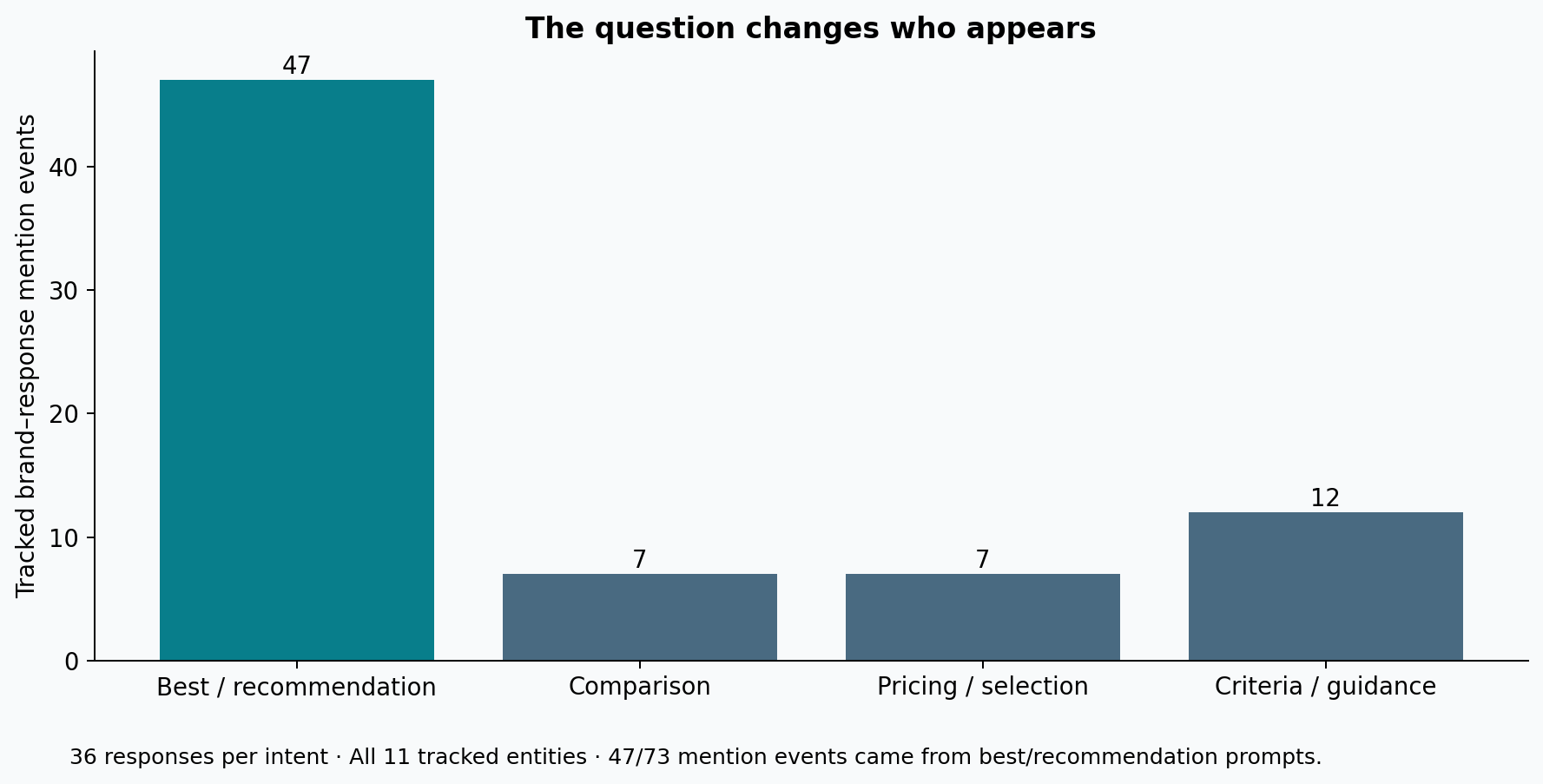
The best/recommendation questions produced 64.38% of candidate mention events, despite accounting for only 25% of responses. The remaining three intent groups produced 26 events across 108 responses.
This is a useful directional observation, but it is not a universal multiplier for GEO. The four prompt groups ask different things. A question about contract criteria may be answered well without naming a vendor. A question about the best agencies practically invites names. Some candidate events are also false positives or source-only matches.
The practical implication is simple: define the kind of visibility you want before judging a score. If your goal is entry into a buying shortlist, test shortlist questions. If your goal is to become a reference for procurement decisions, inspect guidance and pricing sources. A brand can serve one role more strongly than another.
A single average across these roles can conceal the opportunity. This is why AI visibility across engines, languages and intents needs a matrix rather than one impressive-looking percentage.
The released brand tables—and why they require qualification
The following tables reproduce the home-market counts from the entity rows. Each proportion uses 72 local responses as its denominator. The intervals reproduce the Wilson calculation with z = 1.96.
These are released parser counts, not an audited league table of agency quality or genuine narrative recommendations. They are included in full so the article does not hide inconvenient evidence or silently replace the release.
Iran: the released candidate counts
| Registry entity | Candidate mentions | Rate | Descriptive 95% Wilson interval | Recorded recommendations | Target-domain cited responses | Recorded top-1 | Tracked SOV |
|---|---|---|---|---|---|---|---|
| Novin | 12 | 16.67% | 9.80–26.91% | 2 | 0 | 1 | 36.36% |
| Web24 | 11 | 15.28% | 8.75–25.32% | 1 | 0 | 1 | 33.33% |
| Triboon | 7 | 9.72% | 4.79–18.74% | 0 | 7 | 0 | 21.21% |
| InTen | 3 | 4.17% | 1.43–11.55% | 0 | 1 | 0 | 9.09% |
| Dimarketing | 0 | 0.00% | 0.00–5.07% | 0 | 0 | 0 | 0.00% |
The local total is 33, not 34 as stated in the prose of the published results page. The published SOV percentages already correspond to 33. Novin and Web24 account for 23/33 candidate local events, or 69.70%.
Türkiye: the released candidate counts
| Registry entity | Candidate mentions | Rate | Descriptive 95% Wilson interval | Recorded recommendations | Target-domain cited responses | Recorded top-1 | Tracked SOV |
|---|---|---|---|---|---|---|---|
| Zeo Agency | 18 | 25.00% | 16.44–36.09% | 1 | 0 | 0 | 47.37% |
| Webtures | 17 | 23.61% | 15.30–34.60% | 1 | 6 | 1 | 44.74% |
| Roas Digital | 3 | 4.17% | 1.43–11.55% | 0 | 0 | 0 | 7.89% |
| SEM Danışmanlık | 0 | 0.00% | 0.00–5.07% | 0 | 0 | 0 | 0.00% |
| Stradiji | 0 | 0.00% | 0.00–5.07% | 0 | 0 | 0 | 0.00% |
| B2Press | 0 | 0.00% | 0.00–5.07% | 0 | 0 | 0 | 0.00% |
The Turkish local total is 38. Zeo and Webtures account for 35/38, or 92.11% of released candidate local events. That is not 92.11% of Turkish AI recommendations, Turkish agencies or the whole Turkish market. Other agencies appear in the raw prose outside the registry, including Mobitek and others. The registry is a selected cohort, not a census.
The global entity rows also contain one Zeo candidate in an Iranian response and one InTen candidate in a Turkish response. Those two events explain why the all-entity total is 73 while the home-market totals sum to 71. Neither is credible evidence of cross-border brand discovery after inspecting the matching text.
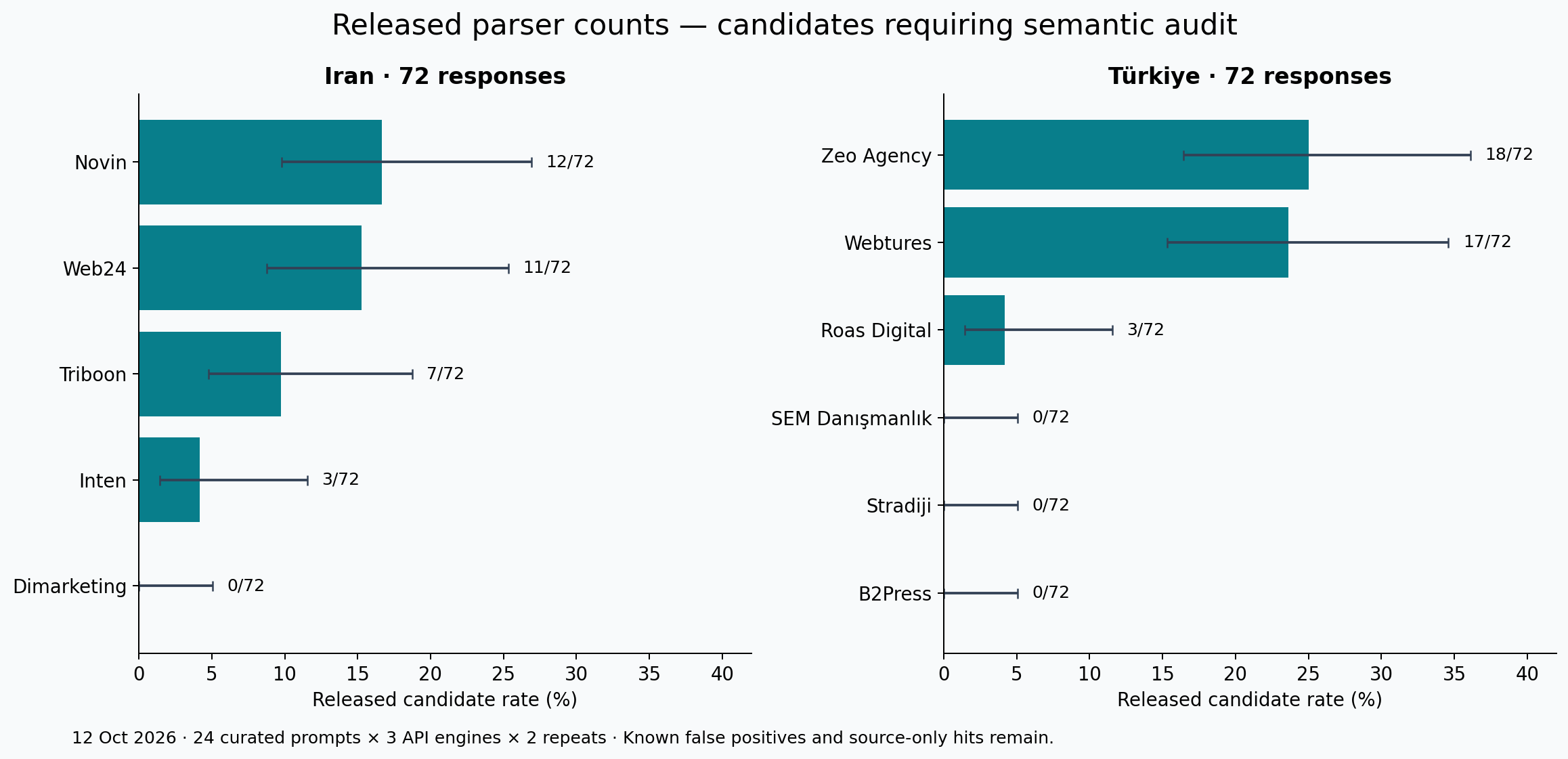
Even without the parser issues, Novin's 12 and Web24's 11 are too close to support a confident winner claim. The same applies to Zeo's 18 and Webtures' 17. Their descriptive intervals overlap substantially. The observations also share prompts and providers, so treating 72 responses as independent random trials would overstate population-level certainty.
Zero means “not detected by this rule in this sample.” It does not mean an agency lacks capability, reputation or future opportunity. The zero-count interval itself extends above zero under the simple binomial model, and that model does not capture all the design uncertainty here.
The second finding: the parser can manufacture visibility
When the evidence behind a score is preserved, you can examine what triggered it. This is where several of the most valuable findings emerged.
InTen versus “search intent”
In prm-reg-ir-010, Perplexity's second run discusses search intent. The released entity scorer marks InTen as mentioned. The Turkish prm-reg-tr-009 OpenAI second run also contains “Search Intent” and receives an InTen flag.
Neither occurrence is a reference to our business.
An additional InTen flag appears on the Persian agency-versus-in-house comparison, although inspection of that answer does not establish a genuine brand reference. The clear evidence for InTen in this run is a source citation to `inten.asia/digital-pr/` in the Persian digital-PR pricing answer. A domain-only anchor is different from a business being named and recommended in narrative prose.
That is a useful source-visibility result. It is not evidence that Turkish buyers are discovering InTen, and it is not a recommendation win.
Roas Digital versus ROAS and Acroas
All three home-market Roas candidate events are problematic:
| Response | Actual matching context | Interpretation |
|---|---|---|
| Turkish e-commerce agency question, OpenAI repeat 1 | ROI and ROAS in a performance-metric sentence | Metric acronym, not Roas Digital |
| Turkish technical-audit question, Gemini repeat 0 | Acroas | A different name, not proof of this registry entity |
| Turkish contract-KPI question, Perplexity repeat 0 | ROAS alongside customer-acquisition metrics | Metric acronym, not an agency mention |
The benchmark registry anticipated acronym confusion in its exclusion list, but the preserved scoring results show that anticipation was insufficient. A declared guardrail must be tested against actual outputs.
Zeo inside a redirect URL
Some Zeo flags are triggered by character sequences in long Google grounding redirect URLs. Those opaque strings are transport identifiers. They are not text in which the assistant recommends Zeo.
The same issue invalidates the apparent Iranian Zeo event. The Turkish Zeo count also includes URL-related artifacts and another flag without a clear narrative name occurrence. Zeo still appears repeatedly and clearly in the Turkish agency answers, but the released total should not be described as a clean measure of prose mentions.
Novin: an adjective and an identity problem
The Persian word «نوین» also means “modern” or “new.” Some released flags occur in phrases about modern tools, technology or frameworks, rather than a company.
There is a second problem. Several clear business-name occurrences refer to Novin Marketing, while the registry bucket is “Novin” associated with novin.com. This article has not established that every such name denotes that exact registry organization. A name family cannot automatically be converted into a verified legal or commercial identity.
Source lists can become “mentions”
GEO-Scope's recorded response text often includes an appended Source list. The prose may never name Webtures or Triboon, yet their domain appears in that list. The released parser sometimes treats that as a mention.
This explains much of the distance between those businesses' candidate mention totals and name occurrences in prose. It also illustrates why citation and narrative mention must remain separate, even when both are valuable.
A conservative text-only sensitivity check
For this article, I ran a second, explicitly narrower screen over all 144 preserved answers. It removes appended source lists, strips URL destinations and domain-only Markdown labels, and searches for bounded brand-name forms in the remaining text. For Novin it requires an agency/name context rather than the adjective alone. For Roas it requires the qualified agency name rather than the metric acronym.
This screen is reproducible in the accompanying code. It is not a replacement semantic gold standard, does not resolve the Novin identity issue, and does not re-score endorsements or prove all missed aliases have been found.
| Home-market entity | Released candidates | Text-only name hits | Interpretation |
|---|---|---|---|
| Novin name family | 12 | 8 | Agency-name occurrences remain; identity must be resolved |
| Web24 | 11 | 11 | Narrative-name presence survives this narrower screen |
| Triboon | 7 | 1 | Most candidate events are source/domain exposure |
| InTen | 3 | 0 | Clear source citation survives separately; no text-only name hit |
| Dimarketing | 0 | 0 | No match under either rule |
| Zeo Agency | 18 | 13 | Repeated narrative presence, with artifacts removed |
| Webtures | 17 | 11 | Narrative presence plus separate source exposure |
| Roas Digital | 3 | 0 | Three candidate events fail the contextual check |
| SEM Danışmanlık | 0 | 0 | No match under either rule |
| Stradiji | 0 | 0 | No match under either rule |
| B2Press | 0 | 0 | No match under either rule |
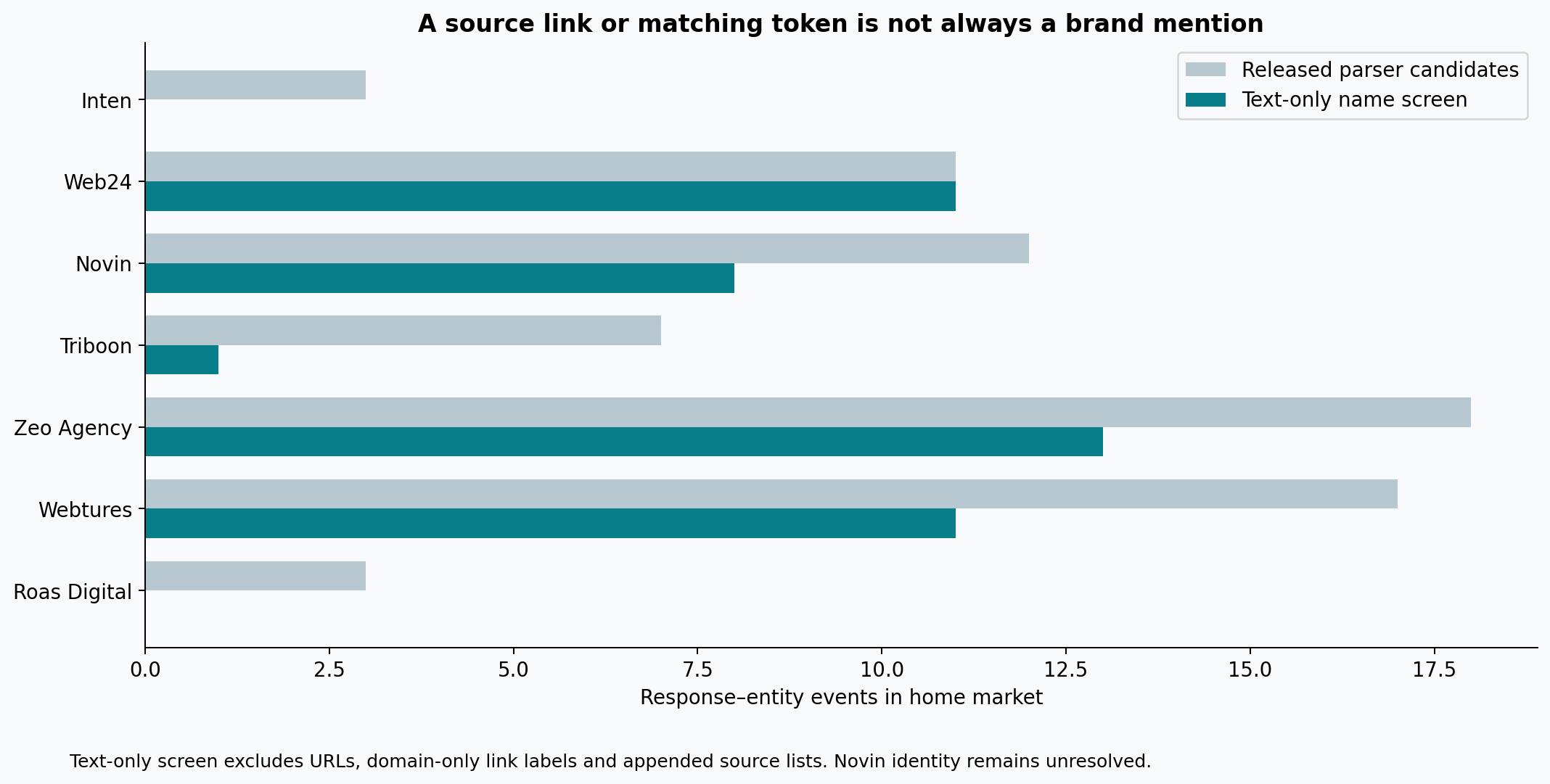
The home-market candidate total is 71; the narrower name screen gives 44. That difference is definition sensitivity, not a blanket claim that all 27 differences are fabricated answers. Some are legitimate citations scored in the wrong conceptual layer. Others are false entity matches. Novin identity ambiguity remains even among the 44.
The resulting headline should never be “these agencies own the market.” The defensible statement is that Zeo and Webtures have repeated narrative presence in these Turkish shortlist questions; Web24 appears repeatedly in the Persian set; source exposure tells a different story; and the registry/scoring rules materially affect the totals.
Recommendations need more scrutiny than a Boolean field
Only five entity–response events are marked recommended: true, all from the OpenAI adapter. They occur in three responses: Persian e-commerce agency selection, Persian technical-audit selection, and Turkish technical-audit selection.
That is a property of the released extraction rules. It does not establish that Gemini or Perplexity never recommended agencies. Their raw answers contain shortlist-like language and proposed options. Conversely, one recorded Novin recommendation is associated with a response in which the detected Persian word is used adjectivally, so it should not be accepted as a verified endorsement of the registry entity.
There is also a position problem. In the first Persian e-commerce answer, the recorded Novin rank is 1, although the raw answer lists other agencies before it. A parser may attach a number from a later summary or nearby list to the wrong entity. A top1 field is therefore not automatically a trustworthy commercial position.
The correct next step is to annotate recommendation spans and their corresponding entities, then validate precision and recall independently. This article reports the original five flags for completeness; it does not promote them into a verified recommendation rate or use them to declare an engine winner.
The third finding: 2,291 citation records are not 2,291 independent sources
The release advertises 2,291 citations. The raw arrays do contain 2,291 URL occurrences. But counting the same link repeatedly is different from counting distinct URLs or publishers.
| Counting rule | Recomputed total | Meaning |
|---|---|---|
| All URL occurrences in citation arrays | 2,291 | Repeated records included |
| Unique URL–response pairs | 1,570 | Same URL counted once within each response |
| Globally distinct exact URL strings | 1,013 | Exact-string deduplication across the whole run |
| Google grounding redirect occurrences | 944 | Opaque redirect records, not 944 identified publishers |
These distinct strings include redirect URLs. We have not resolved every redirect to its destination, normalized every canonical URL or independently checked the factual support of every cited page. “Zero hallucinated sources” and “100% verified factual claims” are not established by these counts. Hashes confirm file integrity, not truth.
The study contains 1,183 URL occurrences in the Persian responses and 1,108 in the Turkish responses. Globally deduplicated exact strings by market number 549 and 471 respectively; their sum exceeds 1,013 because some strings occur in both markets.
Source frequency changes when duplicates are removed
The following examples use raw URL occurrences and the number of responses containing a domain at least once. Google redirect records are shown separately rather than called a publisher.
| Market | Domain | URL occurrences | Responses containing domain |
|---|---|---|---|
| Iran | iranweblife.com | 21 | 9 |
| Iran | miladjalayi.com | 14 | 8 |
| Iran | frac.tl | 14 | 2 |
| Iran | demandsage.com | 12 | 2 |
| Iran | triboon.net | 12 | 7 |
| Iran | virgool.io | 11 | 9 |
| Iran | setare.com | 11 | 6 |
| Iran | seodo.agency | 10 | 4 |
| Iran | ensun.io | 9 | 3 |
| Türkiye | agencies.semrush.com | 22 | 8 |
| Türkiye | edvido.com | 16 | 6 |
| Türkiye | pr.net.tr | 16 | 6 |
| Türkiye | prix-studio.com | 14 | 9 |
| Türkiye | ranktracker.com | 13 | 5 |
| Türkiye | onuruzunonline.com | 12 | 1 |
| Türkiye | habergazetesi.com.tr | 12 | 7 |
| Türkiye | indigodergisi.com | 11 | 3 |
| Türkiye | publicus.com.tr | 10 | 8 |
All frequencies are recomputed from preserved citation arrays. The complete domain ledger is included in the accompanying data files. Domain frequency does not classify page independence, editorial reliability or commercial influence.
A page used repeatedly within one long answer can look more important under occurrence counting than under response-level counting. Both are legitimate descriptive measures if labeled accurately. Neither proves that obtaining a placement on the domain will cause a recommendation.
Why the source ecosystem still matters
The Turkish answers include agency-discovery and comparison environments such as Semrush's agency directory and Edvido. Persian answers include business-authored agency lists, specialist material, publishing platforms and digital-PR content, including Iran Web Life and Triboon.
This supports a practical research direction: inspect the sources your buyers' questions actually produce. It does not justify calling every list “independent,” every publication “authoritative” or every source “earned media.” An agency-owned list may include competitors while still serving the owner's commercial interests. Domain labels alone cannot resolve that issue.
Some recorded answers also import international pricing and practices into a local discussion. In the Persian agency-versus-in-house response, international dollar figures are used alongside an Iran-oriented explanation. In one Turkish pricing answer, GEO is interpreted partly as geographic/local optimization rather than Generative Engine Optimization.
These are observed examples of localization and meaning drift. They are not measured prevalence estimates for all 144 answers. They remind us that a locally phrased question does not guarantee a locally valid answer. Before a buyer acts on a price, capability or agency claim, the underlying source needs checking.
The fourth finding: engines differ, but more links do not mean better answers
| Recorded API adapter | Responses | URL occurrences | Exact distinct URL strings | Unique URL–response pairs | Mean latency | Median latency | Candidate mentions |
|---|---|---|---|---|---|---|---|
OpenAI search-enabled API, gpt-4o | 48 | 344 | 137 | 177 | 21.10 s | 15.68 s | 23 |
Gemini grounding API, gemini-2.5-flash | 48 | 944 | 390 | 390 | 18.13 s | 13.25 s | 26 |
Perplexity API, sonar-pro | 48 | 1,003 | 502 | 1,003 | 8.07 s | 6.21 s | 24 |
Latency is measured by the benchmark's recorded request timing. It may include adapter, network and retry effects. It is not a universal speed rating of these products.
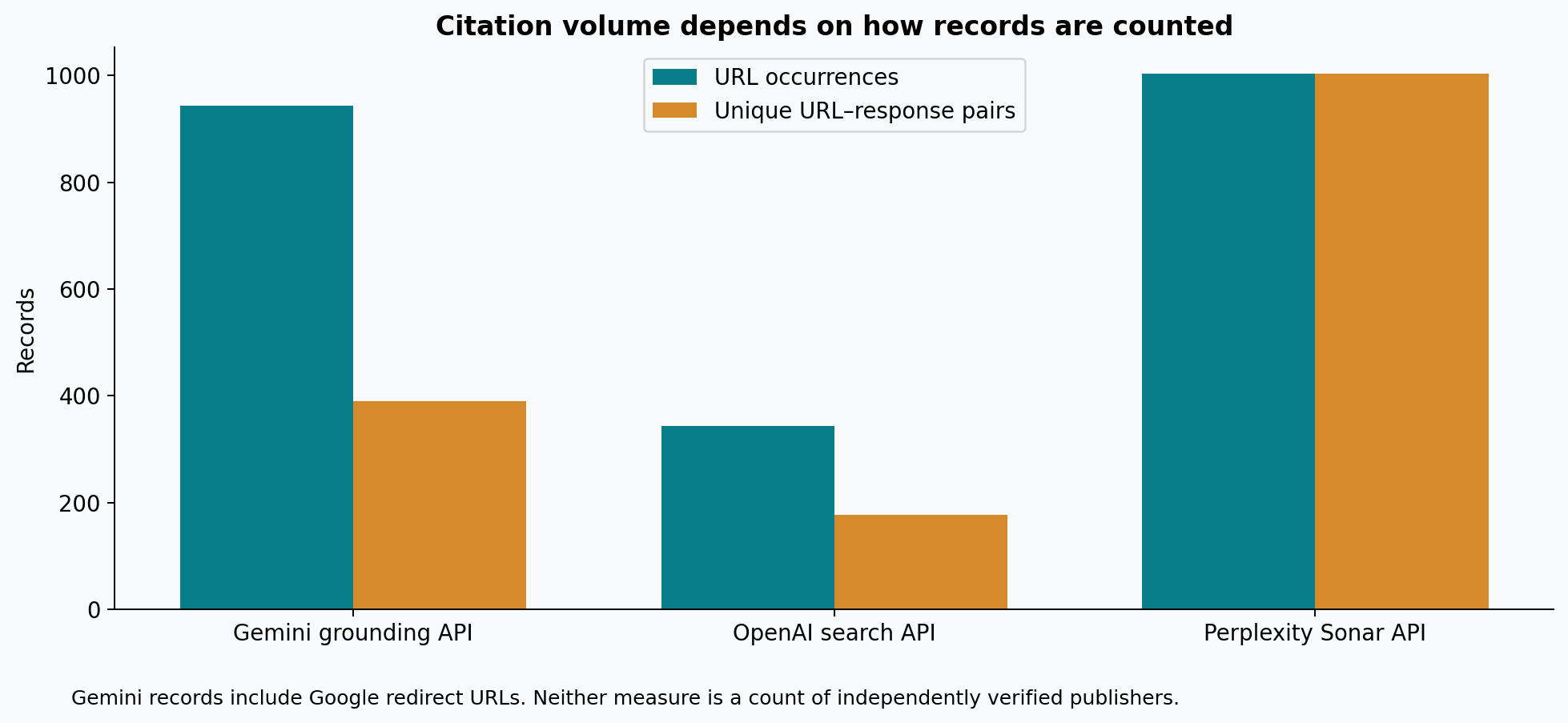
Perplexity returned the largest citation-array total and had the lowest mean latency in this run. Gemini's citation strings were Google grounding redirects; its 944 occurrences reduce to 390 unique URL–response pairs. OpenAI's repeated links similarly reduce from 344 occurrences to 177 pairs.
The differences tell us about the recorded outputs and their representation. They do not rank factual accuracy, source diversity after redirect resolution, business value or likelihood of conversion. A shorter answer with one well-supported reference can be more useful than a longer answer with repeated links.
Brand patterns differ by engine
The table below breaks down released candidate mentions in each brand's home market. Each cell has 24 local responses as its denominator. Apply the parser qualifications above.
| Entity | OpenAI | Gemini | Perplexity |
|---|---|---|---|
| InTen | 2 | 0 | 1 |
| Web24 | 2 | 6 | 3 |
| Novin bucket | 6 | 6 | 0 |
| Triboon | 1 | 0 | 6 |
| Dimarketing | 0 | 0 | 0 |
| Zeo Agency | 6 | 8 | 4 |
| Webtures | 4 | 4 | 9 |
| Roas Digital | 1 | 1 | 1 |
| SEM Danışmanlık | 0 | 0 | 0 |
| Stradiji | 0 | 0 | 0 |
| B2Press | 0 | 0 | 0 |
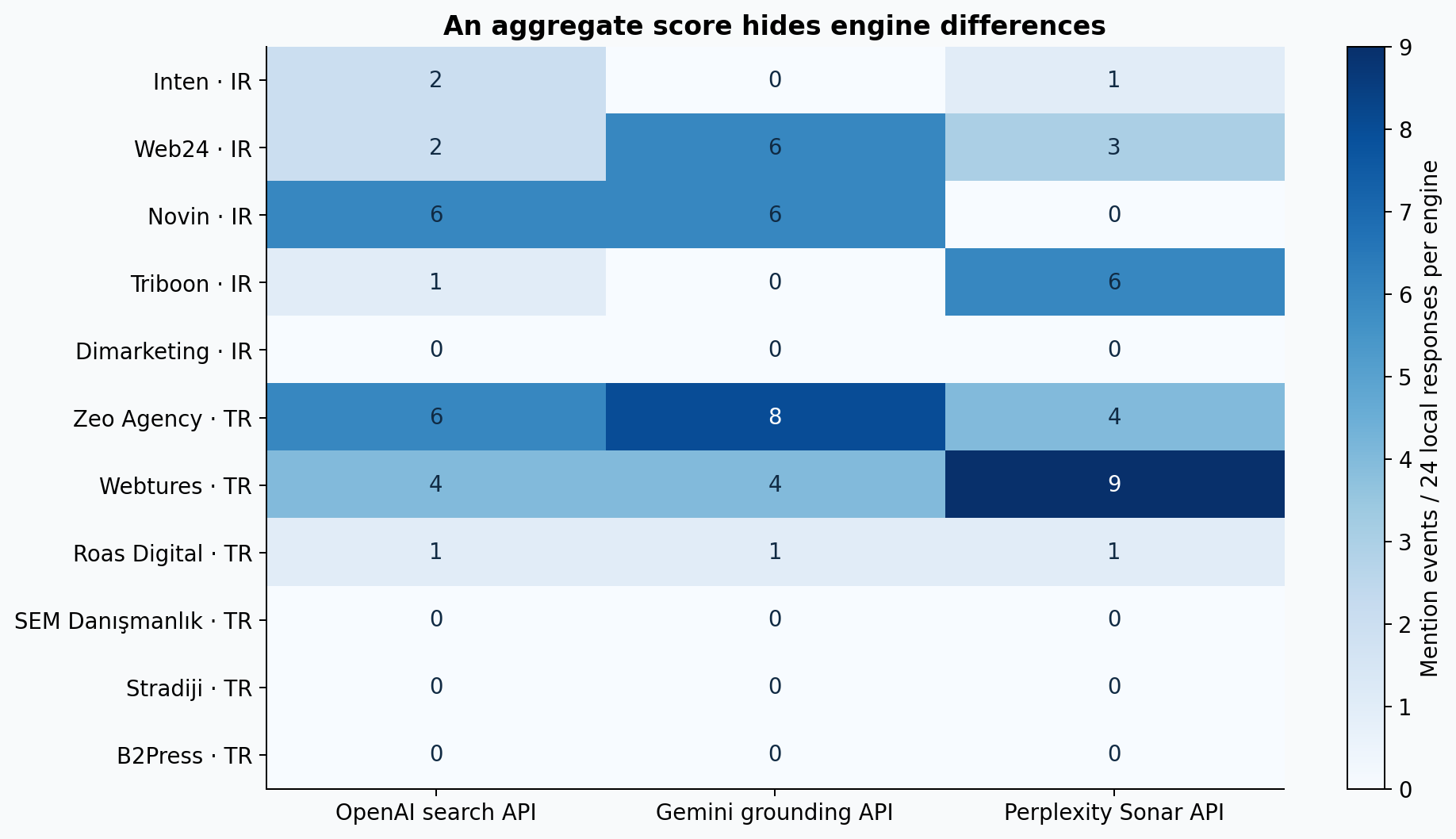
Triboon's Perplexity pattern is largely source exposure. Novin's bucket has name and identity ambiguity. Roas's balanced-looking row is made entirely of problematic matches. This is exactly why a neat heatmap should never substitute for inspecting evidence.
For a business, the next investigation should ask: which exact questions produced a genuine name mention, which produced a source link, and which produced an unsupported score? You improve a concrete information gap, not an aggregate color on a dashboard.
The cost figure is reported, not reconciled
The summary declares a run cost of $2.16 against a $10 ceiling. The configuration's pre-run estimate is $2.64. However, all 144 raw response records have provider_reported_cost: null and cost_status: unreported. The gateway payloads do preserve estimated_cost.unit values: their sums are 3.762795 for OpenAI, 1.75278189 for Gemini and 0.89638 for Perplexity, totaling 6.41195689 units. Those gateway estimates are not a reconciled invoice, and their billing-unit semantics should be documented before treating them as dollar charges; they do not reconcile the summary’s $2.16 claim.
Consequently, $2.16 should be labeled summary-reported cost, not a independently reconciled invoice total. The arithmetic $2.16/144 = $0.015 per response is valid only conditional on accepting that summary value. It is not the cost per one of the 1,584 entity rows, and it excludes any unrecorded setup, engineering, review or publication effort.
The fifth finding: two runs do not always tell the same story
For each of the 24 prompts and three engines, I compared the set of entities flagged in repeat 0 with the set flagged in repeat 1. That creates 72 repeat pairs.
| Repeat comparison over released candidate sets | Result |
|---|---|
| Same candidate entity set | 50/72 pairs, 69.44% |
| Different candidate entity set | 22/72 pairs, 30.56% |
| Empty set in both runs | 38/72 pairs, 52.78% |
| Pairs with at least one candidate in either run | 34 |
| Mean Jaccard overlap among those 34 nonempty pairs | 0.4412 |
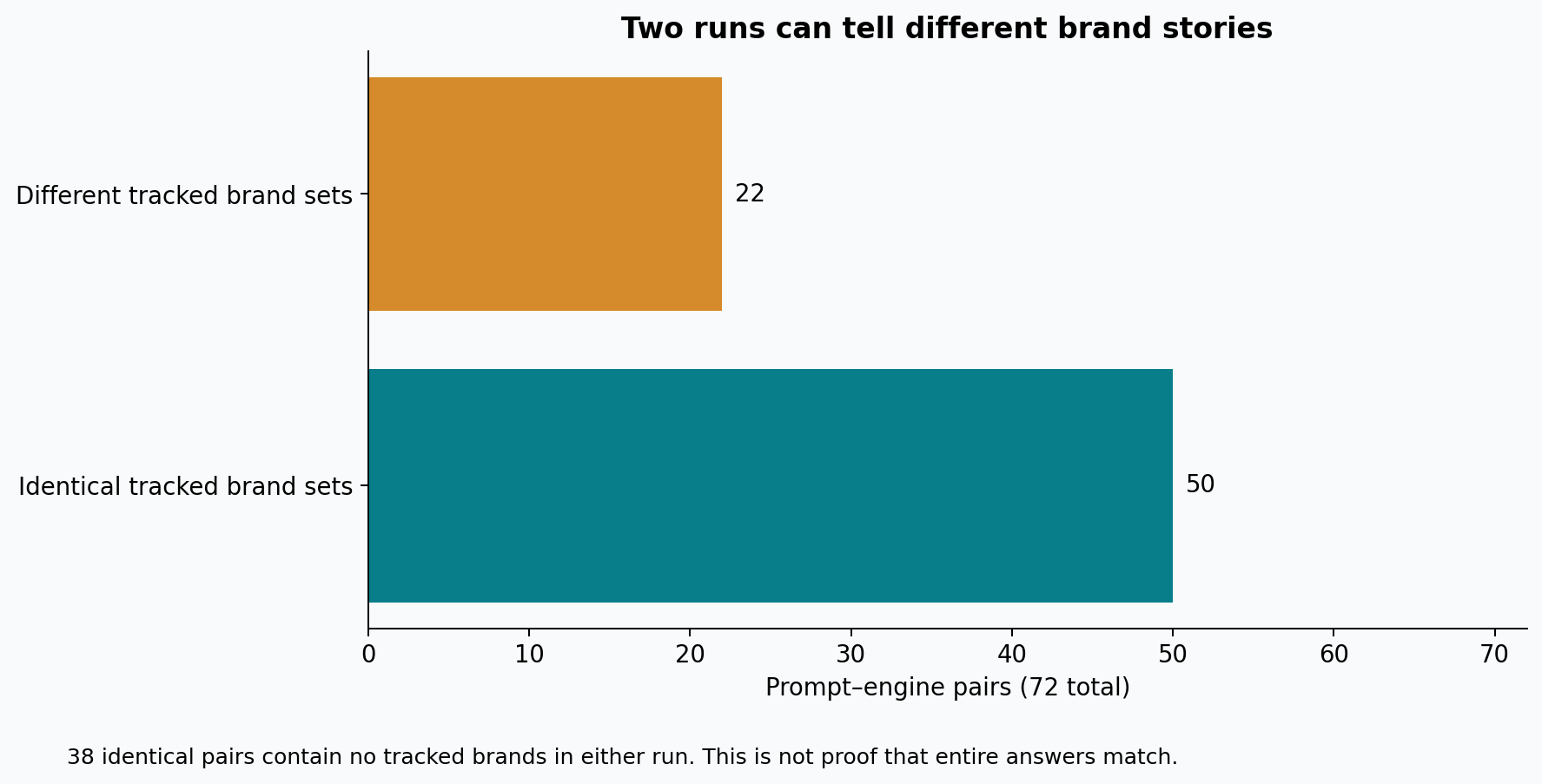
The Jaccard calculation divides the number of shared candidate entities by the number appearing in either run. A value of 1 means the sets match; 0 means they have no shared entity. Empty–empty pairs are excluded from the reported mean so they do not manufacture a reassuring similarity score.
This is an article-level diagnostic of the released parser output. False positives affect it, and it does not measure whole-answer similarity, recommendation stability or exact-source stability. Two responses can flag the same brand set and still give very different reasons, prices or advice.
It nevertheless demonstrates why one screenshot cannot carry a commercial claim. A business that appears once has not acquired a permanent place in an engine. To assess durability, we need more repeated runs over longer periods, with stable scoring definitions and prompt-level reporting.
What the broader GEO evidence adds—and where comparison stops
This benchmark drew inspiration from Peak Ace's LLM Industry Benchmark 2026, published on October 8. The official article describes 1,000 commercial prompts across ten industries in Germany, measured during August 2026, with five runs per system across Gemini, ChatGPT and Google AI Overviews.
That is different from the description in parts of our regional methodology, which attributes other markets and engines to the reference study. For comparison, the reference study's own current methodology takes precedence.
The useful connection is its intent-based approach and its observation that retrieved source formats vary with both question and industry. Its publication also separates retrieval from final-answer citation and warns against treating source formats as causal ranking factors.
Our two-market sample provides a complementary regional view. It cannot reproduce Peak Ace's percentages or support a universal rule that third-party lists always beat a brand's own pages. The defensible generalization is narrower: map the source mix for your own category and buyer questions; keep retrieval, citation and recommendation separate.
Earlier GEO-Scope benchmarks teach an instrumentation lesson
I also checked the earlier release files rather than treating their README descriptions as interchangeable results.
| Earlier release | Questions | Successful completions in metrics | Error records in metrics | Citation records in metrics | Why it should remain separate |
|---|---|---|---|---|---|
global-ai-answers-2026.1 | 34 | 74 | 62 | 0 | Mixed provider classes; incomplete execution |
global-ai-answers-2026.2-pilot | 100 | 202 | 198 | 0 | Pipeline pilot across broader countries and topics |
global-ai-answers-2026.2 | 500 | 626 | 1,374 | 0 | Broad human-concern sample; extensive missingness |
geo-seo-digital-agency-iran-2026.1 | 30 | 51 | 69 | 0 | Its metrics classify all 51 successes as fallback |
Source: the versioned `metrics.json` files under [GEO-Scope benchmark releases](https://github.com/tmolavi/geo-scope/tree/main/benchmark/releases). These counts describe those artifacts, not a fresh validation of all their raw responses.
These are not samples to pool with the 144 October answers. Their topics, providers, scoring, missingness and execution classes differ. In particular, the older Iranian agency release's much higher displayed mention rates cannot establish a decline to October's lower rates. That would compare different instruments and incomplete execution populations.
The useful inference is methodological: coverage and execution class belong beside visibility. Zero captured citations may indicate a capture or grounding issue; it does not prove an engine used no external information. A provider name alone does not prove an execution mode. A planned run count does not equal a successful run count.
There is operational progress in preserving a complete 144-record matrix and native search-call evidence in the regional release. There is also a clear remaining task: repair semantic extraction and reporting consistency before using the results for high-stakes agency comparisons.
How this fits MAVI and the Molavi GEO Pyramid
The Molavi AI Visibility Index, or MAVI, distinguishes structural readiness from observed visibility. The Molavi GEO Pyramid gives a way to organize accessibility, extractability, entity clarity, source use and measured outcomes.
This experiment belongs on the observed side. We did not perform a matched technical audit of all eleven websites, quantify their content structures or change their schema in a controlled intervention. We therefore cannot say a particular readiness feature caused a mention.
What the evidence supports is the usefulness of keeping the layers separate. Triboon's source links are a different result from Web24's repeated prose-name occurrences. InTen's citation is a different result from a recommendation. A generic word matching an entity is not observed brand authority.
The experiment is compatible with MAVI's measurement discipline. It does not independently validate every weight, causal interpretation or example statistic in the broader framework. Nor does this article reuse the site's separate 250-query example matrix as evidence for the 144-response regional run.
For teams working with the framework, the practical roles are clear: AnswerPath GEO helps organize the questions; SAGE examines readiness; GEO-Scope records responses; a validated scoring layer interprets them. The loop ends with another measurement, not with a readiness score presented as a guarantee.
A practical GEO strategy suggested by this evidence
The following steps are operational proposals informed by the benchmark. Their commercial effect was not tested in this experiment.
1. Start with the customer's decision
Write down the problems a buyer asks before knowing your name. Include shortlist, comparison, pricing and contract questions. Keep real customer questions separate from researcher-written templates. This study's 24 templates are useful examples; they do not replace research into your own demand.
Do not give every prompt the same business value automatically. A generic educational question and a high-intent procurement question can require different outputs and budgets. Preserve the original wording when remeasuring, and add new questions as a separate cohort.
2. Make the brand unambiguous
Store official names, qualified names, domains, aliases and exclusion rules. Include negative cases such as a metric acronym or a common word. Distinguish Novin from Novin Marketing unless their relationship is independently resolved. Do not infer a brand from a random URL token.
Entity clarity on your website may help readers and retrieval systems, but the immediate evidence here concerns measurement clarity. A good registry is still useless if the parser scans the wrong text fields or ignores word boundaries.
3. Publish information that answers the actual procurement question
An enterprise buyer needs scope, deliverables, constraints, examples and evidence. A pricing buyer needs a clear explanation of what changes the cost. A technical-audit buyer needs to understand what will be inspected and what the deliverable contains.
Use independently verifiable cases when available. Show dates, definitions and actual limitations. These are useful editorial practices; this dataset did not test their causal effect on AI visibility.
4. Inspect relevant third-party coverage and source pages
Review the pages actually returned for your questions. Find inaccurate descriptions, outdated facts, unclear relationships or missing evidence. Contribute information a publisher can verify. Disclose paid placements rather than presenting purchased publicity as independent evaluation.
Citation frequency is a research lead, not a command to buy links on the most frequent domain. A page can be repeated because of one answer's structure, and the cited owner may never enter the shortlist.
5. Monitor outcomes in separate columns
For every prompt and engine, store narrative mentions, source citations, recommendation spans, positions and errors separately. Record exact versions and execution dates. Keep raw evidence so a future parser fix can replay the same responses without pretending a new live run occurred.
The concept discussed in citation selection versus absorption is a useful next measurement direction. This release does not include validated claim-to-source alignment sufficient to calculate a factual absorption ratio. Do not invent one from link counts.
6. Validate the scorer before increasing scale
Create a human-annotated sample with positive and negative examples in both languages. Report false positives and missed matches. Evaluate recommendations separately from names and domains. A 20-record spot check can miss rare but systematic failures, especially when those failures attach to short brand names.
The release reports 20/20 manual QA matches. This article did not independently reconstruct the original annotation process, and the matching errors above show that the claim must not be read as 100% accuracy over the entire dataset.
7. Repeat with a design that answers the next question
To test change over time, keep a frozen prompt cohort and track it repeatedly. To test a content intervention, define what changed, record a baseline, choose comparison prompts or entities, and observe more than one post-change run. To assess a wider market, expand the registry and questions deliberately.
A hundred additional questions can broaden coverage, but only if their provenance, strata and scoring remain coherent. Scaling an ambiguous parser simply produces more ambiguous numbers.
What we can generalize today
Three principles travel beyond Iran and Türkiye more safely than the brand percentages do.
First, visibility depends on the question being asked. The business role of a mention must be interpreted in context. A shortlist question and a contract-guidance question create different opportunities.
Second, source presence and commercial selection are different outcomes. A domain can supply information without its business being recommended. A source list should not be converted into narrative mindshare.
Third, an AI benchmark is only as credible as its evidence and scoring definitions. False matches, redirects, repeated citations and denominator choices can create an apparently precise result that answers the wrong question.
These principles are supported by concrete examples here and are useful hypotheses for other categories. We cannot generalize the measured percentages, the apparent country concentration, the latency values or the reported cost to unrelated industries and future dates.
Why tomorrow's answer may be different
An answer can change because the engine, its retrieval configuration, available pages, query interpretation or generation changes. A corrected entity registry can also change the score while the original answer stays exactly the same.
That last distinction matters. There are two different kinds of movement: a business becomes more visible in new answers, or a measurement system becomes better at recognizing what was already there. A dashboard must not merge the two.
The October run provides a dated baseline with raw evidence. Two same-window repeats give a limited look at variation. They do not estimate how stable these patterns will be next week, after a model update or in a consumer session with location and history.
When this benchmark is repeated, the new results should appear as a new version. The current evidence should remain accessible, and any scoring correction should state whether it is a replay or a fresh observation. That is how research accumulates instead of turning into a succession of unexplained screenshots.
The conclusion: earn a place in the answer—and demand a valid measurement
For a business owner, the important question is whether a relevant buyer can discover, evaluate and trust the company through an AI-assisted decision. A generic “AI knows my brand” response does not answer it.
This regional benchmark gives us the questions, the response evidence and the beginnings of a source map. It also shows how easy it is for a scoring layer to confuse a business with a word, a metric or a URL fragment.
I would rather publish that uncomfortable finding than hide it behind an impressive total. The source citation to our own InTen page is worth reporting. An apparent mention manufactured from “search intent” is worth correcting.
The work ahead is practical: ask better buyer questions, maintain clear entity identities, publish useful evidence, examine the actual sources, and validate every layer of measurement. Then run the experiment again.
Tomorrow's answer may change. A transparent method lets us understand what changed—and whether the change is real.
The full prompt set, original responses, scoring records and checksum file are available in the [public regional dataset](https://github.com/tmolavi/geo-scope/tree/main/benchmarks/regional-commercial-intent-2026.1). For the conceptual distinction between preparation and observed performance, read [MAVI](https://molavi.pro/research/mavi). For implementation notes, see [how to measure AI visibility](https://molavi.pro/notes/how-to-measure-ai-visibility).
Research transparency and provenance
This is first-party analysis by the creator of GEO-Scope and founder of a registry-listed business, InTen. It is not an independent endorsement of the tool or an external quality assessment of the agencies. The original benchmark files were inspected at commit 4adef3ada9bb5ccf0eea05fa5b4bae3f45637706. No repository files or live websites were changed while producing this article.
The accompanying code recalculates record counts and descriptive statistics from the frozen files. It adds a text-only sensitivity screen; it does not claim a complete semantic reannotation. Reported name counts inherit identity and alias limitations. Domain citations remain separate from names. Source-link presence is not proof of source factual correctness.
| Release inconsistency or limitation | Treatment in this article |
|---|---|
| Results prose says 34 Iranian mentions | Recomputed home-market candidate total is 33 |
| Results intent table differs from raw rows and summary | Article uses recomputed 47/7/7/12 candidate events and 663/582/556/490 URL occurrences |
| Results latency values differ from raw files | Article uses recorded means 21.10/18.13/8.07 seconds |
| Citation total described as unique/verified | Article distinguishes occurrences, exact URL strings and unresolved redirects |
| All records flagged grounded despite inconsistent per-answer evidence | Article reports 112 citation-bearing answers, 32 without captured citations, and only 21 OpenAI search-call payloads |
| OpenAI requests use US location | Market labels describe language/topic, not physical-location measurements |
| Entity aliases create false matches | Original counts preserved; context errors and narrower screen disclosed |
| Source-list domains counted as mentions | Text-only screen separates them from prose name exposure |
| Recommendation and rank flags need validation | Reported as extraction flags, not verified endorsements or rankings |
| Summary reports $2.16; raw costs are unreported | Labeled summary-reported, not invoice-reconciled |
limitations.md retains a NOT_RUN preparation header | Execution status grounded in raw records and current summary, while substantive limitations remain applicable |
| Reference-study description differs from Peak Ace's current publication | Uses the reference's own stated German-market methodology |
| Manifest's creation date predates execution | Uses recorded October 12 response window for measurement date |
| 20/20 QA reported in summary | Not treated as proof of dataset-wide accuracy |
| “First at this scale” wording in repository | Not repeated; a systematic novelty review was not performed |
Source and further-reading ledger
- Regional dataset at the inspected commit: controlling source for this article's run, prompts and original results.
- Raw response file: response text, citations, timing and execution payloads.
- Entity observations: source of released parser candidate counts and flags.
- Prompt catalog: exact questions and research-question provenance.
- Benchmark methodology: design intent, definitions and statistical boundaries.
- Peak Ace's LLM Industry Benchmark 2026: separately sourced methodological context; no pooled percentages or causal inference.
- MAVI: author's conceptual measurement framework, not independent validation of this experiment.
- GEO versus AI Visibility: conceptual definitions.
- Citation selection and absorption: further reading on source use; no absorption metric calculated here.
- Earlier GEO-Scope releases: separate historical datasets, not a combined longitudinal sample.
Suggested citation: Molavi, T. (2026, October 12). Who Does AI Recommend? An Iran–Türkiye GEO Benchmark—and the Measurement Traps Behind the Numbers. Analysis of GEO-Scope `regional-commercial-intent-2026.1`, source commit `4adef3a`.
Appendix A. Every question, original wording and prompt-level interpretation
All questions below are curated research questions. English renderings are explanatory translations, not additional measured prompts. Each question has six responses: three engines × two repeats. Candidate counts may include multiple entities in one response and retain released-parser limitations. “No tracked candidate” does not mean the answer contains no businesses outside the registry.
prm-reg-ir-001 · best recommendation
Original (IR): بهترین آژانسهای سئو در ایران برای وبسایتهای بزرگ فروشگاهی کدامند؟
English rendering: Which are the best SEO agencies in Iran for large e-commerce websites?
| Responses | URL occurrences | Candidate mention events | Responses with a candidate | Recorded recommendation events | Candidate entities (counts) |
|---|---|---|---|---|---|
| 6 | 103 | 8 | 6 | 1 | novin:4; web24:4 |
Interpretation: All six responses flag at least one tracked entity. This shortlist-style wording exposes local agency names, but its Novin rank and identity flags need review.
prm-reg-ir-002 · best recommendation
Original (IR): کدام شرکتها در ایران خدمات بهینهسازی برای موتورهای هوش مصنوعی (GEO) ارائه میدهند؟
English rendering: Which companies in Iran provide Generative Engine Optimization (GEO) services?
| Responses | URL occurrences | Candidate mention events | Responses with a candidate | Recorded recommendation events | Candidate entities (counts) |
|---|---|---|---|---|---|
| 6 | 106 | 3 | 2 | 0 | novin:2; web24:1 |
Interpretation: Only two of six responses flag tracked candidates despite 106 URL occurrences. Many named businesses can fall outside the selected registry; this is not evidence that Iran has only two GEO providers.
prm-reg-ir-003 · best recommendation
Original (IR): برترین ارائهدهندگان خدمات ممیزی تکنیکال سئو برای کسبوکارهای سازمانی در ایران چه کسانی هستند؟
English rendering: Who are the top providers of technical SEO audits for enterprise businesses in Iran?
| Responses | URL occurrences | Candidate mention events | Responses with a candidate | Recorded recommendation events | Candidate entities (counts) |
|---|---|---|---|---|---|
| 6 | 94 | 9 | 5 | 2 | web24:5; novin:4 |
Interpretation: Five responses flag candidates, mostly Web24 and the Novin bucket. Technical specialization is a productive shortlist topic; a generic Persian adjective also contaminates one Novin event.
prm-reg-ir-004 · comparison
Original (IR): تفاوت خدمات سئوی سنتی با مشاورههای بهینهسازی برای جستجوی هوش مصنوعی چیست و کدام به صرفهتر است؟
English rendering: How do traditional SEO services differ from AI search optimization consulting, and which is more cost-effective?
| Responses | URL occurrences | Candidate mention events | Responses with a candidate | Recorded recommendation events | Candidate entities (counts) |
|---|---|---|---|---|---|
| 6 | 105 | 0 | 0 | 0 | none |
Interpretation: No tracked candidates appear under the released rules, although citations are plentiful. A service-paradigm comparison can be answered without selecting an agency.
prm-reg-ir-005 · comparison
Original (IR): مقایسه عملکرد آژانسهای سئوی تخصصی سازمانی با تیمهای اختصاصی داخلی در ایران
English rendering: Compare specialist enterprise SEO agencies with dedicated in-house teams in Iran.
| Responses | URL occurrences | Candidate mention events | Responses with a candidate | Recorded recommendation events | Candidate entities (counts) |
|---|---|---|---|---|---|
| 6 | 92 | 3 | 2 | 0 | web24:1; novin:1; inten:1 |
Interpretation: The release flags Web24, Novin and InTen. The InTen evidence does not survive the text-only check. International pricing figures also appear in a local-market discussion; their local validity was not established.
prm-reg-ir-006 · comparison
Original (IR): مقایسه ابزارهای بومی و بینالمللی برای سنجش سهم مدل و دیدهشدن برند در موتورهای هوش مصنوعی
English rendering: Compare local and international tools for measuring share of model and brand visibility in AI engines.
| Responses | URL occurrences | Candidate mention events | Responses with a candidate | Recorded recommendation events | Candidate entities (counts) |
|---|---|---|---|---|---|
| 6 | 93 | 1 | 1 | 0 | novin:1 |
Interpretation: The lone Novin candidate comes from a generic modern-framework context. Tool-comparison prompts also name products beyond the agency registry, so this cohort is poorly suited to measuring tool discovery.
prm-reg-ir-007 · pricing vendor selection
Original (IR): تعرفه و مدلهای قیمتگذاری قراردادهای سالانه سئو و بازاریابی مبتنی بر هوش مصنوعی در ایران چگونه تعیین میشود؟
English rendering: How are fees and pricing models for annual SEO and AI-based marketing contracts determined in Iran?
| Responses | URL occurrences | Candidate mention events | Responses with a candidate | Recorded recommendation events | Candidate entities (counts) |
|---|---|---|---|---|---|
| 6 | 128 | 0 | 0 | 0 | none |
Interpretation: No tracked agency candidates are recorded, while URL volume is the highest among Persian prompts. Pricing information can be sourced without introducing the tracked agency names.
prm-reg-ir-008 · pricing vendor selection
Original (IR): هزینه اجرای کمپینهای روابط عمومی دیجیتال و رپورتاژ آگهی برای تقویت اعتبار برند در موتورهای جستجو چقدر است؟
English rendering: How much do digital PR and advertorial campaigns cost when intended to strengthen brand credibility in search engines?
| Responses | URL occurrences | Candidate mention events | Responses with a candidate | Recorded recommendation events | Candidate entities (counts) |
|---|---|---|---|---|---|
| 6 | 123 | 4 | 3 | 0 | inten:1; triboon:3 |
Interpretation: This is the clear InTen source-citation case and the sole Triboon narrative-name case under the narrower screen. Citations and pricing explanation should remain separate from endorsements.
prm-reg-ir-009 · pricing vendor selection
Original (IR): چگونه یک پیمانکار مطمئن برای ممیزی سئوی فنی و مشاوره استراتژیک جستجو در بازار ایران انتخاب کنیم؟
English rendering: How should we select a reliable contractor for technical SEO auditing and strategic search consulting in Iran?
| Responses | URL occurrences | Candidate mention events | Responses with a candidate | Recorded recommendation events | Candidate entities (counts) |
|---|---|---|---|---|---|
| 6 | 94 | 0 | 0 | 0 | none |
Interpretation: No tracked candidates are recorded. The response may still answer vendor-selection criteria; zero agency names is not an answer-quality failure.
prm-reg-ir-010 · criteria guidance
Original (IR): چه معیارهایی را باید پیش از عقد قرارداد با شرکتهای سئو و بازاریابی جستجو در ایران ارزیابی کرد؟
English rendering: Which criteria should we evaluate before signing a contract with SEO and search marketing companies in Iran?
| Responses | URL occurrences | Candidate mention events | Responses with a candidate | Recorded recommendation events | Candidate entities (counts) |
|---|---|---|---|---|---|
| 6 | 78 | 1 | 1 | 0 | inten:1 |
Interpretation: The single InTen candidate is the phrase search intent, not the business. This prompt is a useful negative test for entity parsing.
prm-reg-ir-011 · criteria guidance
Original (IR): شاخصهای کلیدی برای سنجش آمادگی وبسایت جهت حضور و پیشنهاد شدن در پاسخهای هوش مصنوعی چیست؟
English rendering: What are the key indicators of website readiness to appear and be recommended in AI answers?
| Responses | URL occurrences | Candidate mention events | Responses with a candidate | Recorded recommendation events | Candidate entities (counts) |
|---|---|---|---|---|---|
| 6 | 89 | 3 | 3 | 0 | zeo:1; triboon:2 |
Interpretation: Two Triboon source events and a Zeo URL-token artifact produce three candidates. Guidance can create source exposure while opaque links create false cross-market impressions.
prm-reg-ir-012 · criteria guidance
Original (IR): مهمترین فاکتورها در سنجش اثربخشی خدمات روابط عمومی آنلاین بر سئو و سیگنالهای اعتبار برند چیست؟
English rendering: Which factors matter most when evaluating online PR effects on SEO and brand credibility signals?
| Responses | URL occurrences | Candidate mention events | Responses with a candidate | Recorded recommendation events | Candidate entities (counts) |
|---|---|---|---|---|---|
| 6 | 78 | 2 | 2 | 0 | triboon:2 |
Interpretation: Both candidates are Triboon source-domain events; the text-only screen gives no agency-name occurrence here. This is a source-role result, not an agency shortlist.
prm-reg-tr-001 · best recommendation
Original (TR): Türkiye'de büyük ölçekli e-ticaret siteleri için en iyi SEO ajansları hangileridir?
English rendering: Which are the best SEO agencies in Türkiye for large-scale e-commerce websites?
| Responses | URL occurrences | Candidate mention events | Responses with a candidate | Recorded recommendation events | Candidate entities (counts) |
|---|---|---|---|---|---|
| 6 | 96 | 12 | 6 | 0 | zeo:6; webtures:5; roas:1 |
Interpretation: Zeo is named in all six responses; Webtures is named in five. The Roas candidate is the ROAS metric. This is the most consistent named-brand discovery case in the Turkish sample.
prm-reg-tr-002 · best recommendation
Original (TR): Türkiye'de yapay zeka arama motorları optimizasyonu (GEO) ve yapay zeka arama danışmanlığı sunan önde gelen ajanslar hangileridir?
English rendering: Which leading agencies in Türkiye offer GEO and AI search consulting?
| Responses | URL occurrences | Candidate mention events | Responses with a candidate | Recorded recommendation events | Candidate entities (counts) |
|---|---|---|---|---|---|
| 6 | 129 | 9 | 6 | 0 | zeo:5; webtures:4 |
Interpretation: All six responses contain tracked candidates. Zeo and Webtures appear repeatedly in narrative text. This supports visibility for these exact research questions, not verified capability claims.
prm-reg-tr-003 · best recommendation
Original (TR): Kurumsal web siteleri için kapsamlı teknik SEO denetimi hizmeti veren en başarılı ajanslar hangileridir?
English rendering: Which are the most successful agencies providing comprehensive technical SEO audits for enterprise websites?
| Responses | URL occurrences | Candidate mention events | Responses with a candidate | Recorded recommendation events | Candidate entities (counts) |
|---|---|---|---|---|---|
| 6 | 135 | 6 | 3 | 2 | zeo:3; webtures:2; roas:1 |
Interpretation: Three responses have candidates; one Roas event is Acroas and one Zeo event comes from a redirect token. The recorded recommendation list also needs entity-span review.
prm-reg-tr-004 · comparison
Original (TR): Türkiye pazarında butik SEO ajansları ile tam hizmet dijital pazarlama ajanslarının artı ve eksi yönleri nelerdir?
English rendering: What are the advantages and disadvantages of boutique SEO agencies versus full-service digital marketing agencies in Türkiye?
| Responses | URL occurrences | Candidate mention events | Responses with a candidate | Recorded recommendation events | Candidate entities (counts) |
|---|---|---|---|---|---|
| 6 | 75 | 0 | 0 | 0 | none |
Interpretation: No tracked candidate appears. Agency-model trade-offs need not produce company names; this prompt is not an exact counterpart to the Persian in-house-team question.
prm-reg-tr-005 · comparison
Original (TR): Klasik arama motoru optimizasyonu ile yapay zeka motoru optimizasyonu (GEO) arasındaki temel farklar nelerdir?
English rendering: What are the fundamental differences between traditional search engine optimization and Generative Engine Optimization (GEO)?
| Responses | URL occurrences | Candidate mention events | Responses with a candidate | Recorded recommendation events | Candidate entities (counts) |
|---|---|---|---|---|---|
| 6 | 86 | 1 | 1 | 0 | zeo:1 |
Interpretation: The sole Zeo candidate does not survive the narrower narrative screen. A definition question should be assessed for conceptual accuracy as well as named brands.
prm-reg-tr-006 · comparison
Original (TR): Yapay zeka modellerinde marka görünürlüğünü ölçen araçlar ile geleneksel SEO sıralama takip araçlarının karşılaştırması
English rendering: Compare tools measuring brand visibility in AI models with traditional SEO rank-tracking tools.
| Responses | URL occurrences | Candidate mention events | Responses with a candidate | Recorded recommendation events | Candidate entities (counts) |
|---|---|---|---|---|---|
| 6 | 131 | 2 | 2 | 0 | webtures:2 |
Interpretation: Two Webtures source events appear, with no text-only name hit. The tool ecosystem lies largely outside the agency registry.
prm-reg-tr-007 · pricing vendor selection
Original (TR): Türkiye'de kurumsal SEO ve GEO danışmanlığı aylık ve yıllık hizmet bedelleri hangi kriterlere göre belirlenir?
English rendering: Which criteria determine monthly and annual enterprise SEO and GEO consulting fees in Türkiye?
| Responses | URL occurrences | Candidate mention events | Responses with a candidate | Recorded recommendation events | Candidate entities (counts) |
|---|---|---|---|---|---|
| 6 | 79 | 2 | 2 | 0 | zeo:2 |
Interpretation: Two Zeo candidates fail the narrower name screen. One recorded answer interprets GEO partly as geographic/local SEO, showing a concrete acronym-meaning problem.
prm-reg-tr-008 · pricing vendor selection
Original (TR): Arama görünürlüğünü artırmak için dijital PR ve backlink stratejisi yürüten ajansları seçerken bütçe planlaması nasıl yapılmalıdır?
English rendering: How should a budget be planned when selecting agencies running digital PR and backlink strategies to improve search visibility?
| Responses | URL occurrences | Candidate mention events | Responses with a candidate | Recorded recommendation events | Candidate entities (counts) |
|---|---|---|---|---|---|
| 6 | 59 | 0 | 0 | 0 | none |
Interpretation: No tracked candidate appears. This budgeting question does not demonstrate absence of Turkish digital PR providers; it demonstrates the result for the selected cohort and prompt.
prm-reg-tr-009 · pricing vendor selection
Original (TR): Teknik SEO denetimi ve yapay zeka arama uyumluluğu için hizmet sağlayıcı seçerken nelere dikkat edilmelidir?
English rendering: What should be considered when selecting a provider for technical SEO audits and AI search compatibility?
| Responses | URL occurrences | Candidate mention events | Responses with a candidate | Recorded recommendation events | Candidate entities (counts) |
|---|---|---|---|---|---|
| 6 | 73 | 1 | 1 | 0 | inten:1 |
Interpretation: The single InTen event is Search Intent in Turkish prose. It is not cross-border discovery of an Iranian agency.
prm-reg-tr-010 · criteria guidance
Original (TR): Bir SEO ve yapay zeka görünürlük ajansı ile sözleşme imzalamadan önce hangi performans kriterleri (KPI) sorgulanmalıdır?
English rendering: Which KPIs should be questioned before signing with an SEO and AI visibility agency?
| Responses | URL occurrences | Candidate mention events | Responses with a candidate | Recorded recommendation events | Candidate entities (counts) |
|---|---|---|---|---|---|
| 6 | 100 | 2 | 2 | 0 | zeo:1; roas:1 |
Interpretation: The Roas candidate is a KPI acronym and the Zeo candidate is not a surviving narrative name hit. Procurement guidance creates a strong test of brand-versus-metric boundaries.
prm-reg-tr-011 · criteria guidance
Original (TR): Bir markanın yapay zeka yanıtlarında tavsiye edilme ve kaynak gösterilme oranını artırmak için hangi adımlar izlenmelidir?
English rendering: What steps can increase a brand’s recommendation and citation rates in AI answers?
| Responses | URL occurrences | Candidate mention events | Responses with a candidate | Recorded recommendation events | Candidate entities (counts) |
|---|---|---|---|---|---|
| 6 | 74 | 2 | 2 | 0 | webtures:2 |
Interpretation: Both Webtures events are source-domain exposure rather than text-only name hits. A company can contribute educational content without being offered as the vendor.
prm-reg-tr-012 · criteria guidance
Original (TR): Yapay zeka modelleri tarafından yetkin kaynak kabul edilmek için dijital PR çalışmalarında hangi metrikler takip edilmelidir?
English rendering: Which metrics should digital PR track to help a brand be considered a competent source by AI models?
| Responses | URL occurrences | Candidate mention events | Responses with a candidate | Recorded recommendation events | Candidate entities (counts) |
|---|---|---|---|---|---|
| 6 | 71 | 2 | 2 | 0 | webtures:2 |
Interpretation: Both Webtures events are source exposure. This supports inspecting relevant content sources while avoiding a causal claim about digital PR tactics.
Appendix B. Full evidence and reproduction
The accompanying data/all-144-responses.csv contains every original response, its model, repeat, timestamp, latency and citations. raw-answers.html provides a searchable browser view of all 144 answers. data/all-24-prompts.csv provides the full question-level ledger, while brands.csv, providers.csv, intents.csv, all-source-domains.csv, repeat-stability.csv and text-only-screen.csv expose every supporting breakdown.
Run python analyze.py with Python and Matplotlib available, using the frozen source files included in source-benchmark. The checked-in source commit is recorded in data/audit.json. This is deterministic reanalysis of recorded evidence; it makes no paid inference requests. Its text-only rule is a sensitivity check, not a fully validated semantic parser.